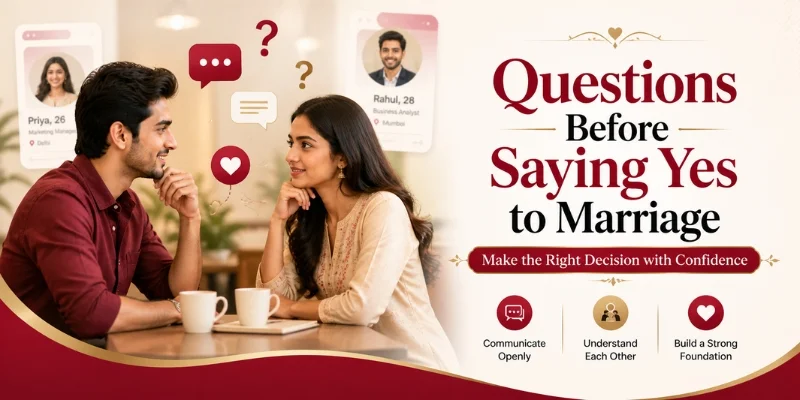
Arranged marriages remain a deeply meaningful path to partnership for millions of families across India and around the world. They blend tradition, family involvement, and personal choice in ways that look different from purely dating-based relationships. But regardless of how a match comes together, the decision to marry someone still deserves thoughtful reflection. These arranged marriage questions aren’t about doubting the process itself. They’re about making sure you walk into this life decision with clarity, honesty, and realistic expectations on both sides.
📖 Also Read: Rohit Sharma Retirement Talk Grows Ahead Of Decisive Lord’s ODI vs England
5 Arranged Marriage Questions At a Glance
| Question | What It Reveals |
| 1. What are your core values and non-negotiables? | Long-term compatibility beyond surface-level traits |
| 2. How do you handle conflict and communication? | How disagreements will actually get resolved |
| 3. What are your expectations around family and finances? | Practical, everyday compatibility |
| 4. What does this marriage mean to you, personally? | Whether you’re both entering this for similar reasons |
| 5. Do I actually feel comfortable, or just pressured? | Your own genuine readiness, separate from outside expectations |
Note: This guide offers general reflection points. It isn’t a substitute for personal judgment, family conversations, or professional counseling where needed.
Why These Arranged Marriage Questions Matter
Arranged marriages often move at a different pace than relationships built over months or years of dating. Families get involved early. Timelines can feel compressed. There’s frequently a sense of social or familial expectation attached to the decision.
None of that makes arranged marriage inherently less capable of producing a genuinely happy, lasting partnership. Countless successful marriages have started exactly this way. Research on marital satisfaction generally finds that arranged and love marriages report comparable levels of long-term happiness, especially when both partners enter thoughtfully.
What matters is making sure a shorter courtship doesn’t cost you genuine understanding. Arranged marriage conversations often happen within a narrow window, sometimes just a handful of meetings before a decision is expected. That makes it even more important to ask the right questions during that window, rather than assuming things will simply work themselves out after the wedding. These five arranged marriage questions can help you use that limited time effectively.
Question 1: What Are Your Core Values and Non-Negotiables?
Before anything else, find out what genuinely matters to the person you’re considering marrying. Go beyond the basics a typical bio-data or family introduction covers. Career ambitions, religious or spiritual beliefs, views on raising children, attitudes toward extended family, and personal boundaries around independence: these are all areas where surface-level compatibility can hide deeper misalignment.
Ask directly, and specifically, rather than relying on vague, easily-agreeable answers. Instead of “Are you religious?”, explore how religious practice would actually show up in daily life. That might mean regular rituals or dietary practices. It could also mean how religious differences between families get navigated. Similarly, rather than “Do you want kids?”, explore timing and parenting philosophy. Ask how you’ll both balance career and family once children arrive. These specifics matter more than broad statements. Two people can both say yes to wanting a family while picturing very different day-to-day realities.
Question 2: How Do You Handle Conflict and Communication?
Every marriage involves disagreement at some point, regardless of how it began. What separates couples who navigate conflict well from those who struggle isn’t the absence of disagreement. It’s how each partner approaches it. Asking directly, even early on, can offer real insight into what day-to-day married life might feel like.
Ask how the person has handled disagreements in past relationships, whether with family, friends, or previous partners. Notice whether they prefer discussing issues immediately or need space first. Neither style is wrong on its own, but a significant mismatch, one partner wanting immediate resolution while the other needs distance, can create real friction if you never discuss it openly. It also helps to gently explore how they’ve seen their own parents handle disagreements, since communication patterns often trace back to what someone witnessed growing up.
Question 3: What Are Your Expectations Around Family and Finances?
In many arranged marriage contexts, family involvement extends well beyond the wedding itself. Financial arrangements, living situations, and household responsibilities often get shaped by extended family expectations, not just the couple’s own preferences. Getting genuinely clear on these practical matters early can prevent significant strain later.
Discuss whether you’ll live independently or with extended family, and if with family, what that day-to-day dynamic looks like. Financial questions matter just as much. How will household expenses get managed? Will both partners work outside the home? How will major financial decisions get made, jointly or individually? It also helps to understand each partner’s expectations around supporting their own parents. Differing assumptions here can become a real source of tension if you don’t address them before marriage.
Question 4: What Does This Marriage Mean to You, Personally?
This question digs beneath the logistics to something more fundamental. Why is this person choosing to marry, and what do they genuinely hope this partnership brings to their life? Motivations for marriage vary significantly, even within the same family or community. Understanding a potential partner’s genuine motivation reveals a great deal about long-term compatibility.
Some people approach marriage primarily as a partnership built around shared companionship and emotional connection. Others navigate significant family or social pressure and view marriage as something that simply needs to happen at this life stage, regardless of their own deeper readiness. Neither motivation is wrong on its own. But a significant mismatch, one partner seeking deep emotional partnership while the other mainly responds to external pressure, can create real challenges down the line. Try asking what they’re most looking forward to about being married, or where they hope their life will be in five or ten years. Questions like these offer real insight without feeling like an interrogation.
Question 5: Do I Actually Feel Comfortable, or Just Pressured?
The final, and arguably most important, question isn’t directed at your potential partner at all. It’s directed at yourself. Arranged marriage processes can carry real social, familial, or generational pressure. It’s genuinely difficult to make a clear-eyed decision about a lifelong partnership if that pressure is clouding your judgment.
Reflect honestly. Do you feel like you’ve had genuine space to ask questions and get real answers? Or does the process feel rushed in a way that makes you uncomfortable? Do you feel growing ease when speaking with this person, even if some initial nervousness is natural? And critically: if you expressed hesitation or wanted more time, would your family genuinely respect that? Your own emotional readiness matters just as much as compatibility with your potential partner. Be honest with yourself about the difference between healthy nervousness, which is normal before any major life decision, and a genuine sense that something feels wrong or rushed.
How to Actually Have These Conversations
Knowing which questions to ask is only half the equation. How you ask them matters just as much, particularly within the often time-limited format of arranged marriage meetings. A few practical approaches can help these conversations feel natural rather than like a formal interview.
First, consider requesting additional one-on-one time beyond family-supervised meetings. That could mean a phone call, a video chat, or an outing without other family members present, somewhere the conversation can flow more openly. Many families today genuinely support this kind of additional interaction, since a handful of brief, supervised meetings often isn’t enough for either person to feel confident in their choice.
Second, frame questions conversationally rather than as a checklist. This tends to yield more honest, natural answers. Try sharing your own perspective first on a topic, then asking for theirs. This often opens up more genuine dialogue than a blunt, one-sided question.
It’s also worth remembering that body language and tone often reveal as much as the words themselves. Someone who seems genuinely engaged, asks thoughtful questions back, and shows curiosity about your answers is signaling something very different from someone who gives brief, guarded responses and seems eager to move the conversation along.
What If the Answers Aren’t What You Hoped For?
Sometimes, asking these questions reveals genuine mismatches. That’s important information, not a failure of the process. If significant differences emerge around core values, family expectations, or fundamental motivations for marriage, take that seriously rather than assuming things will resolve naturally after the wedding.
At the same time, distinguish between genuine incompatibility and simple differences you can navigate through ongoing conversation and mutual effort. Not every difference is a dealbreaker. Two people can have different communication styles and still build a strong marriage, as long as both are willing to understand and adapt to each other over time. The goal of these arranged marriage questions isn’t finding a partner who agrees with you on everything. It’s entering the marriage with clear eyes about where you align naturally and where you’ll need to actively work at understanding each other.
The Role of Family in This Process
Family involvement is often one of the defining features of arranged marriage. It can be a genuine strength, not just an obstacle to navigate around. Parents and family members frequently bring valuable perspective and practical wisdom. In many cases, they have a genuine investment in seeing the marriage succeed, which can be a real asset throughout the relationship, not just during matchmaking.
That said, have honest conversations with your own family about how much independence you’ll have in making this final decision. Ideally, have this conversation before you’re deep into meeting potential partners. Understanding upfront whether your family sees this as your choice, with their support and guidance, versus a decision they expect to make largely on your behalf, helps you approach the entire process, including these five questions, with much greater clarity and confidence.
How Arranged Marriage Has Evolved in Recent Years
Arranged marriage today, particularly in urban India and among diaspora communities, looks considerably different from the process a generation or two ago. Many modern arranged marriages now include extended courtship periods. Matrimonial apps and platforms give individuals far more agency in browsing and selecting potential matches. Couples today also generally get significantly more one-on-one interaction before any final decision, compared to the more heavily family-controlled processes of previous decades.
This evolution matters directly for how these arranged marriage questions get asked and answered in practice. Earlier generations often had only one or two brief, chaperoned meetings before a decision was expected. Today’s arranged marriage candidates often have weeks or even months of phone calls, video chats, and in-person meetings to work through exactly these kinds of questions. That expanded timeline doesn’t eliminate the value of a clear framework for these conversations. But it does mean there’s often genuinely more room to ask them thoroughly, rather than cramming every important topic into a single, brief meeting.
Red Flags Worth Taking Seriously
Every relationship involves some natural give-and-take and compromise. Still, certain patterns during these conversations deserve careful attention. Don’t dismiss them as simple personality differences. Watch for a partner who consistently deflects direct questions about their expectations. Watch too for irritation when you raise topics like finances or family involvement. Pressure to decide faster than you’re comfortable with is also worth taking seriously as a warning sign.
Also notice any gap between what your partner says directly and what family or matchmakers say on their behalf. That inconsistency is worth exploring directly. Healthy arranged marriage processes generally involve real transparency. Mixed or contradictory messaging, whether about career plans, family situation, or personal history, is a legitimate reason to slow down. In some cases, it’s reason enough to reconsider the match altogether.
Balancing Family Wisdom With Personal Instinct
One genuine strength of arranged marriage as a system is the involvement of people who often know you deeply and have your long-term wellbeing at heart. Parents and family members frequently bring practical wisdom, and sometimes a clearer-eyed perspective, than someone in the early, emotionally charged stages of a new relationship might have on their own. Their input on a potential match, particularly around practical factors like family values, lifestyle, or long-term stability, can be genuinely valuable. Don’t dismiss it reflexively.
At the same time, you’re the one who will live inside this marriage day to day. No amount of family enthusiasm for a match can substitute for your own genuine sense of comfort, connection, and confidence in the decision. The healthiest approach weighs family perspective and guidance seriously, while still trusting your own instincts and the answers you’ve gathered through your own direct conversations, particularly around these five core areas.
When to Involve a Neutral Third Party
Sometimes significant uncertainty remains even after direct conversations. In those cases, it can genuinely help to involve a neutral third party, whether that’s a trusted family friend who knows both families, a premarital counselor, or a religious or community leader experienced in guiding couples through this stage. A neutral perspective can help surface concerns either party might hesitate to raise directly, particularly in cultures where questioning a proposed match openly can feel socially difficult.
Premarital counseling has grown increasingly common even within traditional arranged marriage contexts. It offers a structured, professionally guided space to work through exactly these kinds of compatibility questions before a wedding date is finalized. If family-supervised meetings alone haven’t given you enough space to explore these five questions thoroughly, seeking this kind of additional support is a reasonable, increasingly normalized step. It doesn’t signal that something is wrong with the match itself.
A Quick Checklist Before the Wedding Date Gets Set
Beyond the five core questions, it helps to have a simple pre-wedding checklist. Have you had at least one conversation without family present? Have you discussed finances directly, not just in general terms? Do you know how your partner handles stress, not just how they describe themselves?
Have you met each other’s close friends, not just immediate family? Friends often reveal a different, more relaxed side of a person. Finally, have you given yourself real time to sit with the decision, away from the excitement of matchmaking meetings and family enthusiasm? A quiet moment of reflection, alone, often clarifies things that a room full of well-meaning relatives cannot.
Key Talking Points
1. These Questions Work Regardless of How You Met
These five areas of reflection, values, conflict style, practical expectations, motivation, and personal readiness, are genuinely relevant for any couple considering marriage. That holds true whether the relationship began through family introduction or independent dating.
2. Timing Pressure Is Real, But Rushing Rarely Helps
Many arranged marriage processes involve real time pressure, whether from family expectations or practical scheduling constraints. Even so, taking whatever additional time is reasonably available to ask these questions thoughtfully tends to serve both partners far better than rushing toward a decision.
3. Honesty Now Prevents Bigger Problems Later
Difficult or uncomfortable answers at this stage are far easier to navigate than the same issues surfacing years into a marriage. Approach these conversations with genuine honesty, even when it feels awkward. It ultimately protects both partners’ long-term happiness.
Arranged Marriage Questions: Frequently Asked Questions (FAQs)
What are the most important arranged marriage questions to ask?
The five key arranged marriage questions to prioritize cover core values and non-negotiables, conflict and communication style, family and financial expectations, personal motivations for marriage, and your own genuine comfort level with the decision.
How much time should I take before deciding on an arranged marriage?
There’s no fixed timeline. Most experts suggest taking whatever time genuinely feels necessary to have honest, in-depth conversations, rather than rushing based purely on external pressure or scheduling convenience.
Is it normal to feel nervous before an arranged marriage decision?
Yes, some nervousness is completely normal before any major life decision. The key distinction is between healthy nervousness and a genuine sense that something feels rushed, wrong, or misaligned with your own values.
Can arranged marriages be as happy as love marriages?
Research generally suggests arranged and love marriages report comparable long-term satisfaction levels, particularly when both partners enter the relationship with realistic expectations and open communication from the start.
What if my family and I disagree about a potential match?
Have an open, honest conversation with your family about your own comfort level and concerns. Most families genuinely want their loved one to be happy long-term. Expressing hesitation thoughtfully is different from outright rejecting the process.
Should I involve a counselor before an arranged marriage decision?
It can genuinely help, especially if family-supervised meetings alone haven’t given you enough space to explore important compatibility questions. Premarital counseling is increasingly common and normalized, even within traditional arranged marriage contexts.
Conclusion — Ask Now, Not Later
Saying “yes” to an arranged marriage is one of life’s most significant decisions. It deserves the same thoughtful reflection you’d bring to any major life choice. These five arranged marriage questions, covering values, communication, practical expectations, motivation, and your own personal comfort, won’t guarantee a perfect marriage. No set of questions can. But they can help you enter this partnership with genuine clarity, honest expectations, and a real sense of who you’re choosing to build a life with, rather than simply hoping things work out after the fact.
Stay tuned to Mirrorly.in for more relationship and lifestyle guidance.
📖 Also Read: Rohit Sharma Retirement Talk Grows Ahead Of Decisive Lord’s ODI vs England