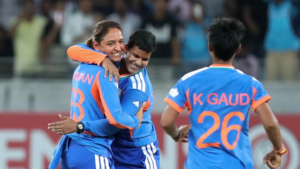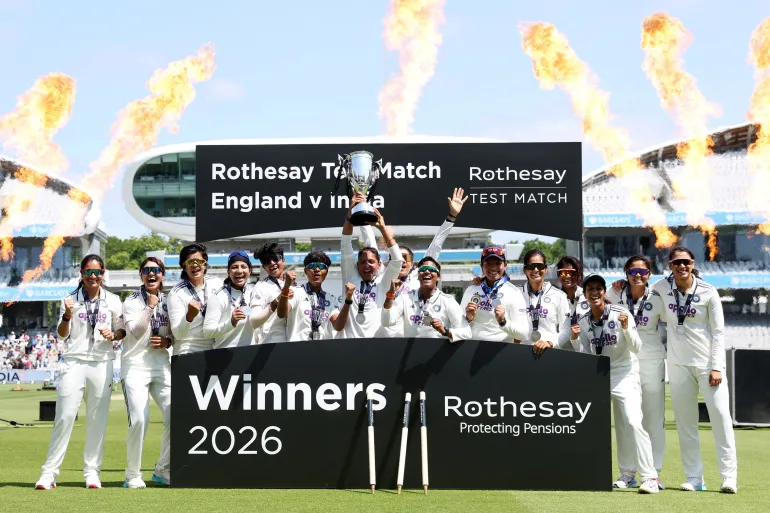
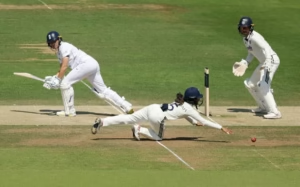
India didn’t just win a cricket match on Monday. They wrote themselves into the record books at the most famous ground in the sport. In this India thrash England story, Harmanpreet Kaur’s side completed a crushing 270-run victory over England in the first-ever women’s Test played at Lord’s, bowling the hosts out for 186 in pursuit of an imposing 457-run target. Sneh Rana and Deepti Sharma shared the last four wickets between them, sealing a result that instantly ranks among Indian women’s cricket’s finest overseas achievements.
The win came in front of a sun-drenched Lord’s crowd that included India men’s cricket great Sachin Tendulkar. It also arrived barely a week after England had lost the T20 World Cup final to Australia on the very same ground, adding an extra layer of symbolism to India’s celebrations.
📖 Also Read: Anthropic Extends Claude Fable 5 Access To Paid Subscribers Until July 19: Here’s What Changes Later
India Thrash England: Match at a Glance
| Match | England Women vs India Women — One-Off Test |
| Venue | Lord’s Cricket Ground, London |
| Duration | 4 days, concluding Monday, July 13, 2026 |
| Result | India won by 270 runs |
| India 1st Innings | 285 |
| England 1st Innings | 170 |
| India 2nd Innings | Declared, set England 457 to win |
| England 2nd Innings | 186 all out |
| Historic Significance | First-ever women’s Test at Lord’s |
Note: Match details are based on reports from Al Jazeera, AFP, the ICC, and Outlook India.
A Ground Steeped in History, A First for Women’s Test Cricket
Lord’s has hosted Test cricket for 142 years and more than 150 men’s Tests. Yet this match marked something Lord’s had never seen before: a women’s Test match. The ground had previously hosted women’s cricket only in white-ball formats, dating back to a 1976 one-day international between England and Australia, and more recently a women’s ODI between England and India in 2012. A full women’s Test, though, had simply never been played there until this week.
The England and Wales Cricket Board first confirmed this fixture back in August 2024, calling it a moment of real significance for the sport. Nearly two years later, that promise was delivered, and it was India, not the hosts, who made sure the occasion would be remembered for a genuinely dominant performance rather than a closely fought contest.
How India Built Their Dominant Position
Put in to bat first by England, India laid the platform for the entire match with a first-innings total of 285. Half-centuries from Smriti Mandhana and captain Harmanpreet Kaur anchored the innings, giving India a competitive total to defend and set the tone for the bowlers who would follow.
England’s reply fell well short. Bowled out for 170, the hosts found themselves immediately up against it. Kranti Gaud starred with the ball, claiming figures of 5 for 37, the first five-wicket haul by any bowler in a women’s Test at Lord’s. That effort gave India a substantial first-innings lead and control of the match heading into their second innings.
Yastika Bhatia’s Historic Century Seals India’s Advantage
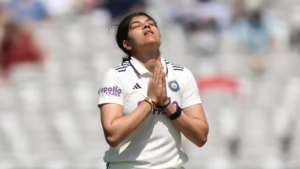
India used their second innings to turn a healthy lead into an insurmountable one. Yastika Bhatia produced the standout individual performance of the match, becoming the first woman to score a century in a Test at Lord’s. Her landmark innings, combined with a second half-century from Smriti Mandhana and another contribution from wicketkeeper-batter Richa Ghosh, allowed India to push their total to a level that effectively ended England’s hopes before the chase even began.
Richa Ghosh’s own innings deserves particular mention. Her fifty came up in just 52 balls, the fifth-fastest half-century by an Indian woman in red-ball cricket, adding some genuine attacking flair to India’s declaration total. By the time India declared, they had set England a target of 457, a number no team had ever chased successfully in the format’s history at that scale.
England’s Second-Innings Collapse
Chasing 457 was always a tall order, and England’s second innings quickly turned into a rearguard action rather than a genuine pursuit of victory. The hosts resumed the final day at 130 for 6, already staring down the barrel of defeat, with wicketkeeper-batter Amy Jones standing firm on 52 not out as their last realistic hope of extending the match.
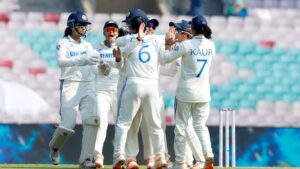
England batted for just over 90 minutes on the final morning before folding entirely. Jones added only two more runs to her overnight score before pulling Sneh Rana straight to mid-wicket for 54. From there, the innings unraveled quickly. Sophie Ecclestone, who had survived two dropped catches off Kranti Gaud earlier in her innings, put up some late resistance alongside Issy Wong, but the pair could only delay the inevitable rather than prevent it. Rana eventually wrapped up the match by bowling Ecclestone for 50, sparking jubilant celebrations among the vocal India supporters inside Lord’s.
England Bowling Figures — India’s Second Innings
| Bowler | Wickets | Key Impact |
| Sneh Rana | 4/42 | Removed Amy Jones, finished the match by bowling Ecclestone |
| Deepti Sharma | Multiple wickets | Dismissed Issy Wong and Lauren Bell |
Where This Win Ranks in Women’s Test History
A 270-run victory margin puts this result among the most emphatic in the format’s history. It stands as India’s second-highest winning margin by runs in Women’s Tests, and the fourth-highest of all time in the format. The all-time record still belongs to India themselves, a 347-run demolition of England in Navi Mumbai back in 2023, showing just how dominant India’s Test side has become against this particular opponent in recent years.
For England, the defeat marked their second-heaviest Test loss by runs in the format’s history, and their fourth defeat in five Test matches recently played. It also closed out the international careers of two respected veterans, Tammy Beaumont and former captain Heather Knight, neither of whom got the send-off English fans would have wanted from their final Test appearances.
A Bittersweet Backdrop for England
England’s struggles in this Test can’t be fully separated from the context surrounding it. The match began just days after England’s heartbreaking T20 World Cup final defeat to Australia, also played at Lord’s, on July 5. That’s an extraordinarily tight turnaround between a major global tournament final and the start of a Test match, and it visibly affected England’s side.
Speaking after the match, England captain Nat Sciver-Brunt acknowledged the difficulty of switching formats with so little recovery time. She said cricketers have to be ready for that kind of transition and recover as best they can before preparing for a Test match. It was a measured response that avoided offering excuses while still pointing to a genuine scheduling challenge that the format now faces as women’s cricket’s calendar grows more congested.
A Perfect Ending to India’s Lord’s Tour
For India, this result provided a satisfying bookend to what had otherwise been a mixed tour of England. The team had earlier been knocked out of the T20 World Cup at the group stage, at Lord’s itself, by eventual champions Australia. Ending the tour with a landmark, record-margin Test win at the same historic ground gave India’s players and fans a far happier set of memories to carry home.
Beyond the immediate result, the match also continued a broader run of strong form for India’s Test side. It followed on the heels of India’s first-ever Test win over England on home soil, a 347-run victory in Navi Mumbai, and their historic first-ever Test win over Australia, an eight-wicket triumph in Mumbai in which Sneh Rana was named player of the match for taking two wickets in as many balls. Taken together, these results point to a genuinely dominant period for Indian women’s Test cricket, even though the format remains relatively rare on the international calendar compared to white-ball cricket.
Why This Test Matters Beyond the Scoreline
This India thrash England result carries weight that extends well past a single dominant scoreline. Women’s Test cricket remains a relatively rare format on the international calendar, with most boards prioritizing white-ball fixtures for scheduling and broadcast reasons. Against that backdrop, securing a full four-day Test at a venue as historically significant as Lord’s represented a genuine milestone for the women’s game, regardless of which side eventually won.
That India delivered such a commanding performance on this particular stage adds another layer of significance. A tightly contested, low-scoring thriller might have generated its own headlines, but a 270-run demolition, complete with individual records at the venue, ensures this match will be remembered as a genuine showcase of what women’s Test cricket can offer when given a proper platform. For a format still working to establish itself more permanently on crowded international calendars, performances like this one make a strong practical case for scheduling more fixtures like it in the future.
The Broader Context: Women’s Test Cricket’s Slow Expansion
Test matches remain the format most boards are reluctant to schedule for their women’s teams, largely due to the four-day time commitment and the broadcast and travel costs involved compared to white-ball cricket. Historically, this has meant many top women cricketers play only a handful of Test matches across their entire careers, a sharp contrast to the men’s game, where Test cricket remains the sport’s most prestigious format with a packed global calendar.
Against that backdrop, the recent run of high-profile women’s Tests, including India’s clashes with England and Australia, and now this historic fixture at Lord’s, reflects a gradual but meaningful shift. Cricket boards and organizers appear increasingly willing to schedule marquee women’s Test fixtures at iconic venues, partly in response to growing public interest in the women’s game following recent T20 and ODI World Cup tournaments. Whether that momentum translates into a more regular, structured women’s Test calendar going forward remains to be seen, but matches of this magnitude, played in front of large, engaged crowds, make a strong case for continuing in that direction.
India’s Recent Test Dominance in Numbers
Zooming out across India’s last few Test assignments paints a picture of a side peaking at exactly the right moment. Their 347-run win over England in Navi Mumbai in 2023 remains the largest victory margin by runs in the history of women’s Test cricket. Their subsequent eight-wicket win over Australia in Mumbai marked their first-ever Test victory against that opponent after eleven previous attempts stretching back to 1977, ending a genuinely historic wait. And now, this 270-run win over England at Lord’s adds a third landmark result to that recent run, this time achieved on foreign soil against a host nation under considerable pressure to perform.
BCCI Secretary Jay Shah publicly celebrated India’s earlier back-to-back Test wins over England and Australia, describing the achievements as history made through what he called brilliance from the squad. That kind of public recognition from the sport’s administrators in India reflects how seriously the board has come to view Test success for the women’s team, a shift from a period when white-ball formats received the overwhelming majority of institutional attention and investment.
How Fans and Media Reacted to the Historic Win
Coverage of this India thrash England victory spread quickly across international outlets, with major cricket boards and news organizations, including the ICC, AFP, and Al Jazeera, all running detailed reports within hours of the final wicket falling. One widely circulated match report described India’s overall performance across the four days as “outstanding,” a fitting summary of a Test in which the visitors were dominant in batting, bowling, and fielding for almost the entire contest, barring a couple of uncharacteristic dropped catches.
Inside Lord’s itself, the atmosphere on the final day reflected the significance of the occasion. A vocal contingent of India supporters made their presence felt throughout the morning session, growing louder as England’s last recognized batters fell in quick succession. The presence of Sachin Tendulkar among the spectators added a further layer of occasion to proceedings, with his attendance widely noted across match reports as a symbolic link between men’s and women’s cricket history at the same historic ground.
Key Talking Points
1. A Genuinely Historic Occasion, Not Just Another Fixture
Lord’s had waited 142 years and more than 150 men’s Tests before finally hosting a women’s Test match. That India chose to mark the occasion with such a dominant, record-margin win only adds to how memorable this fixture will be remembered in the sport’s history.
2. Individual Milestones Defined the Match
Kranti Gaud’s five-wicket haul and Yastika Bhatia’s century were both firsts for a women’s Test at Lord’s, giving this match a personal significance for two players that extends well beyond the team result.
3. India’s Spin Attack Delivered When It Mattered Most
Sneh Rana and Deepti Sharma combining to finish off England’s innings underlines the growing depth and reliability of India’s spin bowling in the longer format, a key factor behind their recent string of Test successes.
4. England’s Calendar Congestion Is a Growing Concern
Playing a Test match just days after a World Cup final loss put England at a clear disadvantage, and Sciver-Brunt’s comments suggest this kind of scheduling squeeze could become a recurring talking point as women’s cricket’s calendar continues to expand.
4. England’s Calendar Congestion Is a Growing Concern
Playing a Test match just days after a World Cup final loss put England at a clear disadvantage, and Sciver-Brunt’s comments suggest this kind of scheduling squeeze could become a recurring talking point as women’s cricket’s calendar continues to expand.
5. A Fitting Farewell Overshadowed by Defeat
For Tammy Beaumont and Heather Knight, this match marked the end of their international careers. Under different circumstances, their final Test appearances might have drawn more individual attention, but England’s heavy defeat meant the occasion was largely overshadowed by India’s dominant performance instead.
India Thrash England: Frequently Asked Questions (FAQs)
What was the result of the first women’s Test at Lord’s?
India won by 270 runs, bowling England out for 186 after setting them a target of 457 in the first-ever women’s Test played at Lord’s.
Who were the standout performers for India?
Kranti Gaud (5/37) took the first five-wicket haul in a women’s Test at Lord’s, while Yastika Bhatia scored the venue’s first century in the format. Sneh Rana and Deepti Sharma shared the final wickets to seal victory.
How significant was this win for India historically?
It’s India’s second-highest winning margin by runs in Women’s Tests and the fourth-highest of all time in the format, behind India’s own record 347-run win over England in 2023.
Why did England struggle so much in this Test?
England played this Test just days after losing the T20 World Cup final to Australia at the same venue, leaving little recovery time between formats, a factor captain Nat Sciver-Brunt acknowledged after the match.
Was this the first time a woman scored a century in a Test at Lord’s?
Yes. Yastika Bhatia became the first woman to score a century in a women’s Test at Lord’s, a landmark achievement in the venue’s cricketing history.
Did any notable spectators attend the match?
Indian cricket great Sachin Tendulkar was among the crowd at Lord’s to witness the historic victory.
How does this compare to India’s other recent Test wins?
This win follows India’s record 347-run victory over England in Navi Mumbai in 2023 and their historic first-ever Test win over Australia earlier this year, continuing a dominant run for India’s women’s Test side.
How long has Test cricket existed at Lord’s before this match?
Lord’s has hosted men’s Test cricket for 142 years and over 150 matches, but this fixture marked the venue’s first-ever women’s Test, decades after its first women’s cricket match of any kind, a 1976 ODI between England and Australia.
Conclusion — A Landmark Win for Women’s Cricket
This India thrash England result will be remembered as one of the defining moments in women’s cricket’s push into new territory at historic venues. Beyond the emphatic scoreline, the match delivered individual milestones, a first Lord’s century, a first five-wicket haul at the ground, and a result that firmly cements India’s growing reputation as a Test cricket powerhouse in the women’s game. For England, it’s a result to learn from, particularly around scheduling and recovery between formats. For India, it’s a triumphant close to a tour that began with disappointment and ended with history.
Looking ahead, this victory adds fresh momentum to the broader conversation around expanding women’s Test cricket’s presence on the international calendar. A match this one-sided might, on the surface, seem like an unlikely advertisement for scheduling more fixtures in the format. In practice, though, the record-breaking individual performances, the sizeable and engaged Lord’s crowd, and the sheer historical weight of the occasion all point in the opposite direction, suggesting that when boards do commit to staging marquee women’s Tests at iconic venues, the format can deliver moments genuinely worthy of the stage. Whether this translates into more regular women’s Test fixtures at grounds like Lord’s in the years ahead remains an open question, but India’s players have certainly given administrators plenty of reason to consider it.
Stay tuned to Mirrorly.in for more coverage of India’s women’s cricket team.
📖 Also Read: Anthropic Extends Claude Fable 5 Access To Paid Subscribers Until July 19: Here’s What Changes Later