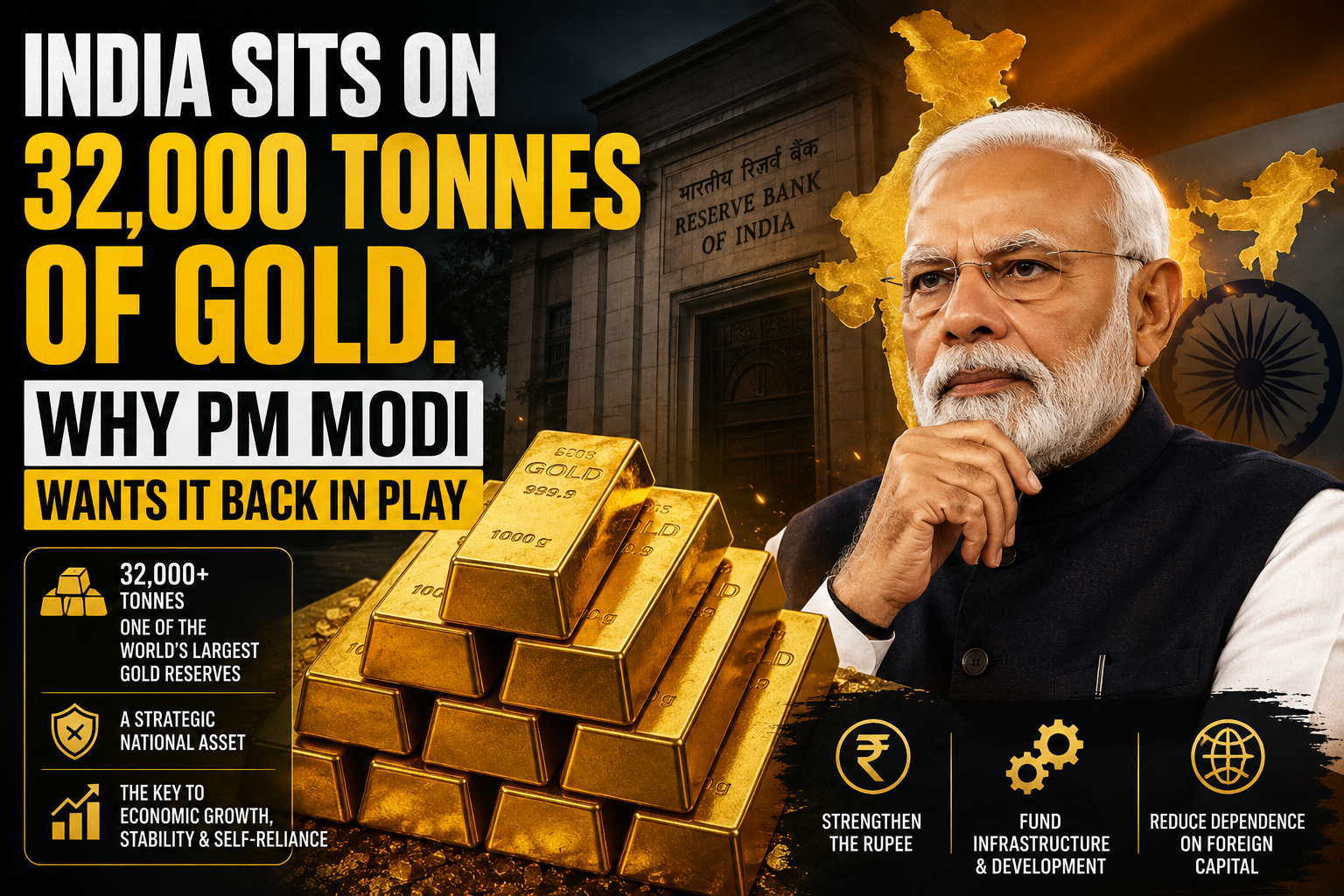
India Gold Reserves 2026 tell a staggering story — households, temples, and trusts across the country hold an estimated 32,000 tonnes of gold, more than the official reserves of the United States, Germany, and China combined. And yet, this staggering wealth sits largely idle: locked in lockers, buried in vaults, and wrapped in traditions stretching back thousands of years.
Now, Prime Minister Narendra Modi wants to change that. Through a revamped push on India’s Gold Monetization Scheme and Sovereign Gold Bond programme, New Delhi is making its most ambitious attempt yet to bring this sleeping giant back into the formal economy. Here is everything you need to know.
Key Facts — India Gold Reserves
| Parameter | Details |
| Gold Holdings | 32,000+ tonnes (household + temple trusts) |
| RBI Official Reserves | ~800+ tonnes (as of 2025) |
| India Global Rank | #2 largest gold consumer in the world |
| Sovereign Gold Bond (SGB) | Scheme to mobilize idle household gold |
| Gold Monetization Scheme | Deposit gold in banks; earn interest |
| PM Modi Initiative | Re-launched gold monetization push in 2024-25 |
| Estimated Gold Value | Over $2.5 trillion (approx.) |
| Temple Gold (estimate) | ~3,000 tonnes (includes Tirupati, Padmanabhaswamy) |
India Gold Reserves 2026: How Large Are They?
The 32,000-tonne figure is not a government estimate — it is a conservative industry calculation compiled by the World Gold Council and domestic research institutions. It covers gold held across three broad categories:
- Household Gold: Jewellery, coins, and bars stored in homes across urban and rural India. Estimated at 25,000–27,000 tonnes.
- Temple and Religious Trusts: Iconic temples like Tirupati Balaji, Padmanabhaswamy, and Shirdi Sai Baba collectively hold thousands of tonnes of gold in donations, idols, and offerings.
- RBI and Sovereign Reserves: The Reserve Bank of India officially holds over 800 tonnes, a figure that has grown steadily as India diversified away from dollar-denominated assets.
To put India’s gold reserves in perspective: at current 2026 gold prices, 32,000 tonnes is worth approximately $2.5 trillion — roughly equivalent to India’s entire GDP.
Why PM Modi Wants to Mobilise India Gold Reserves 2026
The logic behind mobilising India’s gold reserves in 2026 is straightforward. India is the world’s second largest consumer of gold and one of the largest importers. Every year, India spends tens of billions of dollars importing gold from abroad — gold that then flows largely into jewellery boxes and bank lockers, generating no economic return.
This creates a twin problem for the Indian economy:
- Gold imports put persistent pressure on India’s current account deficit and weaken the rupee.
- Idle household gold generates no interest, no investment return, and contributes nothing to the banking system’s liquidity.
By channelling even a fraction of this gold back into the formal financial system, New Delhi hopes to reduce import dependency, boost bank liquidity, lower the trade deficit, and give Indian savers a return on an asset that currently earns them nothing.
The Two Big Tools: GMS and SGB

The government’s strategy to manage India Gold Reserves 2026.
Gold Monetization Scheme (GMS)
Under the Gold Monetization Scheme, individuals and institutions can deposit their physical gold with designated banks for a fixed period. In return, they earn interest — currently in the range of 0.5% to 2.5% per annum, depending on tenure. The deposited gold is melted, refined, and lent to jewellers and manufacturers, keeping it productive within the domestic economy rather than sitting idle.
Sovereign Gold Bonds (SGB)
Sovereign Gold Bonds allow investors to hold gold in paper form — backed by the Government of India — without the risks of storing physical gold. SGBs offer a 2.5% annual interest rate plus the benefit of gold price appreciation, with full capital gains tax exemption on maturity. For long-term savers, SGBs are arguably the most efficient way to hold gold in India.
Why Has It Not Worked Fully Yet?
Despite being in place since 2015, both schemes have underperformed against their potential. The Gold Monetization Scheme has collected only a few hundred tonnes — a fraction of the tens of thousands of tonnes estimated to be lying idle in Indian homes. Several factors explain the gap:
- Emotional and Cultural Attachment: Gold in India is not merely an investment — it is a symbol of security, status, and generational wealth. Parting with physical gold, even temporarily, carries deep psychological resistance.
- Lack of Awareness: A large proportion of Indian households, particularly in rural areas, remain unaware of government gold schemes or distrust formal banking channels with their most precious asset.
- Cumbersome Process: The deposit process under GMS involves melting gold to test purity, which many owners find unappealing given the sentimental value attached to jewellery.
- Competition from Physical Gold: For many Indians, the comfort of holding physical gold at home outweighs the modest interest returns offered by the scheme.
Recognising these barriers, the Modi government has been working on a revised, simplified version of the Gold Monetization Scheme with better outreach, higher interest rates, and reduced procedural friction.
The Temple Gold Question
Perhaps the most politically sensitive dimension of India’s gold mobilisation debate involves temple trusts. Temples like Padmanabhaswamy in Kerala, Tirupati Balaji in Andhra Pradesh, and Vaishnodevi in Jammu together hold thousands of tonnes of gold accumulated over centuries through devotee offerings.
Successive governments have gingerly raised the idea of bringing temple gold into the formal economy, only to retreat in the face of religious sensitivities and institutional resistance. Temple trusts argue that gold offerings belong to the deity and cannot be monetized without devotees’ consent. The Supreme Court has also weighed in on the governance of temple wealth in landmark judgments.
For the Modi government, navigating the temple gold question requires walking a delicate tightrope between economic pragmatism and religious sentiment — a tightrope that no government has yet successfully crossed.
India Gold Reserves 2026: What It Means for the Economy
If even 10% of India’s estimated 32,000 tonnes of private and institutional gold were brought into the formal system, the economic impact would be transformative:
- Reduction in gold imports worth tens of billions of dollars annually, significantly easing current account pressure.
- A major boost to domestic banking system liquidity, potentially freeing up capital for lending to businesses and infrastructure.
- A reduction in India’s dependence on dollar-denominated imports, strengthening the rupee over time.
- A new income stream for Indian savers who currently earn zero return on their physical gold holdings.
The broader vision, as articulated by senior government officials, is to transform India’s gold from a passive store of value into an active engine of economic growth — without forcing citizens to give up their gold permanently.
India Gold Reserves 2026 in a Global Gold Rush
India’s gold mobilisation push is happening against a backdrop of global gold fever. Central banks around the world — including those of China, Russia, Turkey, and Poland — have been aggressively adding gold to their reserves as a hedge against dollar volatility and geopolitical uncertainty.
India’s RBI has itself been quietly accumulating gold, repatriating significant quantities from storage in the UK back to domestic vaults in a move widely seen as a statement of economic self-reliance. Gold crossed $3,000 per troy ounce for the first time in 2024, making India’s vast household gold reserves even more valuable in dollar terms.
Conclusion
India Gold Reserves 2026 — all 32,000 tonnes — represent one of the most extraordinary concentrations of private wealth anywhere in the world. It is a legacy of centuries of civilisational history, cultural practice, and financial conservatism. But it is also, from a purely economic perspective, an enormous dormant asset.
PM Modi’s push to bring this gold back into productive use is neither new nor simple. It is a challenge that has defeated previous governments. But with rising gold prices, a more financially literate young population, and a revised policy toolkit, the conditions may finally be aligning for India to unlock at least part of this sleeping fortune.
Whether that happens depends not just on government policy, but on whether millions of Indian families can be convinced to trust a scheme more than they trust the lockbox under their bed.