US Plans Extra 12.5% Tariffs on India and 59 Countries Over Forced Labour: What It Means for India

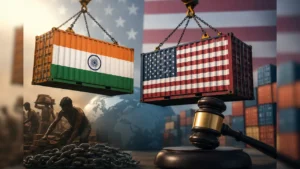
The United States has announced a major trade move. The USTR proposed a 12.5% extra tariff targeting India and 53 other countries. The reason? These countries failed to enforce bans on goods made with forced labour. This US tariffs India 2026 proposal shocked India’s trade community. However, India has denied all allegations. Moreover, India wants to resolve this through bilateral trade talks with the US.
USTR Jamieson Greer announced this on June 3, 2026. Furthermore, the US launched Section 301 investigations in March 2026 against 60 countries. The US has placed India among 54 nations facing 12.5% duty. In addition, the final decision will come in late June or July 2026. Therefore, India must act fast to protect its export interests.
This article covers everything about US tariffs India 2026. First, we explain what USTR proposed. Second, we discuss why India is targeted. Finally, we analyse the impact on Indian exports and economy.
Key Facts — US Tariffs India Forced Labour 2026
| Announced By | USTR Jamieson Greer — June 3, 2026 |
| Proposed Tariff on India | Additional 12.5% on all imports |
| Countries Affected | 60 economies including India, China, Japan, UK |
| Legal Basis | Section 301 of US Trade Act 1974 |
| Investigation Launched | March 11-12, 2026 |
| Hearing Date | July 7, 2026 |
| Comments Deadline | July 6, 2026 |
| Final Decision Expected | Late June or July 2026 |
| India’s Response | Denied allegations, wants bilateral talks |
| Textile Tariff | Lower rate proposed — specific rate TBC |
US Tariffs India Forced Labour: What Exactly Was Proposed?
The Office of the United States Trade Representative has proposed imposing additional duties on imports from 60 economies, including India, after concluding that these countries have failed to ban and adequately enforce restrictions on products made using forced labour.
The proposed tariff structure is tiered — countries are penalised based on how far their policies fall short of US expectations.
Tariff Structure:
- 5% additional tariff — 54 countries including India, China, Japan, UK that have NO effective forced labour import ban
- 10% additional tariff — 6 countries including Canada, Mexico, EU, Taiwan, Pakistan that have PARTIAL regimes
- Textile exception — a special volume-based mechanism for textiles and apparel with lower tariffs
US Trade Representative Jamieson Greer said the measures are intended to address what Washington sees as unfair competition created by forced-labour-linked supply chains. His exact statement was: “The failure of our most important trading partners to address the importation of goods made with forced labour is unacceptable. This creates a dynamic where American workers are forced to compete globally on an unlevel playing field.”
What Is Section 301 and Why Is It Being Used?
Section 301 is a provision of the US Trade Act of 1974 that gives the USTR the authority to investigate and respond to foreign government acts, policies, or practices that are unjustifiable, unreasonable, or discriminatory — and that burden or restrict US commerce.
Importantly, Section 301 can be used even when the act or policy in question is not necessarily a violation of international legal obligations. A practice can be considered “unreasonable” if it is simply “unfair or inequitable” from the US perspective.
The USTR launched two separate Section 301 investigations in March 2026 — one covering forced labour and one covering excess industrial capacity — both targeting around 60 economies. The forced labour investigation has now concluded with the proposed 12.5% tariffs.
Is This Legal Under WTO Rules?
This is where it gets controversial. India’s trade think tank GTRI (Global Trade Research Initiative) has pointed out that the current investigation exceeds the scope of Section 301 — which typically deals with market-access barriers faced by US firms in the country being investigated, not what a country imports and from where.
GTRI has also argued that the proposed 12.5% tariff exceeds the US’s own WTO commitments. India is expected to challenge the legal basis of this investigation at the WTO and in bilateral discussions.
Why Is India Being Targeted?
It is important to understand that India is NOT being accused of using forced labour in its own exports to the United States. The allegation is different — and more nuanced.
The USTR’s complaint against India is that India has not imposed effective restrictions on importing goods from third countries — particularly China — that are made using forced labour. In other words, India is being penalised not for what it exports, but for what it imports.
The US is essentially saying: if you allow goods made with forced labour (from countries like China) to enter your market, and some of those goods then get re-exported to the US, you are enabling forced labour supply chains that disadvantage American workers.
India’s government has rejected this reasoning, with Indian officials requesting that such concerns be addressed within the framework of the ongoing bilateral India-US trade negotiations.
How Could This Affect India’s Exports and Economy?
Which Indian Sectors Are Most at Risk?
- Textiles and Apparel — India’s biggest export to the US, though a special textile mechanism with lower tariffs has been proposed
- Engineering goods — Could face full 12.5% additional duty
- Pharmaceuticals — India is America’s largest generic drug supplier
- IT and software — Not directly affected as services are not covered
- Gems and jewellery — Could be significantly impacted
- Auto components — Another major export category that could be affected
India-US Trade Context:
The US is India’s largest trading partner. In 2025-26, India’s merchandise exports to the US were approximately $80 billion. An additional 12.5% tariff on these exports would make Indian goods significantly more expensive for American consumers and businesses — potentially reducing India’s competitive advantage in the US market.
However, analysts point out that since China also faces the same 12.5% tariff (and already faces much higher baseline tariffs from previous trade wars), the competitive impact on India may be limited. In fact, this could even benefit India relative to China in some sectors.
What Has India Said?
India’s commerce ministry responded swiftly to the USTR proposal, stating that the proposed tariffs are not final and will go through a process of public consultation before any decision is made. Indian officials have denied the forced labour allegations under the relevant clauses.
India’s position has three key components:
- Denial — India denies that it has failed to enforce restrictions on forced-labour goods
- Legal challenge — India’s trade experts argue the investigation exceeds the scope of Section 301 and violates WTO commitments
- Bilateral resolution — India wants these concerns addressed within the India-US bilateral trade negotiations, not through unilateral tariff measures
The Global Trade Research Initiative (GTRI) has advised that India should formally challenge the probe, arguing that the US is attempting to impose its preferred import-control framework on other countries through unilateral trade measures.
What Happens Next?
The proposal has now entered a formal public consultation phase. Here is the timeline for what happens next:
| June 22, 2026 | Deadline for hearing requests and testimony summaries |
| July 6, 2026 | Deadline for written public comments |
| July 7, 2026 | USTR hearings on proposed actions |
| July 24, 2026 | Expiry of temporary Section 122 tariffs (10%) |
| Late June/July 2026 | Final decision on 12.5% tariffs expected |
The USTR expects to announce a final decision in late June or July 2026 — potentially before the expiry of the temporary Section 122 tariffs on July 24. Once finalised, the tariffs could take effect almost immediately.
The Bigger Picture — India-US Trade Negotiations
This development comes at a highly sensitive time for India-US trade relations. The two countries announced a framework for an interim trade agreement in February 2026, reaffirming their commitment to wider bilateral trade negotiations.
The USTR’s forced labour move adds a new and contentious compliance layer to these trade talks, placing labour-linked supply chain rules more firmly on the negotiation table. India will now have to navigate this challenge while simultaneously trying to finalise a broader trade deal with Washington.
Trade analysts note that the timing of the proposal could be intentional — increasing pressure on India during negotiations to accept stronger labour compliance commitments as part of any final trade deal. India will need to walk a fine line: defending its interests while keeping the broader trade relationship on track.
US Tariffs India Forced Labour 2026 — Conclusion
The US tariffs India forced labour 2026 proposal is a significant development that adds new complexity to India’s most important bilateral trade relationship. While the tariffs are not yet finalised and India has clearly rejected the allegations, the proposal signals that the US is prepared to use aggressive trade enforcement tools to push its trading partners toward stronger labour compliance frameworks.
For India, the priority now is to engage actively in the public consultation process, build a strong legal and diplomatic case against the tariffs, and use the ongoing bilateral trade negotiations to find a resolution that protects India’s export interests while addressing US concerns.
The next two months — from now until the final decision in late June or July — will be crucial for India’s trade diplomacy. Stay tuned to Mirrorly.in for all the latest updates on this developing story.