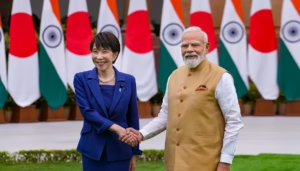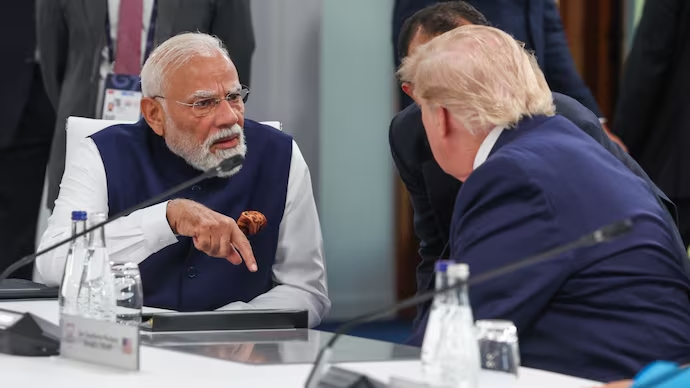
The famous bear hug is gone. On June 16, 2026, Prime Minister Narendra Modi and US President Donald Trump met on the sidelines of the G7 Summit in Evian, France — for the first time in 16 months — and the world noticed what was missing. No embrace. No theatrics. Just a formal handshake.
The symbolism was hard to ignore. These two leaders — who had once performed joint “Namaste Trump” rallies and exchanged warm bear hugs on the world stage — greeted each other with the bare minimum of diplomatic courtesy. A full-fledged bilateral meeting was scheduled for Wednesday, June 17, but Tuesday’s brief interaction set the tone: this is no longer a bromance. This is diplomacy — careful, measured, and weighed down by serious unresolved issues.
So what went wrong between India and the US? And can these G7 talks in France actually fix it?
📋 Modi-Trump G7 Meeting — Quick Summary
| Detail | Info |
| Meeting | G7 Summit 2026 Sidelines |
| Date | June 16–17, 2026 |
| Venue | Evian-les-Bains, France |
| Last Meeting | February 2025 (16 months ago) |
| Greeting | Handshake — No Hug |
| Bilateral Talks | June 17, 6:30 PM IST |
| Key Issues | Trade Tariffs, Indian Mariners, Operation Sindoor |
| India’s Status at G7 | Invited Guest Nation |
🛑 16 Months of Strain — What Went Wrong?
The India-US relationship has never been a simple one — but the last 16 months have tested it in ways few could have predicted. Let’s understand the fault lines:
- Operation Sindoor & Trump’s Mediation Claims
India’s military operation against Pakistan in May 2025 was a decisive moment — but Washington’s response created friction. Trump repeatedly and publicly claimed that the US had mediated a ceasefire between India and Pakistan, even suggesting he used trade threats as leverage to end the conflict. Indian officials flatly rejected this characterization. For New Delhi, the idea of any third-party mediation on Pakistan — let alone American credit for ending the conflict — is politically toxic. The damage to diplomatic optics was real.
- The 50% Tariff Shock
Washington hit Indian goods with a punishing 50% tariff last year — half of it explicitly framed as a penalty for India’s continued purchase of Russian oil. Negotiations for a bilateral trade deal have since been underway, with a July 9, 2026 deadline looming before even higher tariffs kick in. But talks have stalled, with GM crop restrictions on the Indian side emerging as a key sticking point. The tariff shadow has hung over every engagement between the two sides.
- Indian Mariners Killed by US Navy
Perhaps the most explosive issue: just days before the G7 Summit, the US Navy — carrying out a blockade of Iranian ports — attacked three Indian-crewed commercial vessels in the Gulf. Three Indian seafarers were killed. India summoned the US Charge d’Affaires twice. External Affairs Minister S. Jaishankar called Secretary of State Marco Rubio to register India’s “strong protest” over what New Delhi called “unjustified lethal attacks.” Modi did not publicly comment on the deaths ahead of the G7 — but at the summit roundtable, seated right next to Trump, he raised the “loss of Indian lives” and the disruption of trade through the Strait of Hormuz. The room did not miss the message.
🤝 What Happened at the G7 Outreach Session
Modi arrived at the G7 outreach session in Evian to find Trump already seated at the roundtable. The two shook hands. Modi was seen smiling and laughing in response to something Trump said — a reminder that personal chemistry between the two leaders has not entirely evaporated.
But at the session itself — themed ‘Forging New Partnerships and Rebuilding International Solidarity’ — Modi, flanked by Trump and German Chancellor Olaf Scholz, spoke carefully. He referred to the world as “uncertain” and criticised “a lack of respect for international law” — without naming any country. He welcomed progress on West Asia peace efforts but was pointed about the cost: Indian lives lost, global trade disrupted.
It was diplomacy wrapped in understatement — and everyone understood what was being said.
💰 The Trade Deal Clock is Ticking
The bilateral meeting scheduled for June 17 carries real urgency. A trade deal is not just a diplomatic nicety — it is a live economic deadline. Without a framework agreement before July 9, India faces the prospect of even higher US tariffs on its exports.
US and Indian trade negotiators have reportedly hardened their positions in recent rounds. India’s restrictions on genetically modified crops — a significant US export interest — remain a major sticking point. Washington, in turn, is pressing India to reduce purchases of Russian oil and increase procurement of US defence equipment.
Experts are cautious. “A meeting would have been helpful to clarify the trade deal,” said Harsh Pant of King’s College London and the Observer Research Foundation. “Negotiating with Trump is difficult, especially now when the president has other pressing concerns.”
⚖️ What India Needs vs What the US Wants
| India’s Priorities | US Priorities |
| Relief from 50% tariff regime | India to reduce Russian oil imports |
| No third-party mediation narrative on Kashmir/Pakistan | Higher defence procurement from the US |
| Accountability over Indian mariners killed in Gulf | Resolution of GM crops market access |
| Respect for India’s strategic autonomy | Trade deal before July 9 deadline |
| Stronger bilateral trade framework | India’s alignment with US on China, Iran |
🇮🇳 Can the Relationship Be Repaired?
Despite the strain, there are reasons for cautious optimism. India and the US share deep structural interests — in Indo-Pacific security, technology cooperation, semiconductors, defence, and counterterrorism. These do not evaporate because of a rocky patch.
Modi and Trump have spoken multiple times by phone in recent months. The White House has repeatedly affirmed the importance of the relationship. India’s growing economic weight — it was invited to the G7 as a guest precisely because of its strategic importance — gives New Delhi real leverage.
But the path to repair is not easy. The Indian mariners issue is emotionally charged and politically sensitive for Modi domestically. The tariff dispute is concrete and economically painful. And Trump’s habit of making claims about India-Pakistan that New Delhi considers interference — and then repeating them publicly — is a structural irritant that a single bilateral meeting cannot fix.
For now, the handshake will have to be enough. The hug can wait.
📊 G7 2026 — Key India-US Issues at a Glance
| Issue | Status |
| India-US Bilateral Meeting (June 17) | Scheduled — Ongoing |
| Trade Deal Deadline | July 9, 2026 |
| US Tariff on Indian Goods | 50% (including Russian oil penalty) |
| Indian Mariners Killed in Gulf | 3 dead — India lodged strong protest |
| Operation Sindoor Mediation Dispute | India rejects Trump’s mediation claims |
| Last Modi-Trump In-Person Meeting | February 2025 — 16 months ago |
| Modi’s Status at G7 | Invited Guest (not a member) |
🏁 Conclusion — The Hug that Wasn’t
In diplomacy, what is absent speaks as loudly as what is present. The missing hug between Modi and Trump at Evian is not just a photo opportunity gone — it is a signal that India-US ties, while still alive and important to both sides, are no longer running on personal warmth alone. They are being tested by real issues: dead Indian sailors, punishing tariffs, and a disputed narrative about who ended a war.
Wednesday’s bilateral meeting is the real test. If Modi and Trump can agree on even a partial trade framework before July 9 — and if the US acknowledges India’s grievances over the maritime deaths — the relationship can get back on track. If not, the handshake at Evian may be remembered as the moment the world’s two largest democracies started drifting apart.
Stay tuned to Mirrorly.in for all the latest updates from the G7 Summit, the Modi-Trump bilateral meeting, and the India-US trade deal negotiations.
📖 Also Read: India Women Beat Pakistan By 64 Runs — Mandhana, Deepti & Ghosh Star In Women’s T20 World Cup 2026 Opener