Meta AI App Personalised Children Stories: Inside StoryKit, Meta’s New Storytelling Pilot

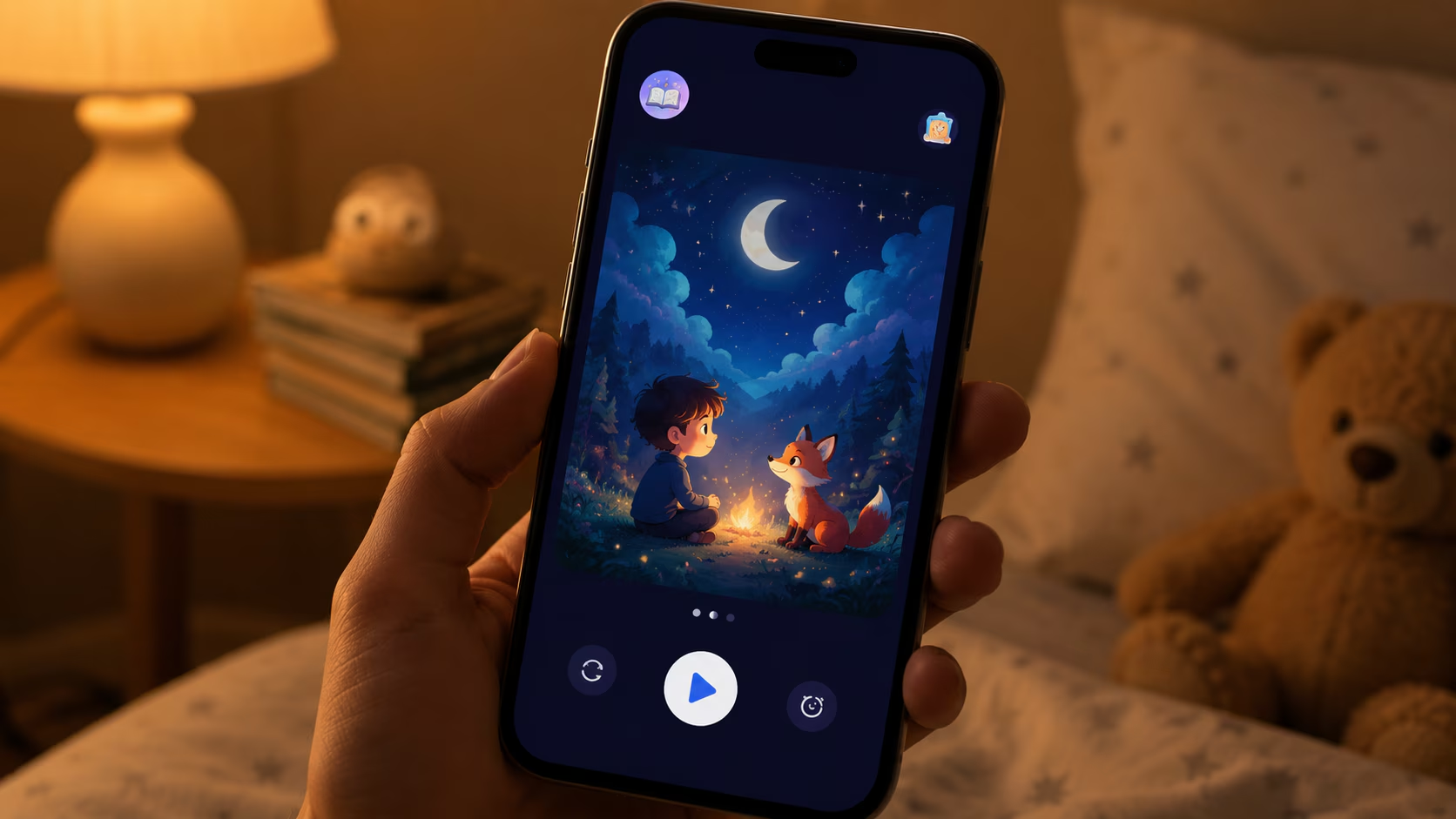
This Meta AI app personalised children stories project has a name: StoryKit. Spotted first on Apple’s App Store by 9to5Mac and later confirmed by Meta to TechCrunch, the app lets parents generate custom storybooks for their kids using generative AI, complete with characters, settings, illustrations, narration, and original music. The app is currently live only in select markets, including Mexico, as Meta pilots the concept before deciding whether to expand it more broadly.
📖 Also Read: Forget The AI Layoff Panic: India Has A Deeper Employment Problem
Meta’s AI App For Personalised Children Stories: Quick Facts
| App Name | StoryKit: personalized stories |
| Developer | Meta |
| Where It’s Live | Select markets, including Mexico (not yet in the US) |
| Minimum User Age | 18+ (adults only) |
| Underlying AI Model | Muse Spark (Meta Superintelligence Labs) |
| Story Formats | Picture Book, Audiobook |
| Social Features | None |
| Safety Measures | AI content filters, parent PIN, no text input needed |
Note: Details in this report are based on coverage from TechCrunch, 9to5Mac, Storyboard18, Social Samosa, and The Bridge Chronicle.
How This Meta AI App for Personalised Children Stories Actually Works
Creating a story on StoryKit comes down to three simple choices, and the App Store listing is explicit about the intended simplicity: “You don’t need to write a single word.” First, users create a main character, either by snapping a photo of a child’s favorite toy or person to “bring them to life,” or by describing one from scratch. Second, they describe the story’s setting, whether that’s an enchanted forest, a distant galaxy, or anywhere else a child might imagine. Third, they select a lesson or theme they want the story to teach, allowing parents to “weave in values like kindness, courage, or empathy without it feeling like a lecture.”
Once those three inputs are set, StoryKit generates a complete, illustrated story built around them. The app offers two output formats: a Picture Book, where users swipe through illustrated pages accompanied by narration and a musical score, and an Audiobook, designed for hands-free, screen-free listening during car rides, bath time, or before sleep. Finished stories can be saved to a private library, downloaded as PDFs, and accessed offline once downloaded.
The Safety Guardrails Built Into the App
Given that this app is explicitly built around generating content meant for children, Meta has emphasized several safety measures in its public statements about the pilot. A Meta spokesperson confirmed that StoryKit includes AI safety filters and content guardrails specifically for AI-generated content, alongside parent PIN protection to control access within the app.
Perhaps most notably, StoryKit has no social sharing features whatsoever, a deliberate design choice that keeps generated stories private rather than allowing them to be posted, shared, or discovered by other users. The app is also restricted to users aged 18 and older, meaning children cannot download, access, or use StoryKit independently; every story must be created by an adult, typically a parent, on the child’s behalf.
Why Meta Is Testing This Now
StoryKit’s arrival fits into a broader pattern of experimentation at Meta this year. Earlier in 2026, the company replaced its Llama models with Muse Spark, the first model to emerge from Meta Superintelligence Labs, and has since rolled out Muse Spark-powered features across its standalone Meta AI app as well as WhatsApp, Instagram, Facebook, Messenger, and Threads. StoryKit appears to be another experiment testing whether that same underlying AI technology has a viable place in family-focused, creative applications, distinct from Meta’s core social and chat products.
A Meta spokesperson told TechCrunch the company is currently using this pilot phase specifically to understand how parents engage with the storytelling experience before making any decision about a broader rollout. Meta hasn’t disclosed how many users are currently participating in the pilot, nor has it confirmed a full list of countries where the app is available, reinforcing that this remains an early-stage, limited test rather than a confirmed future product.
Part of a Broader Wave of Experimental Meta Apps
StoryKit isn’t an isolated experiment. Earlier in July 2026, Meta quietly launched a separate app called Pocket, which lets users create small interactive apps and games using text prompts, also without an official public announcement. Taken together, these quiet, low-key launches suggest Meta may currently be in an informal experimentation phase, testing multiple standalone AI-powered consumer products simultaneously to see which concepts resonate before committing to wider marketing or rollout.
This approach also follows a separate, less successful Meta AI experiment: the company pulled an Instagram AI image generation tool just three days after launch, following privacy backlash. That recent stumble may help explain why StoryKit has rolled out so quietly and in such a limited pilot capacity, with Meta apparently opting for a cautious, low-visibility testing approach rather than a high-profile launch this time around.
How StoryKit Fits Into a Crowded AI Storytelling Market
Meta isn’t the first company to explore AI-generated children’s stories. Several existing apps already offer similar personalized storybook functionality, letting parents input a child’s name, age, and favorite themes to generate custom stories with AI-created illustrations and narration. What potentially sets StoryKit apart is Meta’s underlying AI infrastructure and its emphasis on multiple output formats, including original music alongside illustrations and narration, plus its explicit no-social-features policy, a notable design choice for a company whose business has historically centered on social sharing and engagement.
Whether Meta’s version can meaningfully differentiate itself from the existing crowd of AI storytelling apps, or whether it primarily serves as a testbed for Muse Spark’s creative capabilities more broadly, remains to be seen as the pilot continues.
The Bigger Question: AI and Children’s Storytelling
Beyond the specific mechanics of StoryKit, its arrival has reignited a broader conversation about AI’s growing role in experiences traditionally built around human creativity and connection, particularly bedtime storytelling, long considered a meaningful bonding ritual between parents and children. Some commentary on the app’s launch has raised questions about whether outsourcing story creation to AI risks displacing moments of genuine parent-child imaginative connection, even as Meta frames the app as a tool intended to help parents create personalized stories rather than replace shared reading experiences altogether.
That tension, between AI as a helpful creative tool and AI as a potential substitute for genuine human interaction, is likely to remain a central part of how StoryKit, and similar AI-powered family apps, get received by parents and child development experts alike as adoption grows.
Key Talking Points
1. Adult-Only Access Is a Deliberate Safety Choice
By restricting StoryKit to users 18 and older, Meta ensures every generated story passes through parental oversight before reaching a child, rather than allowing kids to interact with the AI generation process directly and unsupervised.
2. No Social Features Marks a Notable Departure for Meta
For a company built primarily around social sharing and engagement, StoryKit’s complete lack of social functionality stands out, suggesting Meta sees genuine value in keeping this particular product private and family-focused rather than optimized for virality.
3. This Is Explicitly a Test, Not a Confirmed Product
With limited regional availability and no announced timeline for wider release, StoryKit remains firmly in pilot territory. Its future depends entirely on how parents respond during this evaluation phase.
Meta AI App Personalised Children Stories: Frequently Asked Questions (FAQs)
What is Meta’s new AI app for personalised children’s stories called?
The app is called StoryKit: personalized stories, and it’s currently being piloted by Meta in select markets, including Mexico.
Can children use StoryKit on their own?
No. StoryKit is restricted to users aged 18 and older, meaning parents or other adults must create the stories on a child’s behalf.
What safety features does StoryKit include?
Meta says the app includes AI safety filters, content guardrails, and parent PIN protection, and it has no social sharing features.
What formats does StoryKit generate stories in?
StoryKit produces stories as an illustrated Picture Book with narration and music, or as a screen-free Audiobook for hands-free listening.
Is StoryKit available in the United States?
As of this report, StoryKit is available in select markets like Mexico but has not yet launched in the United States.
Conclusion — A Cautious Test of AI’s Role in Family Life
This Meta AI app personalised children stories pilot offers an early look at how one of the world’s biggest tech companies is approaching AI-generated content for families: cautiously, with strict adult-only access, no social features, and a limited regional rollout designed to gauge genuine parent interest before scaling further. Whether StoryKit ultimately becomes a mainstream Meta product or remains a quiet experiment will depend on how parents in these pilot markets actually respond, and on the broader, ongoing conversation about where AI-generated content belongs, and doesn’t, in children’s lives.
Stay tuned to Mirrorly.in for more coverage of Meta’s AI products and family technology.
📖 Also Read: Forget The AI Layoff Panic: India Has A Deeper Employment Problem