Women’s T20 World Cup 2026 Final: Australia Crush England by 7 Wickets at Lord’s — Beth Mooney and Phoebe Litchfield Star in Dominant Chase

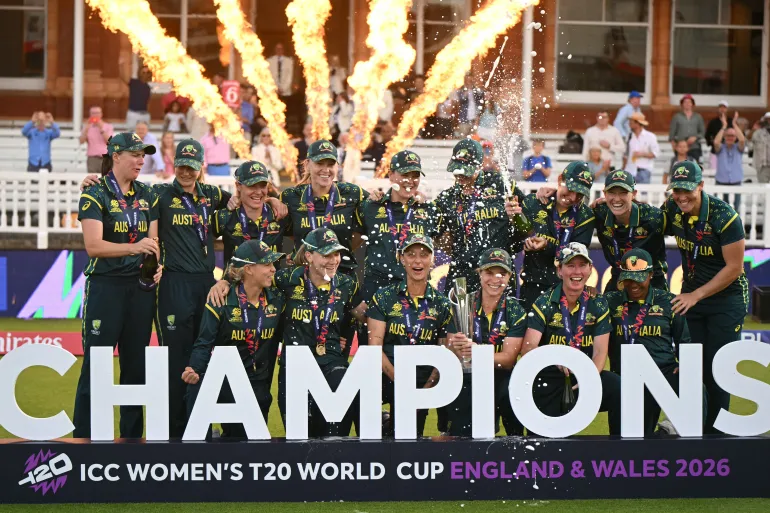
Australia are the ICC Women’s T20 World Cup 2026 champions. At Lord’s Cricket Ground on Sunday, July 5, the Southern Stars dismantled England’s challenge with clinical precision — chasing 151 in just 17.1 overs to win by 7 wickets and claim women’s cricket’s biggest prize in front of a packed Lord’s crowd. Beth Mooney anchored the chase with an unbeaten 64 off 49 balls, while Phoebe Litchfield blazed 48 off 35 in a match-defining 100-run second-wicket partnership. England had posted a competitive 150/4 — Freya Kemp’s extraordinary late 44 off 28 lifting them past 140 — but their total proved 20 runs short against an Australian batting lineup that knew exactly where to attack.
Consequently, Australia add the 2026 Women’s T20 World Cup title to their extraordinary collection of ICC trophies. England’s wait for a major ICC white-ball title at Lord’s continues. Furthermore, the final at the home of cricket delivered everything a showpiece occasion demands — a tight first innings, a superb batting display in the chase, and a full house witnessing the moment Australia’s women confirmed their place as the dominant force in women’s T20 cricket once again.
📖 Also Read: England Beat India 2nd T20I Manchester: Bethell 76* Wins It
Women’s T20 World Cup Final 2026 — Match at a Glance
| Tournament | ICC Women’s T20 World Cup 2026 — Final |
| Match | England Women (ENG) vs Australia Women (AUS) |
| Date | Sunday, July 5, 2026 (8:00 PM IST) |
| Venue | Lord’s Cricket Ground, St John’s Wood, London (Capacity: 28,000) |
| Toss | Australia won the toss and elected to bowl |
| Result | Australia won by 7 wickets |
| England Score | 150/4 in 20 overs |
| Australia Score | 153/3 in 17.1 overs |
| ICC Women’s T20 WC 2026 Champions | 🏆 Australia Women |
| Conditions | Partly cloudy, warm, light breeze — no rain |
Note: All statistics sourced directly from ICC and SportRadar live data.
England Women Batting Scorecard — 150/4 in 20 Overs
| Batter | R | B | 4s | 6s | SR | Dismissal |
| Amy Jones | 6 | 6 | 1 | 0 | 100.00 | Caught b Lucy Hamilton |
| Danielle Wyatt-Hodge | 8 | 9 | 1 | 0 | 88.89 | Caught b Annabel Sutherland |
| Natalie Sciver-Brunt | 58* | 53 | 5 | 0 | 109.43 | Not Out |
| Alice Capsey | 23 | 20 | 2 | 1 | 115.00 | Bowled b Sophie Molineux |
| Heather Knight (C) | 2 | 6 | 0 | 0 | 33.33 | LBW b Kim Garth |
| Freya Kemp | 44* | 28 | 4 | 1 | 157.14 | Not Out |
| Extras: 9 (Wides 3, Leg Byes 4, No Balls 2) | Total: 150/4 in 20 Overs | Run Rate: 7.50 | ||||||
Australia Women Bowling — vs England
| Bowler | O | R | W | Econ |
| Kim Garth | 4 | 20 | 1 | 5.00 |
| Lucy Hamilton | 3 | 19 | 1 | 6.33 |
| Annabel Sutherland | 4 | 34 | 1 | 8.50 |
| Sophie Molineux | 4 | 32 | 1 | 8.00 |
| Georgia Wareham | 2 | 9 | 0 | 4.50 |
| Ashleigh Gardner | 3 | 32 | 0 | 10.67 |
Australia Women Batting Scorecard — 153/3 in 17.1 Overs
| Batter | R | B | 4s | 6s | SR | Dismissal |
| Georgia Voll | 9 | 6 | 2 | 0 | 150.00 | Bowled b Lauren Bell |
| Beth Mooney | 64* | 49 | 10 | 0 | 130.61 | Not Out |
| Phoebe Litchfield | 48 | 35 | 6 | 2 | 137.14 | Bowled b Charlie Dean |
| Ellyse Perry | 13 | 12 | 1 | 0 | 108.33 | LBW b Sophie Ecclestone |
| Ashleigh Gardner | 3* | 2 | 0 | 0 | 150.00 | Not Out |
| Extras: 16 (Wides 11, Byes 4, No Balls 1) | Total: 153/3 in 17.1 Overs | Run Rate: 8.91 | ||||||
England Women Bowling — vs Australia
| Bowler | O | R | W | Econ |
| Charlie Dean | 4 | 28 | 1 | 7.00 |
| Sophie Ecclestone | 3.1 | 24 | 1 | 7.58 |
| Lauren Bell | 3 | 38 | 1 | 12.67 |
| Linsey Smith | 4 | 30 | 0 | 7.50 |
| Charlotte Dean | 4 | 28 | 1 | 7.00 |
| Freya Kemp | 2 | 22 | 0 | 11.00 |
| Danielle Gibson | 1 | 7 | 0 | 7.00 |
Match Report — How the Final Unfolded
England’s Innings — Sciver-Brunt and Kemp Rescue a Wobbling Start
Australia won the toss and elected to bowl at Lord’s — a decision that made perfect sense given the partly cloudy conditions offered early movement for their pace attack. England’s start was immediately troubled. Amy Jones fell for 6 in the 2nd over — caught off Lucy Hamilton — and Danielle Wyatt-Hodge followed for 8 in the 5th over, caught off Annabel Sutherland. Consequently, England found themselves 32 for 2 with the powerplay nearly gone and no settled partnership established.
Natalie Sciver-Brunt held the innings together through the middle. Walking in at No. 3 when the top order fell away, she batted through to finish unbeaten on 58 off 53 — the anchor performance England needed. Alice Capsey provided useful support with 23 off 20, including a six off Molineux, before being bowled in the 10th over. When Heather Knight fell LBW for just 2 in the 11th over, England stood at 80 for 4 and the innings was in danger of stalling below 130.
Freya Kemp — The Match-Defining Cameo
What followed was arguably the defining sequence of England’s World Cup campaign — Freya Kemp, 22 years old, walked in at No. 6 with 10 overs remaining and England desperately needing acceleration. Notably, she delivered exactly that. Kemp’s unbeaten 44 off 28 balls — 4 fours, 1 six, strike rate 157 — transformed England’s total from a modest 130 into a competitive 150. Her fifth-wicket partnership of 80 runs off 55 balls with Sciver-Brunt in the final nine overs was the difference between a gettable and a challenging target. Sophie Molineux’s last over went for 13 — Kemp and Sciver-Brunt making full use of the final overs as Australia’s bowling ran out of variation.
Australia’s Chase — Litchfield and Mooney Put the Final to Bed
Australia’s reply began positively before stumbling briefly. Georgia Voll struck 2 fours in her opening 6 balls before being bowled by Lauren Bell for 9 in the 2nd over. Undoubtedly, that early wicket gave England hope — but what came next extinguished it entirely.
Beth Mooney and Phoebe Litchfield built a 100-run second-wicket partnership off 67 balls — the most decisive passage of play in the entire final. Litchfield was the aggressor, hitting 6 fours and 2 sixes in a 48 off 35 that put the chase firmly in Australia’s hands before the halfway point. Mooney was the anchor, rotating strike efficiently and accelerating when needed — her 64 not out off 49 contained 10 boundaries and was the innings of a champion player on the biggest stage.
Charlie Dean eventually bowled Litchfield in the 13th over, and Sophie Ecclestone dismissed Ellyse Perry LBW in the 16th. However, by that point, Australia needed just 13 runs from 23 balls with 2 wickets in hand. Mooney calmly guided them home in the 18th over — Australia crossing 153 in 17.1 overs with 17 balls to spare.
Key Partnerships — Women’s T20 World Cup Final 2026
| Team | Partnership | Wicket | Runs | Balls | Players |
| England | 1st wicket | 7 runs (8 balls) | 7 | 8 | Jones 6, Wyatt-Hodge 1 |
| England | 2nd wicket | 25 runs (22 balls) | 25 | 22 | Sciver-Brunt 16, Wyatt-Hodge 7 |
| England | 3rd wicket | 35 runs (30 balls) | 35 | 30 | Sciver-Brunt 9, Capsey 23 |
| England | 4th wicket | 3 runs (7 balls) | 3 | 7 | Sciver-Brunt 1, Knight 2 |
| England | 5th wicket (unbroken) | 80 runs (55 balls) | 80 | 55 | Sciver-Brunt 32, Kemp 44* |
| Australia | 1st wicket | 17 runs (12 balls) | 17 | 12 | Voll 9, Mooney 2 |
| Australia | 2nd wicket (match-winning) | 100 runs (67 balls) | 100 | 67 | Mooney 48, Litchfield 48 |
| Australia | 3rd wicket | 23 runs (18 balls) | 23 | 18 | Mooney 14, Perry 8 |
| Australia | 4th wicket (unbroken) | 13 runs (7 balls) | 13 | 7 | Perry 5, Gardner 3 |
Key Talking Points
1. Beth Mooney — The Tournament’s Defining Player
Undoubtedly, Beth Mooney was the player of the final and arguably the player of the tournament. Her unbeaten 64 off 49 at Lord’s combined classical anchor batting with smart acceleration in the final overs. Equally important, her 100-run partnership with Litchfield — built patiently across 11 overs in the heart of the chase — was the moment the final was decided. Mooney’s 10 boundaries in a controlled, unbeaten innings on the biggest stage of women’s cricket is the kind of performance that defines careers and tournaments simultaneously.
2. Phoebe Litchfield — The Young Gun Who Changed the Chase
Phoebe Litchfield walked in at No. 3 and immediately attacked — her 48 off 35 contained 6 fours and 2 sixes and was scored at a strike rate of 137. Consequently, England’s bowlers had no opportunity to establish early pressure in the powerplay, as Litchfield consistently found the boundary and manipulated the field from her first ball. Furthermore, her partnership with Mooney was so dominant — 100 runs at nearly 9 runs per over — that England’s realistic chance of winning disappeared before the halfway point of the chase.
3. Freya Kemp — England’s Best Performer on the Day
England’s one genuine bright spot was Freya Kemp’s extraordinary late cameo. Her 44 not out off 28 lifted England from a likely 130 to an actual 150 and was precisely the kind of innings a World Cup final requires from a lower-order batter. Notably, at 22 years old, Kemp is clearly a central figure in England’s future white-ball plans — her composure under pressure and her ability to hit cleanly in the death overs make her one of the most exciting young talents in women’s cricket. Nevertheless, England needed more from their top order on the day to give Kemp’s late fireworks real consequence.
4. Kim Garth — The Most Economical Bowler in the Final
Australia’s Kim Garth bowled 4 overs for just 20 runs — an economy rate of 5.00 — to claim the best figures of any bowler in the match. Specifically, her ability to tie England’s batters down in the middle overs, denying the acceleration they needed in the 7th to 14th overs, was a key factor in restricting England below 160. Garth’s performance throughout the Women’s T20 World Cup 2026 established her as one of women’s cricket’s most reliable all-format pace bowlers.
5. Australia — The Standard of Women’s T20 Cricket
Ultimately, this Women’s T20 World Cup Final confirmed what has been evident for years: Australia Women are the benchmark in women’s T20 cricket. Their bowling was disciplined across all 20 overs, conceding a total they knew their batting lineup could chase comfortably. Their batting then executed that chase with clinical authority, losing just 3 wickets and crossing the line with 17 balls to spare. Accordingly, Australia’s trophy cabinet grows again — and England must wait for another major ICC final opportunity to end their long wait for white-ball glory at home.
Full Match Statistics — Women’s T20 World Cup 2026 Final
| Statistic | England | Australia |
| Score | 150/4 (20 overs) | 153/3 (17.1 overs) |
| Run Rate | 7.50 | 8.91 |
| Fours | 13 | 20 |
| Sixes | 2 | 2 |
| Top Scorer | Natalie Sciver-Brunt 58* | Beth Mooney 64* |
| Best Bowling | Charlie Dean 1/28 | Kim Garth 1/20 (5.00 econ) |
| Most Economical Bowler | Charlie Dean — 7.00 | Kim Garth — 5.00 |
| Extras | 9 (W3, LB4, NB2) | 16 (W11, B4, NB1) |
| Balls Remaining | 0 | 17 |
Women’s T20 World Cup 2026 Final — Frequently Asked Questions (FAQs)
Who won the Women’s T20 World Cup 2026?
Australia Women won the ICC Women’s T20 World Cup 2026, beating England Women by 7 wickets in the final at Lord’s on July 5, 2026. Australia chased down England’s target of 151 in just 17.1 overs, reaching 153/3 with 17 balls to spare.
Where was the Women’s T20 World Cup 2026 Final held?
The final was held at Lord’s Cricket Ground, St John’s Wood, London — capacity 28,000. The match was played on Sunday, July 5, 2026 in partly cloudy and warm conditions with a light breeze.
Who scored the most runs in the Women’s T20 World Cup 2026 Final?
Beth Mooney (Australia) top-scored in the final with an unbeaten 64 off 49 balls — hitting 10 fours at a strike rate of 130.61. For England, Natalie Sciver-Brunt was the top scorer with an unbeaten 58 off 53 balls — a composed anchor innings that held the England innings together through the middle period.
What did Phoebe Litchfield score in the Women’s T20 World Cup Final?
Phoebe Litchfield scored 48 off 35 balls for Australia — hitting 6 fours and 2 sixes at a strike rate of 137.14. She was bowled by Charlie Dean in the 13th over but had already done the damage — her 100-run second-wicket partnership with Beth Mooney effectively sealed the final for Australia by the halfway point of the chase.
How did Freya Kemp perform in the Women’s T20 World Cup Final?
Freya Kemp was England’s standout batter of the match, scoring an unbeaten 44 off 28 balls (4 fours, 1 six, SR 157.14) at No. 6. Her match-defining 80-run fifth-wicket unbroken partnership with Natalie Sciver-Brunt lifted England from a troubled 70 for 4 to a competitive 150 for 4. She also bowled 2 overs for 22 runs in Australia’s successful chase.
Who was England’s best bowler in the Women’s T20 World Cup Final?
Charlie Dean was England’s most economical and effective bowler, taking 1 wicket for 28 runs in 4 overs at an economy rate of 7.00 — including the key wicket of Phoebe Litchfield in the 13th over. Sophie Ecclestone also took 1 wicket but was expensive due to 6 wides, finishing with 1/24 in 3.1 overs.
Who was Australia’s best bowler vs England in the Women’s T20 World Cup Final?
Kim Garth was Australia’s best bowler with figures of 1/20 in 4 overs — the most economical bowling performance of the entire match at an economy rate of just 5.00. Her disciplined middle-overs spell restricted England’s scoring when they needed acceleration, contributing significantly to England being held to 150 rather than 160+.
What was the winning partnership for Australia in the final?
The match-defining partnership was Australia’s 2nd wicket stand of 100 runs off 67 balls between Beth Mooney and Phoebe Litchfield. Building from the 2nd over after Georgia Voll’s early dismissal, Mooney and Litchfield’s century partnership took Australia from 17/1 to 117/2 — putting the chase well ahead of the required rate and removing any realistic prospect of an England comeback.
Conclusion — Australia Champions, England’s Wait Goes On
Australia lifted the ICC Women’s T20 World Cup 2026 trophy at Lord’s — the home of cricket — and did so with the authority befitting the dominant team in women’s T20 cricket. Beth Mooney’s unbeaten 64, Phoebe Litchfield’s explosive 48, and Kim Garth’s miserly 4 overs told the story of a team that executes on the biggest occasions with complete composure. Evidently, Australia came to Lord’s knowing they were the better side — and they played like it from toss to trophy.
For England, this final represents a painful near-miss. Their 150/4 was respectable — built on Sciver-Brunt’s backbone and Kemp’s brilliant late cameo — but ultimately 15 to 20 runs below the total that might have truly tested Australia’s chase. Furthermore, their bowling found little purchase against Mooney and Litchfield once the second-wicket partnership took hold. Meanwhile, England’s wait for a major ICC white-ball title at Lord’s extends — but a team with Kemp, Capsey and Sciver-Brunt in their core has every reason to believe the next opportunity is not far away.
Stay tuned to Mirrorly.in for complete Women’s T20 World Cup 2026 final coverage, tournament statistics and all the reaction from Lord’s.
📖 Also Read: Argentina vs Cape Verde 3-2 World Cup 2026: Messi’s Champions Survive Extra-Time Thriller