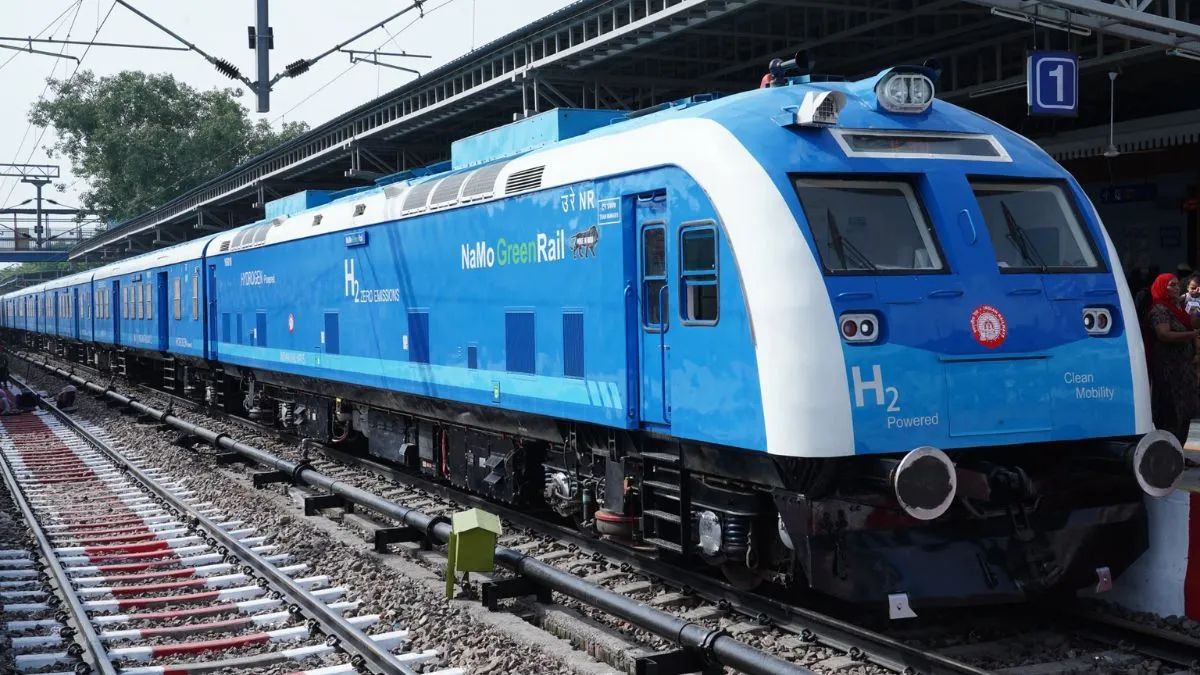
India just entered a small, exclusive club of nations experimenting with hydrogen rail transport. Prime Minister Narendra Modi flagged off the country’s first hydrogen-powered passenger train in Jind, Haryana, on July 17, 2026, running along the 89-km Jind-Sonipat corridor. But how does a hydrogen-powered train works in practice, and what makes this technology genuinely different from the electric and diesel trains most of us are used to? Here’s a full breakdown.
📖 Also Read: Rohit Sharma Retirement Talk Grows Ahead Of Decisive Lord’s ODI vs England
India’s Hydrogen Train: Quick Facts
| Launched | July 17, 2026, by PM Narendra Modi |
| Route | Jind-Sonipat, Haryana (89 km, 12 stations) |
| Operator | Northern Railway |
| Train Type | Hydrogen-Electric Multiple Unit (HEMU) |
| Coaches | 10 (8 passenger + 2 driving power cars) |
| Installed Capacity | Up to 2,400 kW |
| Commercial Speed | 75 km/h (tested up to 110-120 km/h) |
| Project Cost | ₹136 crore (pilot project) |
| Fuel Cells Supplied By | Ballard Power Systems (Canada) |
Note: Details in this report are based on coverage from Outlook India, Republic World, Deccan Herald, and Insights on India, along with statements from Railway Minister Ashwini Vaishnaw.
What Exactly Is a Hydrogen-Powered Train?
To understand how a hydrogen-powered train works, it helps to first place it against the two power sources Indian trains have traditionally relied on. Diesel locomotives burn fossil fuel directly to power their engines, producing exhaust emissions in the process. Electric trains, by contrast, draw power continuously from overhead wires connected to the broader electricity grid, requiring extensive fixed infrastructure along every route they run on.
India’s hydrogen train occupies a genuinely different category from both. Rather than burning fuel or drawing from a grid, it manufactures its own electricity on board as it travels, essentially functioning as a mobile power station. That electricity comes from a technology called a hydrogen fuel cell, a device that generates power through a chemical reaction rather than combustion, with water vapour as its only significant byproduct.
The Core Technology: How the Fuel Cell Generates Power
At the heart of the train sits a stack of fuel cells, and the underlying chemistry, while sophisticated in engineering terms, is conceptually straightforward. Compressed hydrogen gas, stored in reinforced tanks on board the train, is fed into the fuel cell alongside oxygen drawn directly from the surrounding air. Inside each cell, a thin membrane separates the two gases while still allowing a carefully controlled electrochemical reaction to take place between them.
That reaction strips electrons from the hydrogen atoms, and it’s the controlled flow of those electrons that generates usable electricity. The only significant byproducts of this entire process are pure water vapour and a small amount of heat, meaning the train produces zero direct carbon emissions during operation. This electricity then powers the train’s traction motors, which are mounted on the train’s axles, driving the wheels and moving the train forward, much like a conventional electric motor would, just without needing a continuous external power supply.
The Hybrid System: Fuel Cells Plus Batteries
One detail that’s easy to miss but genuinely important to how this train operates is that it doesn’t rely on hydrogen fuel cells alone. India’s hydrogen train uses a hybrid architecture that pairs its fuel cell stack with an integrated Lithium Ferro Phosphate, or LFP, battery system. This combination solves a practical engineering challenge: fuel cells are excellent at producing a steady, consistent electrical output, but they aren’t naturally suited to delivering the sudden power surges a train needs when accelerating from a stop or climbing gradients.
That’s where the battery comes in. When the train starts moving or needs a quick burst of extra power, the LFP battery automatically kicks in alongside the fuel cell, supplying the additional energy needed for that moment. Then, when the train is cruising at lower, steady speeds or braking to slow down for an upcoming station, the surplus electricity generated by the fuel cell, along with energy recovered through regenerative braking, gets automatically diverted to recharge the battery. By the time the train reaches the end of its route, this balancing act typically leaves the battery around 80% charged, ready for the next trip without needing a lengthy, dedicated recharging stop.
Where the Hydrogen Comes From
Fueling a train like this requires infrastructure well beyond the train itself. To support this pilot project, a dedicated hydrogen plant was established at Jind, with a storage capacity of 3,000 kg. Crucially, the hydrogen produced at this facility is generated through electrolysis, a process that uses electricity to split water into hydrogen and oxygen. When the electricity used for that process comes from renewable sources, the resulting hydrogen qualifies as “green hydrogen,” meaning the entire fuel supply chain, not just the train’s operation, can be genuinely low-carbon.
Ensuring a stable, uninterrupted power supply for this electrolysis process was itself a significant part of the project’s infrastructure planning, with an 11 kV power connection secured specifically to keep the hydrogen plant running reliably for both the train’s final commissioning tests and its regular day-to-day operations going forward. On a typical day, the train is expected to make two round trips, covering roughly 356 km in total, while consuming approximately 300 kg of hydrogen.
The Train’s Route, Speed, and Passenger Capacity
India’s first hydrogen train runs on the 89-km Jind-Sonipat section under Northern Railway’s jurisdiction, calling at 12 stations along the way. It’s a Broad Gauge train, consisting of 10 coaches in total: eight passenger coaches plus two driving power cars positioned at either end. While the train has demonstrated speeds of up to 110 to 120 km/h during its extensive trial phases, its standard commercial operating speed on this specific route is capped at 75 km/h, a figure set based on the practical requirements of the Jind-Sonipat corridor rather than the train’s technical limits.
Passenger capacity figures have varied slightly across different reports, with some citing a capacity of at least 682 passengers for this specific configuration, while separate reporting on India’s broader hydrogen train programme has referenced a considerably higher figure of up to 2,638 passengers for full-scale future units. This kind of variation is common with major infrastructure projects still in active development, where final specifications can shift between planning documents, trial runs, and eventual commercial deployment.
Engineering Origins: Retrofitting Old Rakes
Rather than building an entirely new train from scratch, engineers took a more resourceful approach for this pilot project. The train was created by retrofitting old Diesel Electric Multiple Unit, or DEMU, rakes with an advanced, clean hydrogen fuel cell and lithium battery propulsion system, effectively replacing the old diesel-based powertrain with the new hydrogen-electric architecture while reusing much of the existing rolling stock.
This retrofitting approach offered a genuinely practical benefit: it eliminated the need for either traditional diesel fuel systems or the overhead electrical wiring that standard electric trains depend on. The project itself was executed by Northern Railway at a cost of ₹136 crore, with key propulsion equipment supplied by Hyderabad-based engineering firm Medha Servo Drives, while the specialized hydrogen fuel cells themselves were imported from Ballard Power Systems, a Canadian company recognized as an industry leader in fuel cell technology.
How India’s Hydrogen Train Compares Globally
India’s entry into hydrogen rail technology places it alongside a small group of nations that have already adopted similar systems, including Germany, China, and the United Kingdom. What sets India’s approach apart, according to Railway Minister Ashwini Vaishnaw, is the scale of ambition behind the underlying engine technology. India’s broader hydrogen train programme is targeting a 1,200 horsepower engine, which would make it the world’s most powerful hydrogen train engine, significantly outperforming existing designs in other leading nations, where equivalent engines typically range between just 500 and 600 horsepower.
That comparison reflects India’s attempt not just to catch up with existing hydrogen rail technology, but to leapfrog ahead of it in terms of raw power output, an ambitious target for a technology that remains relatively new even among the countries that have already deployed it commercially.
Safety: How the Train Manages Its Hydrogen Supply
Given that hydrogen is a highly flammable gas, safety engineering has been a central focus throughout the train’s development. The train features an integrated, multi-layer safety system that has been certified by Germany’s TÜV SÜD, a globally recognized technical testing and certification body, along with India’s own Petroleum and Explosives Safety Organisation, or PESO. This dual certification reflects both international best practices and domestic regulatory compliance for handling compressed hydrogen safely in a passenger transport setting.
Specific safety features built into the system include automatic shut-off mechanisms, along with dedicated hydrogen leak and flame detectors designed to identify and respond to any potential issues immediately. Before entering full commercial service, the train also underwent extensive testing and trial runs, including a successful earlier test of its hydrogen-powered driving power car, or coach, at the Integral Coach Factory in Chennai, a milestone Railway Minister Ashwini Vaishnaw confirmed publicly as a crucial step toward the full train’s eventual deployment.
Why This Matters for India’s Climate Goals
This hydrogen train launch fits squarely into Indian Railways’ broader push toward cleaner transportation and its stated ambition of achieving net-zero carbon emissions by 2030 across one of the world’s largest rail networks. As a pilot project, the Jind-Sonipat train is intended to demonstrate real-world feasibility for hydrogen technology on non-electrified or short-haul railway tracks, corridors where installing traditional overhead electrical infrastructure may be impractical, expensive, or, in the case of certain heritage routes, simply undesirable from a preservation standpoint.
If this pilot proves successful, it’s intended to pave the way for a much larger rollout. The Ministry of Railways has already allocated approximately Rs 2,800 crore, roughly $337 million USD, toward developing 35 hydrogen fuel cell-based trains as part of this broader initiative, suggesting the Jind-Sonipat launch is very much a first step rather than a standalone, isolated project.
The Environmental Case: Why Hydrogen Over Diesel or Full Electrification
Understanding exactly why Indian Railways chose to pursue hydrogen technology, rather than simply extending diesel operations or pushing for full electrification everywhere, helps clarify this project’s broader significance. Diesel locomotives remain a significant source of emissions across sections of India’s rail network that haven’t yet been electrified, particularly on shorter, lower-traffic routes where the enormous capital cost of installing overhead electrical infrastructure is difficult to justify economically. For these specific corridors, hydrogen offers a genuinely compelling middle path: zero direct emissions like an electric train, but without the fixed infrastructure burden of overhead wires running the entire length of the route.
This makes hydrogen technology particularly well-suited to a specific category of railway lines: shorter branch routes, lines serving lower passenger volumes, or corridors passing through ecologically or architecturally sensitive areas where installing extensive overhead wiring might be impractical or undesirable. Heritage railway routes, for instance, often face restrictions on modifying their surrounding infrastructure, making a self-contained power source like a hydrogen fuel cell train an attractive option for keeping such lines both operational and environmentally friendly without compromising their historical character.
Challenges and Open Questions for Hydrogen Rail Technology
Despite the genuine promise of this technology, several practical challenges remain before hydrogen trains can be deployed at scale across India’s rail network. Building out a network of hydrogen production and refueling infrastructure represents a significant undertaking in its own right, since each new hydrogen train route potentially requires its own dedicated production facility, similar to the plant established specifically for the Jind-Sonipat corridor. Scaling this model nationally would require substantial coordinated investment in hydrogen infrastructure well beyond the trains themselves.
Cost considerations also remain an open question at this early pilot stage. As officials involved in testing the technology have noted, a prototype like this one exists primarily to help engineers understand real-world operational requirements, rather than to deliver an immediately cost-optimized solution. Not every aspect of a genuinely novel technology like this can, or should, be assessed purely in terms of upfront cost, since the value of pioneering technology often lies in what it teaches engineers for the next generation of deployment, and in helping India maintain technological relevance as global rail transport shifts toward cleaner alternatives.
India’s Broader Green Hydrogen Ambitions
This train doesn’t exist in isolation. It’s a visible, high-profile piece of India’s much larger National Green Hydrogen Mission, a government initiative aimed at positioning the country as a global hub for green hydrogen production, both for domestic use and export. That mission spans multiple sectors well beyond railways, including heavy industry, transportation, and energy storage, all areas where hydrogen is seen as a potential tool for reducing reliance on fossil fuels.
Within that broader context, this railway pilot project serves a dual purpose. Beyond its immediate function of moving passengers between Jind and Sonipat, it acts as a highly visible proof-of-concept for hydrogen technology more generally, demonstrating to both policymakers and the public that hydrogen-based systems can function reliably in a demanding, safety-critical, real-world application like passenger rail transport. Success here could help build broader public and institutional confidence in hydrogen technology across other sectors targeted by India’s national mission.
What Passengers Can Expect From the New Train
For everyday commuters on the Jind-Sonipat route, the most immediately noticeable difference is likely to be the experience of riding a fundamentally quieter train. Hydrogen fuel cell propulsion produces significantly less noise and vibration compared to traditional diesel engines, since there’s no combustion process generating the mechanical clatter associated with conventional diesel locomotives. Passengers are also likely to notice the complete absence of exhaust fumes or diesel smell, both at stations and inside the coaches themselves, a subtle but meaningful quality-of-life improvement for daily commuters.
Beyond the immediate travel experience, the train’s operation offers commuters on this specific corridor a tangible, visible example of India’s clean energy transition in action, rather than an abstract policy goal discussed only in government reports. For a route that previously relied on older diesel-powered rakes, the shift to hydrogen represents a genuine, immediately noticeable upgrade in both environmental impact and ride quality.
Key Talking Points
1. This Is a Pilot Project, Not a Nationwide Rollout Yet
While the symbolism of the launch is significant, it’s worth remembering this is a single pilot train on one specific 89-km route. Its success here will directly inform decisions about the much larger 35-train programme already funded and planned.
2. The Retrofit Approach Shows Practical Engineering Thinking
Rather than building entirely new trains, converting existing DEMU rakes demonstrates a resourceful, cost-conscious approach to introducing new technology, potentially making future scale-up faster and cheaper than starting from scratch each time.
3. Green Hydrogen Production Is Just as Important as the Train Itself
A hydrogen train is only as clean as its fuel source. The decision to produce hydrogen at Jind via electrolysis, rather than importing it, is central to ensuring the entire system delivers genuine environmental benefits rather than just shifting emissions elsewhere.
4. India Is Aiming to Lead, Not Just Follow
With a target of building the world’s most powerful hydrogen train engine, India’s ambitions in this space go beyond simply adopting existing technology from countries like Germany, aiming instead to set a new global benchmark.
What’s the difference between this train and a regular electric train?
Unlike electric trains, which draw continuous power from overhead wires, a hydrogen-powered train generates its own electricity on board using fuel cells, eliminating the need for fixed overhead electrical infrastructure along the route.
Why did engineers retrofit old diesel trains instead of building new ones?
Retrofitting existing DEMU rakes with hydrogen-electric propulsion allowed engineers to reuse existing rolling stock while replacing the diesel powertrain, offering a more resourceful and potentially faster path to testing the technology.
How Hydrogen-Powered Train Works: Frequently Asked Questions (FAQs)
How does a hydrogen-powered train actually generate electricity?
A hydrogen-powered train works by feeding compressed hydrogen gas and oxygen from the air into onboard fuel cells, where an electrochemical reaction generates electricity while releasing only water vapour and heat as byproducts.
What route does India’s first hydrogen train run on?
The train runs on the 89-km Jind-Sonipat section in Haryana, under Northern Railway, stopping at 12 stations along the route.
How fast can India’s hydrogen train go?
Its commercial operating speed is capped at 75 km/h on the Jind-Sonipat route, though it has demonstrated speeds of up to 110-120 km/h during trial runs.
Is the hydrogen train safe?
Yes. The train features a multi-layer safety system certified by Germany’s TÜV SÜD and India’s PESO, including automatic shut-offs and hydrogen leak and flame detectors.
Where does the train get its hydrogen fuel from?
Hydrogen is produced at a dedicated plant in Jind using electrolysis, a process that can generate “green hydrogen” when powered by renewable electricity, with the plant holding a storage capacity of 3,000 kg.
How many hydrogen trains does India plan to build?
Indian Railways has allocated around Rs 2,800 crore to develop 35 hydrogen fuel cell-based trains as part of a broader push toward net-zero emissions by 2030.
Conclusion — A Small Pilot With Big Ambitions
Understanding how a hydrogen-powered train works reveals just how different this technology is from anything currently running on India’s vast rail network. By combining onboard hydrogen fuel cells with a smart battery hybrid system, all fed by a dedicated green hydrogen plant, India’s first hydrogen train offers a genuinely zero-emission alternative for routes where traditional electrification isn’t practical. While this remains a single pilot project on one Haryana route for now, the scale of funding already committed to a much larger 35-train programme suggests this launch is just the opening chapter of a much bigger push to decarbonize Indian Railways in the years ahead.
Stay tuned to Mirrorly.in for more explainers on India’s infrastructure and green technology projects, including future updates as the hydrogen train programme expands beyond this pilot corridor.
📖 Also Read: Rohit Sharma Retirement Talk Grows Ahead Of Decisive Lord’s ODI vs England