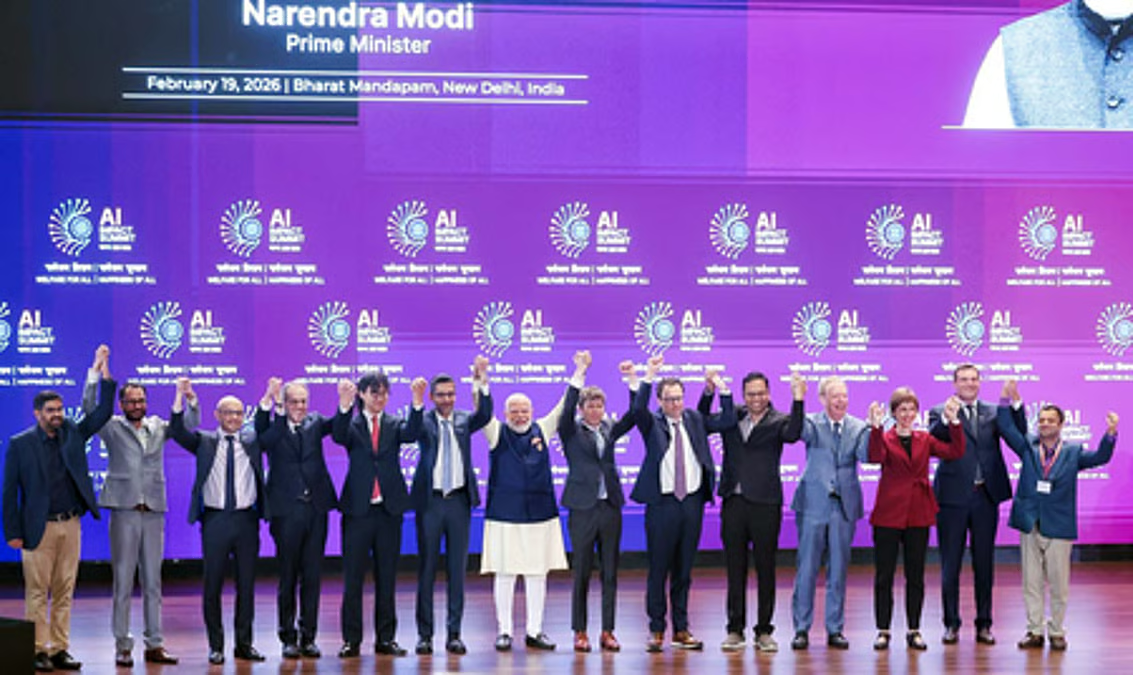
The AI trends in India 2026 tell a very different story from just a year ago. Back then, India’s AI story was largely about compute procurement and future plans. Now, it’s about shipped products, homegrown language models, and real funding momentum. From a sovereign AI push to agentic tools reshaping marketing, here’s a closer look at what’s actually changing this year.
📖 Also Read: Anti-Aging Grooming Basics: 8 Habits That Actually Help
AI Trends in India 2026: Quick Facts
| AI Funding (Jan–Aug 2026) | $1.34 billion across 66 rounds |
| Funding Growth vs. 2025 | 143% increase |
| Total AI Companies in India | 2,900+, with 605 funded |
| Top-Funded AI Companies | Uniphore, Innovaccer, Neysa |
| Key Government Initiative | IndiaAI Mission |
| Notable Milestone | Nine-institution consortium covering all 22 scheduled languages |
Note: Details in this report are based on coverage from Tracxn, explainx.ai, Statista, and MarTech Union.
From Compute Procurement to Shipped Products
A year ago, India’s AI narrative centered mostly on hardware, with the IndiaAI Mission approving around 18,693 subsidized GPUs, but no Indian foundation model had shipped at meaningful scale. This Independence Day, that picture looks very different. Open-source models trained end-to-end on Indian soil are now live, a nine-institution academic consortium is working across all 22 scheduled languages, and Anthropic has opened a Bengaluru office, with India now ranking as Claude’s second-largest market globally. This shift, from procurement headlines to real products, is arguably the single biggest story among the AI trends in India 2026.
6 AI Trends Shaping India in 2026
1. A Funding Surge Unlike Recent Years
Indian AI startups raised $1.34 billion across 66 funding rounds between January and August 2026, marking a 143% jump compared to the same period in 2025. Interestingly, this happened even as the number of funding rounds dropped from 110 to 66, suggesting investors are placing larger, more concentrated bets rather than spreading capital thinly across many early-stage companies.
2. Sovereign AI Models Are Finally Shipping
Homegrown initiatives like Sarvam and BharatGen have moved from development to deployment, giving India its own foundation models rather than relying entirely on foreign platforms. This sovereign AI push reflects a broader national priority: building AI systems trained specifically on Indian languages, data, and context.
3. Agentic AI Is Replacing Manual Workflows
Across marketing and business operations, autonomous AI agents are increasingly taking over tasks that used to require constant manual oversight, from shifting ad budgets between cities in real time to generating new campaign variants automatically. This move from “AI as a tool” to “AI as an agent” is one of the most significant operational shifts happening across Indian businesses this year.
4. Vernacular and Regional Language AI Is Expanding
With a nine-institution consortium now covering all 22 scheduled languages, AI tools are becoming genuinely accessible beyond English and Hindi. This matters enormously for reaching tier-2 and tier-3 markets, where vernacular content and language support can make or break adoption.
5. AI Adoption Is Deepening in Healthcare and Agriculture
India continues to position itself as a hub for AI-powered solutions in healthcare and agriculture specifically, sectors where the potential impact on everyday citizens is especially high. Enterprise adoption of generative AI for automation and customer service is also becoming mainstream across banking and manufacturing.
6. AI Pricing and Infrastructure Are Maturing
On the global stage, steep price cuts on frontier AI models and the rise of practical desktop AI agents suggest the technology is moving past its hype phase and into a period of genuine, unglamorous integration. For India specifically, cheaper access to powerful models means smaller companies and even solo developers can now experiment with AI features that were previously out of reach.
Where the Investment Is Really Going
Beyond the funding numbers, it’s worth noting where the money and attention are concentrated. Accel remains among the top investors in Indian AI companies by volume, while acquisitions are also picking up, with eight AI company acquisitions recorded in India through July 2026 alone. Together, these signals point to a maturing ecosystem where consolidation, not just fresh funding, is starting to shape the competitive landscape.
Key Talking Points
1. Sovereignty Is Becoming a Genuine Priority, Not Just a Talking Point
With models trained end-to-end on Indian soil and language coverage now genuinely comprehensive, India’s AI ecosystem is moving beyond dependency on foreign platforms in a way that wasn’t true even a year ago.
2. Bigger Bets, Fewer Rounds
The drop in funding rounds alongside a sharp rise in total capital suggests investors are backing fewer, more mature companies rather than spreading money across a wide field of early-stage startups.
3. Practical Integration Is Replacing Hype
Much like the global AI conversation, India’s 2026 story is less about flashy new model launches and more about businesses actually embedding AI into daily operations, from marketing to customer service.
AI Trends in India 2026: Frequently Asked Questions (FAQs)
How much funding have AI startups in India raised in 2026?
Indian AI companies raised $1.34 billion across 66 rounds between January and August 2026, marking a 143% increase over the same period last year.
What is the IndiaAI Mission?
The IndiaAI Mission is a government initiative supporting India’s AI ecosystem, including subsidized GPU access and support for building homegrown foundation models.
Which sectors are seeing the most AI adoption in India?
Healthcare, agriculture, banking, and manufacturing are among the sectors seeing the deepest AI adoption as part of the broader AI trends in India 2026.
What is agentic AI, and why does it matter?
Agentic AI refers to autonomous systems that can think, plan, and execute tasks with minimal human oversight, increasingly used in marketing and business operations to replace manual, repetitive workflows.
Which companies have received the most AI funding in India?
As of August 2026, Uniphore, Innovaccer, and Neysa rank among the top-funded AI companies in India.
Conclusion — A Year of Real Progress, Not Just Promises
The AI trends in India 2026 reflect a genuine shift from planning to execution. Between record funding, sovereign language models, and agentic tools reshaping how businesses operate, India’s AI ecosystem has moved well beyond early-stage experimentation this year, and the momentum shows no signs of slowing down.
Stay tuned to Mirrorly.in for more technology and AI updates.
📖 Also Read: Anti-Aging Grooming Basics: 8 Habits That Actually Help