
Every few weeks brings a fresh headline about AI wiping out Indian jobs. TCS cutting 12,000 employees. Oracle laying off another 12,000 in India. Infosys touting bots that could cut manpower needs by 35%. Each story feeds a growing sense of panic. But this India deeper employment problem predates AI by years, and it’s arguably far more consequential than any single wave of layoffs. The real crisis isn’t workers losing existing jobs to algorithms. It’s the millions who were never going to get a good job in the first place.
📖 Also Read: X Android App Rebuild Complete: Elon Musk’s X Unveils Faster, Smoother App After Major Revamp
India’s Deeper Employment Problem: Quick Facts
| New Job Seekers Annually | 8-10 million people |
| Male Graduates in Permanent Jobs (Within 1 Year) | Under 7% |
| Young Graduates Unemployed | ~40% (State of Working India 2026) |
| Workforce in Informal Jobs | Nearly 90% |
| Workforce in Agriculture | ~43% (down from 66% in 1987-88) |
| Graduate Unemployment Rate (PLFS 2023-24) | 13%+ |
| IT Sector Total Employment | ~6 million people |
| Projected AI-Ready Talent Shortage (2026) | 1.4 million professionals |
Note: Figures in this report are based on PLFS data, the State of Working India 2026 report, SBI Research, and reporting from Outlook India, ETV Bharat, and The Daily Pioneer.
The Layoffs Are Real, But They’re Not the Whole Story
To be clear, the AI-linked layoffs making headlines aren’t imaginary. TCS’s 12,000-employee cut was its largest ever. Oracle laid off 12,000 workers in India in March alone. Layoffs.fyi estimates total tech job cuts in India could have reached 165,000 over the past year, driven partly by global parent companies including Microsoft and Amazon. These numbers matter. Real families, real mortgages, real careers are affected.
But focus too narrowly on these headline numbers, and you miss the bigger picture entirely. Researchers at Ashoka University’s Isaac Centre for Public Policy, examining employment data from 2018-19 through 2025, found something counterintuitive. Jobs least exposed to AI, mining, construction, cleaning, food preparation, have actually grown fastest. Highly AI-exposed roles in software, finance, and sales have also expanded, just more slowly. It’s the jobs in the middle, moderately exposed to AI, that have seen almost no growth at all. This India deeper employment problem isn’t a story of AI-driven collapse. It’s a story of a labour market that was already deeply uneven before AI entered the picture.
The Real Crisis: A Structural Fresher Hiring Freeze
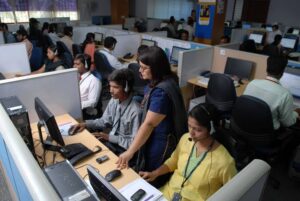
Here’s what the AI layoff panic obscures. The bigger disruption isn’t happening to people who already have jobs. It’s happening to people who are trying to get their first one. Firms across India’s IT-BPM, customer support, finance operations, and analytics sectors, the traditional entry points into formal employment for educated youth, have quietly frozen or slashed entry-level hiring even where they haven’t announced mass layoffs.
An ICRIER survey of 651 IT companies found entry-level recruitment was the worst-affected segment, as firms increasingly prioritize specialized AI skills over conventional programming roles. The mechanism is straightforward. For years, Indian firms hired fresh graduates with low initial productivity, invested in structured training, and scaled them into higher-value roles over time. AI assistants that let existing developers work faster, combined with autonomous agents resolving routine customer interactions, mean firms now need fewer entry-level workers to produce the same output. The layoffs may not come. But the offer letters increasingly don’t either.
Why This Matters More Than Any Single Layoff Round
India adds 8 to 10 million new job seekers to its workforce every single year, according to World Bank and ILO estimates. That’s not a one-time shock like a round of layoffs. It’s a permanent, compounding pressure that requires the economy to generate meaningful new employment continuously, year after year, just to keep pace.
Against that backdrop, the fresher hiring freeze is a genuinely systemic challenge in a way that even a large layoff round isn’t. A worker who loses an existing job at least has work experience, a professional network, and often severance to fall back on while searching for the next role. A graduate who simply never gets hired in the first place has none of that. They exit the formal education system with credentials but no pathway into it. Multiply that by millions of young people every year, and you get a slow-building crisis that’s arguably more dangerous to India’s long-term economic trajectory than any single company’s layoff announcement.
The Numbers Behind India’s Jobless Growth
The “State of Working India 2026” report puts hard numbers to what many young Indians already sense intuitively. Fewer than 7% of male graduates secured a permanent, salaried job within one year of graduating in 2023. Roughly 40% of young graduates remain unemployed altogether. A university degree, once a near-guarantee of upward mobility into India’s middle class, no longer functions that way for a large share of India’s youth.
This pattern has a name among economists: jobless growth, meaning India’s GDP keeps expanding while job creation fails to keep pace with the number of people entering the workforce. PLFS data from 2023 to 2025 shows rising urban and youth unemployment alongside declining labour force participation in key segments, even as headline growth numbers stay respectable. Average monthly income from self-employment has actually dropped in recent years, according to PLFS figures, pointing to underemployment, people technically counted as working, but in low-quality, low-paying, often informal roles that don’t match their skills or aspirations.
Nearly 90% of India’s Workforce Works Informally
Perhaps the starkest number in this entire picture: nearly 90% of India’s workforce remains employed in the informal sector, often without stable wages, job security, or any form of social protection. Agriculture alone still employs around 43% of India’s workforce, even though its share has declined from 66% in 1987-88. That’s real structural progress over four decades, but the pace has been agonizingly slow relative to the number of people who need somewhere better to go.
What’s often described as “disguised unemployment” compounds the problem specifically within agriculture. More people work the land than are actually needed to produce current output, meaning marginal productivity for a large share of agricultural workers is effectively zero. Removing these workers wouldn’t reduce farm output at all, evidence that agriculture is functioning less as a genuine employer and more as a holding pattern for people who can’t find work anywhere else.
A Paradox: Layoffs and a Skills Shortage, Simultaneously
Adding to the complexity, India is dealing with what analysts have called an “AI jobs paradox.” The country has recorded among the highest tech layoff numbers globally this year, yet demand for AI-skilled professionals is rising roughly 2.5 times faster than the global average, according to Stanford’s AI Index. A joint estimate from NASSCOM, McKinsey, and NITI Aayog warns India could face a shortage of 1.4 million AI professionals by the end of 2026 if the workforce doesn’t rapidly upskill.
That paradox, mass layoffs and a severe skills shortage happening at the same time, captures the deeper problem better than any single statistic could. India isn’t simply short on jobs. It’s short on the right kind of match between what workers can do and what a rapidly changing economy actually needs, a mismatch that predates generative AI and that AI is now accelerating rather than creating from scratch.
What Workers Have Told Researchers Directly
Beyond the aggregate statistics, individual accounts add texture to this data. Workers who spoke to labour advocacy groups described an oppressive climate around raising concerns about AI-driven restructuring, with some alleging that industry associations foster environments where employees who speak out face professional retaliation. Without collective bargaining mechanisms common in some other countries, decisions about how AI reshapes jobs are typically made unilaterally by employers, often treating AI purely as a cost-cutting tool rather than a genuine productivity partnership with the existing workforce.
Economists have also flagged the downstream, ripple effects of this uncertainty. Reduced disposable income among affected workers can dampen broader consumption, creating knock-on effects across other sectors of the economy that depend on that spending, from retail to real estate to services. A jobs problem, in other words, doesn’t stay contained to the sector where it starts.
Why India’s Demographic Dividend Is at Risk
India’s working-age population is projected to keep rising until around 2030, after which it will begin to decline, a narrowing window during which the country’s youthful population could either become its greatest economic asset or, if mishandled, a significant liability. Of the roughly 367 million young people currently outside the formal education system, a large share are unskilled or semi-skilled, dependent on informal or irregular work that’s becoming scarcer as automation and AI compress the traditional entry-level job market.
This is the stake that makes this India deeper employment problem so much bigger than any single sector’s AI anxiety. A demographic dividend, a large working-age population relative to dependents, only pays off economically if that population is productively employed. If a meaningful share of India’s youth instead ends up underemployed, informally employed, or simply unable to find first jobs at all, the same demographic bulge that could power decades of growth instead becomes a source of social and economic strain.
Key Talking Points
1. AI Is Accelerating a Pre-Existing Problem, Not Creating a New One
India’s structural employment challenges, informal work, jobless growth, weak entry-level absorption, existed well before generative AI became a mainstream business tool. AI is compressing timelines and sharpening these existing fault lines rather than introducing an entirely new crisis.
2. The Fresher Hiring Freeze Deserves as Much Attention as Layoffs
Because it doesn’t generate a single dramatic headline the way a mass layoff does, the slow, quiet freeze on entry-level hiring gets far less policy and media attention than it deserves, despite arguably affecting a larger number of people over time.
3. Skills Mismatch, Not Just Job Scarcity, Is the Core Issue
The simultaneous existence of layoffs and a severe AI talent shortage shows this isn’t purely a numbers problem. It’s a mismatch between the skills India’s education system produces and the skills its economy increasingly demands.
India’s Deeper Employment Problem: Frequently Asked Questions (FAQs)
What is India’s deeper employment problem, beyond AI layoffs?
India’s deeper employment problem centers on structural jobless growth, a shrinking entry-level hiring market for fresh graduates, and a workforce that remains nearly 90% informal, challenges that predate and extend well beyond current AI-linked layoffs.
How many young graduates in India are unemployed?
According to the State of Working India 2026 report, around 40% of young graduates remain unemployed, while fewer than 7% of male graduates secure a permanent salaried job within a year of graduating.
Is AI actually causing India’s unemployment crisis?
AI is accelerating existing structural problems, particularly by reducing entry-level hiring in IT-BPM and services, but researchers note India’s jobless growth and informal employment challenges predate the current wave of AI adoption.
What percentage of India’s workforce is informally employed?
Nearly 90% of India’s workforce works in informal jobs, often without stable wages, job security, or social protections.
Why is India facing both layoffs and an AI skills shortage at the same time?
This paradox reflects a skills mismatch rather than simple job scarcity: India’s education system isn’t producing AI-ready talent fast enough, even as automation reduces demand for conventional entry-level roles.
Conclusion — Look Past the Headlines to the Real Crisis
The AI layoff panic dominating headlines is real, but it’s also, in a sense, a distraction from the bigger picture. This India deeper employment problem, a structural mismatch between millions of young job seekers and a shrinking pool of quality entry-level opportunities, has been building for years and will likely persist regardless of how any single company’s AI strategy plays out. Addressing it will require far more than reacting to individual layoff headlines: rethinking how India’s education system prepares graduates, expanding formal-sector job creation beyond IT services, and treating the fresher hiring freeze as the systemic crisis it actually is, rather than a footnote to the AI story dominating the news cycle.
Stay tuned to Mirrorly.in for more coverage of India’s economy and employment trends.
📖 Also Read: X Android App Rebuild Complete: Elon Musk’s X Unveils Faster, Smoother App After Major Revamp