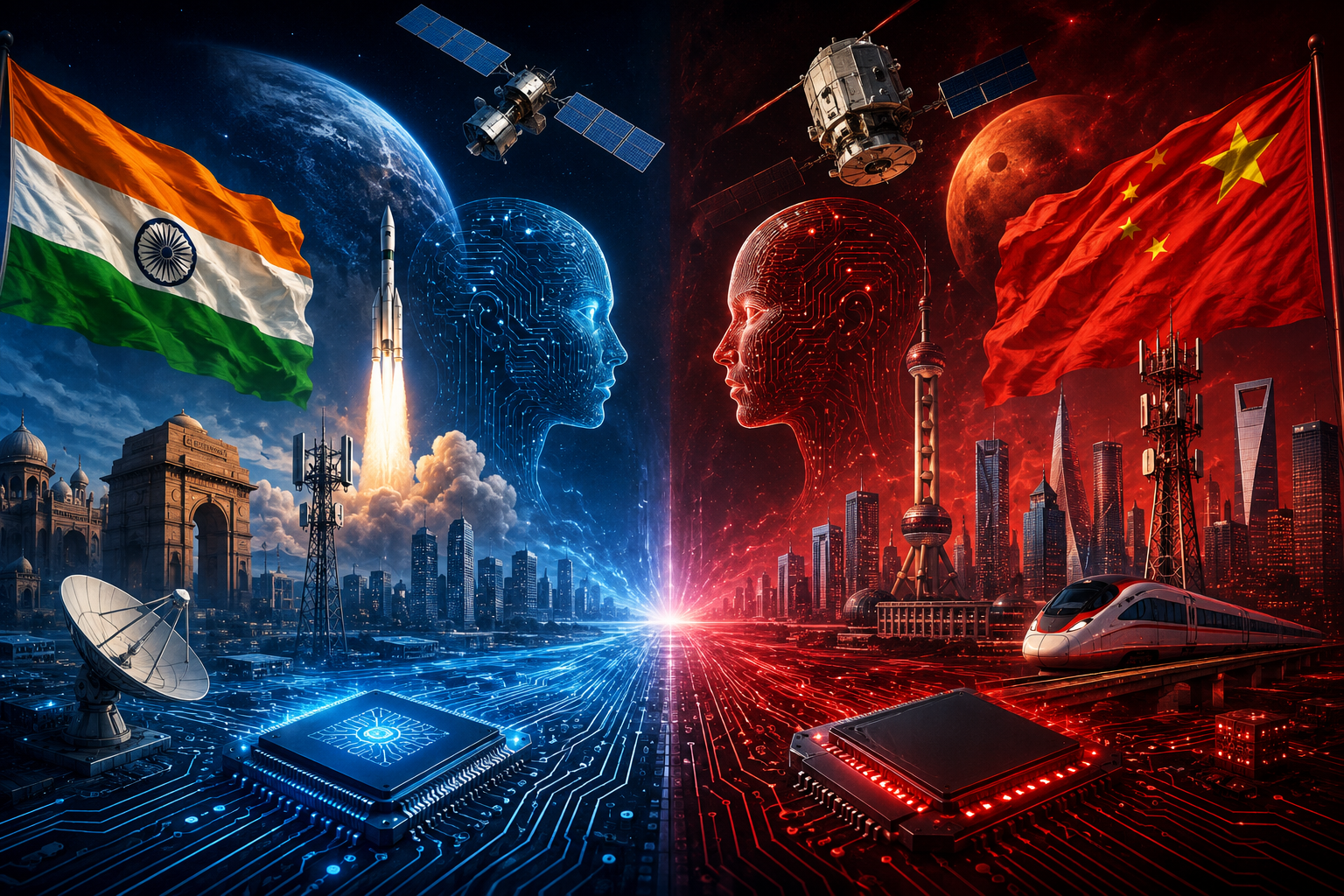
The India China technology race in 2026 is one of the most consequential rivalries in the world today. Furthermore, it is no longer just about who builds faster phones or cheaper electronics — it is about who controls the future of artificial intelligence, semiconductor chips, space exploration, and digital infrastructure. Moreover, the outcome of this race will determine which country emerges as Asia’s dominant technology superpower in the coming decades.
In 2026, both India and China are investing billions of dollars in technology. China leads in many critical areas — from AI models to semiconductor manufacturing to 5G deployment. However, India is rapidly closing the gap in key sectors, backed by major investments, a massive talent pool, and powerful new alliances with the United States and Western democracies.
Here is your complete guide to the India China technology race 2026 — sector by sector, number by number, and country by country.
📖 Also Read: Xiaomi 17T Review India 2026 — Leica Camera Without Flagship Price
India vs China Technology Race 2026 — Quick Comparison
| Sector | 🇮🇳 India | 🇨🇳 China |
| AI Models | Growing — IndiaAI Mission | Leading — DeepSeek, Qwen3 |
| Semiconductors | Emerging — Tata fab starting | Advanced — Huawei 910C chip |
| 5G / 6G | 5G expanding fast | Leading in 6G research |
| Space | ISRO — cost-effective missions | CNSA — heavy investment |
| Tech Investment | $400B pledged — AI Summit | Billions in state funding |
| Talent Pool | Largest IT workforce globally | Large but exodus concerns |
| Digital Payments | UPI — world’s best system | WeChat Pay dominant |
| Critical Tech Lead | 3 of 24 critical technologies | 19 of 24 critical technologies |
1. Artificial Intelligence — China Leads, India Catching Up
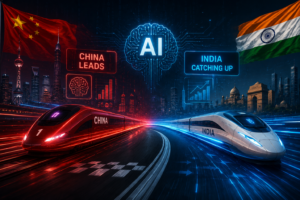
Artificial intelligence is the defining technology of 2026 — and China currently leads India significantly in this race. According to assessments by Bloomberg and ASPI, China leads in 19 out of 24 critical technologies globally — including AI. Moreover, China’s DeepSeek R1 — released in 2025 — was the single most disruptive AI model of the year, matching GPT-4 performance at a fraction of the training cost, and it was open-sourced to the world.
Furthermore, Alibaba’s Qwen3 models compete directly with Western closed models and are available for open use. China is winning the open-source AI model race by a significant margin. In addition, China has invested heavily in AI-powered military systems, autonomous manufacturing, and smart city infrastructure that is deployed and operating — not just theoretical.
India’s AI Push in 2026:
However, India is not standing still. The India AI Mission — approved in 2024 with Rs 10,300 crore over five years — is building shared AI computing infrastructure. Furthermore, India now provides access to 38,000 GPUs and 1,050 TPUs at subsidised rates to Indian enterprises and startups.
Moreover, the India AI Impact Summit 2026 — held in New Delhi in February — was a landmark event. Sam Altman, Sundar Pichai, and French President Macron attended. Furthermore, OpenAI partnered with Tata, Anthropic partnered with Infosys, and Google committed $15 billion to India. Investment pledges exceeded $210 billion across the AI stack.
India’s AI Advantages:
- World’s largest pool of software engineers and AI talent
- BHASHINI platform — AI tools for India’s 22 official languages
- Massive domestic market for AI deployment
- Ola Krutrim’s ‘Bodhi’ AI chips — launching 2026
- Strong startup ecosystem — growing rapidly
China’s AI Advantages:
- DeepSeek R1 — world’s most efficient open-source AI model
- Alibaba Qwen3 — competing with top global AI models
- Massive state funding for AI research and deployment
- AI-powered manufacturing already deployed at scale
- World’s largest AI data infrastructure
📖 Source: EE Times — India AI Impact Summit 2026 Full Coverage
2. Semiconductors — The Most Critical Battle
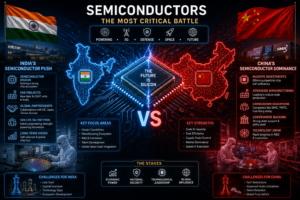
Semiconductors are the foundation of all modern technology — and this is where the India China technology race 2026 is most intense. Furthermore, whoever controls chip manufacturing controls the future of AI, defence, telecommunications, and the global economy.
China’s Semiconductor Position:
China is making significant progress in building semiconductor independence. Huawei’s 910C chip and the CloudMatrix 384 system are genuine competitors to Nvidia’s hardware. Furthermore, Chinese firms ordered over 2 million H200 chips for delivery in 2026 — showing the scale of China’s AI compute ambitions. Moreover, Beijing now requires state-funded AI data centres to use domestically produced chips wherever possible.
However, China still faces significant challenges. US export controls have restricted access to the most advanced chip-making equipment. Furthermore, TSMC’s most advanced processes remain out of reach for Chinese manufacturers, limiting their ability to produce the most advanced chips.
India’s Semiconductor Push:
India has invested $20 billion in semiconductor manufacturing — and the results are beginning to show. Tata Electronics has started building India’s first semiconductor fabrication facility. Furthermore, in 2024, India and the US agreed to build a joint semiconductor fab in Jewar, Uttar Pradesh, focused on defence and space-grade chips.
Moreover, India’s semiconductor strategy focuses on the ‘China Plus One’ advantage — offering global tech companies an alternative manufacturing base outside China. By 2028, experts predict India will move beyond trial production into sub-14nm nodes, competing for high-end mobile and AI chip markets.
India’s Semiconductor Advantages:
- $20 billion investment — Tata, Micron, Applied Materials all committed
- US-India joint fab in Jewar, UP — defence and space chips
- India Semiconductor Mission — building long-term chip self-reliance
- China Plus One strategy — global companies choosing India over China
- RISC-V chip architecture — India developing processors without Western IP
3. Space Technology — ISRO vs CNSA
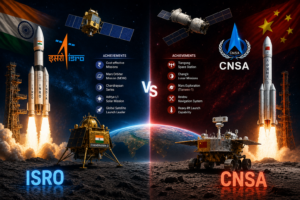
Space is another critical frontier in the India China technology race 2026. Both countries have ambitious space programmes — but they approach it very differently.
India’s Space Achievements:
- Chandrayaan-3 — first country to land near the lunar south pole in 2023
- Aditya-L1 — India’s first solar observatory mission, launched 2023
- Gaganyaan — India’s first human spaceflight mission underway
- ISRO is the world’s most cost-effective space agency
- Private space sector — IN-SPACe policy driving startup ecosystem
- India-US space cooperation — Artemis Accords signatory
China’s Space Achievements:
- Tiangong Space Station — fully operational in 2022
- Chang’e-6 — first mission to return samples from lunar far side
- Tianwen-1 — Mars orbiter and rover, both successful
- Massive budget — far larger than ISRO’s resources
- Plans for crewed Moon landing by 2030
- BeiDou navigation system — alternative to GPS now fully operational
China’s space programme is larger, better funded, and more advanced in certain areas. However, India’s cost-effectiveness and growing private sector make ISRO a formidable competitor, particularly for commercial launches and planetary exploration.
4. Digital Infrastructure — India’s UPI vs China’s WeChat
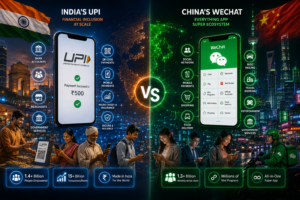
In digital payments and infrastructure, India has built something genuinely world-class. The Unified Payments Interface — UPI — is widely considered the best digital payments system in the world. Furthermore, India processes over 10 billion UPI transactions per month in 2026, and the system is being adopted by multiple countries worldwide.
China’s WeChat Pay and Alipay are also highly advanced digital payment systems. However, concerns about data privacy, state surveillance, and international trust have limited their global adoption outside China’s sphere of influence. Moreover, India’s UPI is now being positioned as a global public good — available for any country to adopt.
India’s Digital Infrastructure Wins:
- UPI — 10+ billion monthly transactions, exported to 10+ countries
- Aadhaar — world’s largest biometric ID system — 1.4 billion enrolled
- DigiLocker — national document management platform
- ONDC — Open Network for Digital Commerce — disrupting e-commerce
- India Stack — global model for digital public infrastructure
5. The Pax Silica Factor — India’s Strategic Alliance
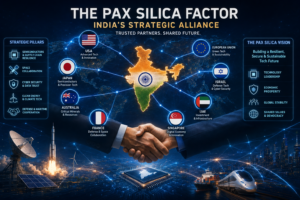
One of the most significant developments in the India China technology race 2026 is India’s decision to join Pax Silica — the US-led framework for securing semiconductor and AI supply chains. US Ambassador Sergio Gor confirmed India’s membership, calling India’s role strategically essential.
Pax Silica spans critical minerals, semiconductor supply chains, sovereign compute infrastructure, and enterprise AI partnerships. Furthermore, India has identified 5.9 million tons of lithium resources in Jammu and Kashmir and is negotiating mineral agreements with Australia, Namibia, and the Democratic Republic of Congo. These steps aim to reduce dependence on China, which supplies over 90 percent of India’s rare earth materials.
“Pax Silica strengthens India’s digital sovereignty by ensuring secure access to semiconductors and AI infrastructure, which are now critical to defence, telecom, mobility, and economic growth.” — Indian Union Minister Ashwini Vaishnaw
India China Technology Race 2026 — Who Is Winning?
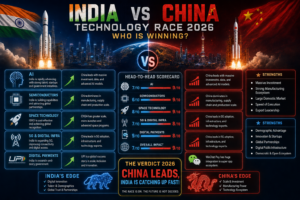
The honest answer is that China is currently ahead of India in most technology sectors. According to Bloomberg and ASPI assessments, China leads in 19 out of 24 critical technologies — from 5G to batteries to hypersonics. Furthermore, China’s domestic semiconductor capability, AI model development, and manufacturing scale are all significantly ahead of India’s current position.
However, India is not losing — it is playing a different game. Furthermore, India’s strengths are in areas where China faces significant weaknesses: international trust, democratic governance, English-language capability, software engineering talent, and strategic alignment with the world’s most advanced democracies.
India Leads China In:
- Software engineering talent — world’s largest IT workforce
- Digital public infrastructure — UPI, Aadhaar, India Stack
- International trust and partnerships — US, EU, Japan allies
- Cost-effective space exploration — ISRO’s track record
- English-language AI and tech ecosystem
- Democratic governance — trusted by global companies
China Leads India In:
- AI model development — DeepSeek, Qwen3, Baidu ERNIE
- Semiconductor manufacturing — Huawei chips, domestic fabs
- 5G and 6G deployment — world’s most advanced networks
- Manufacturing scale — world’s factory for electronics
- State investment scale — far larger government budgets
- Critical technology dominance — 19 of 24 sectors
Conclusion — India China Technology Race 2026
The India China technology race in 2026 is one of the defining geopolitical stories of our time. China currently leads in most technology sectors — but India is rapidly building its capabilities, forming powerful alliances, and leveraging its unique strengths in talent, digital infrastructure, and global trust.
Furthermore, the race is not a simple winner-takes-all contest. India and China may emerge as leaders in different parts of the technology ecosystem — China dominating hardware manufacturing and state-driven AI, while India leads in software, talent, digital public infrastructure, and trusted global partnerships.
In conclusion, the next five years will be decisive. India’s $400 billion AI investment commitments, semiconductor mission, and Pax Silica membership suggest a country that is serious about competing at the highest level. However, China’s lead is real and significant — and closing that gap will require sustained effort, investment, and execution. Stay tuned to Mirrorly.in for all the latest technology news and global affairs updates!