AI Technology Is Upgrading Faster Than Ever — Here Is What It Means for Your Future: Benefits, Risks and What Students Must Do Now

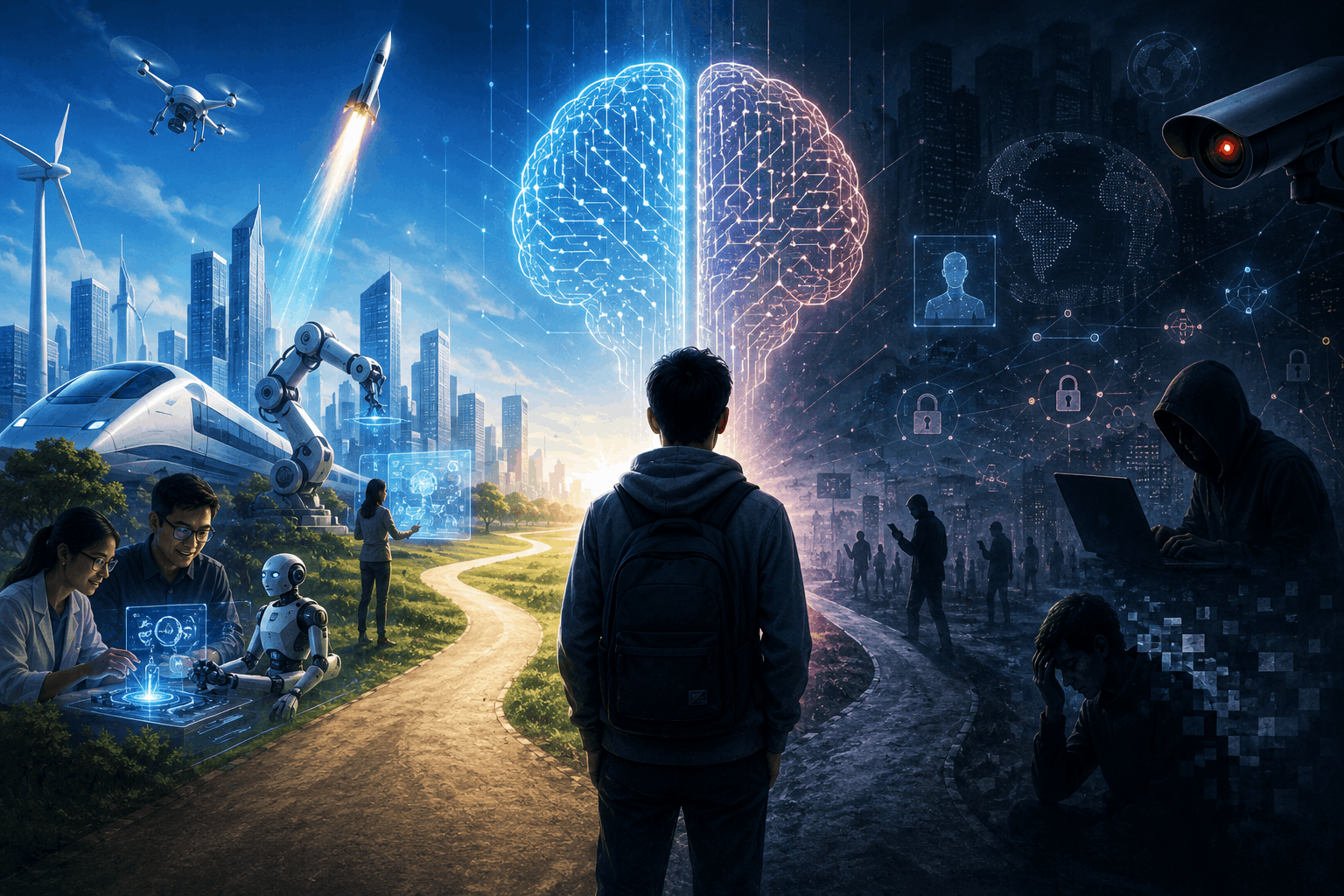
Artificial Intelligence is no longer a science fiction concept or a future possibility — it is already here, already reshaping every industry, and already making decisions that affect your daily life. The AI technology future is arriving faster than anyone predicted. Furthermore, in 2026, AI upgrades faster than any technology in human history — every few months, a new model arrives that is smarter, faster, and more capable than everything before it. Moreover, ChatGPT, Gemini, Claude, Sora, Copilot — these are not just apps. They are the beginning of a fundamental shift in how humans work, learn, create, and live.
For students and young people, the AI technology future carries both enormous promise and genuine risk. Furthermore, the decisions you make in the next five years — about what you learn, what skills you build, and how you adapt — will determine whether AI works for you or against you. Moreover, this blog gives you an honest, balanced picture: the real benefits AI brings to your future, the real risks you need to take seriously, and the practical steps you must take right now to stay ahead.
📖 Also Read: PM Modi in Seychelles: Indian Ocean as Ocean of Opportunity — MAHASAGAR and What It Means
AI Technology and the Future — At a Glance
| What Is AI? | Technology that enables machines to think, learn, create, and solve problems — tasks previously requiring human intelligence |
| Current Stage (2026) | Advanced AI models can write, code, design, diagnose, compose music, pass medical exams and generate video |
| Speed of Change | Faster than any previous technology — new major AI model every 3–6 months |
| Jobs AI Will Eliminate | Data entry, basic coding, content writing, customer service, translation, accounting — millions of routine jobs |
| Jobs AI Will Create | AI trainers, prompt engineers, AI ethicists, human-AI collaboration roles, creative directors, complex problem solvers |
| Biggest Opportunity | Students who learn to USE AI become 10x more productive than those who do not |
| Biggest Risk | Students who ignore AI get left behind — in education, career, and income |
| Your Decision Window | The next 3–5 years determine which side of the AI divide you end up on |
Note: This blog presents a balanced view of AI’s impact on the future. The field is evolving rapidly — some predictions may change as technology develops. Always verify current AI capabilities and limitations from credible sources.
AI Technology Future — How Fast Is AI Upgrading? A Simple Timeline

To understand why the AI technology future matters so much for your career and education, you first need to understand the speed at which it has advanced — and continues to advance. Furthermore, no technology in history has improved this rapidly in this short a time. Moreover, what took the internet two decades to achieve, AI accomplished in under five years.
| Year | What AI Could Do |
| 2018 | Answer basic questions, translate text, recognise images |
| 2020 | Write basic articles, generate simple code, hold basic conversations |
| 2022 | ChatGPT launches — pass university essays, write professional emails, debug code |
| 2023 | Generate realistic images, compose music, pass medical and law exams |
| 2024 | Generate full videos, conduct scientific research, write entire software applications |
| 2025 | AI agents autonomously complete multi-step tasks without human intervention |
| 2026 | AI co-pilots work alongside professionals in medicine, law, finance, education and engineering — every major industry |
Notably, each step in this timeline took roughly one year or less. Furthermore, AI researchers widely agree that the pace of improvement is not slowing down — if anything, it is accelerating. Moreover, by 2030, AI capabilities that seem extraordinary today may become routine tools that every professional is expected to use daily.
AI Technology Future: Benefits for Students and Youth
Positive 1 — AI Technology Future: Personalised Learning for Every Student
One of the most transformative effects of AI on education is the shift toward truly personalised learning. Furthermore, traditional classrooms teach 40 students at the same pace with the same content — regardless of how fast or slow each individual learns, or what each student already knows. Moreover, AI changes this completely.
AI-powered tutoring tools already adapt to each student’s learning pace, identify gaps in understanding, and generate customised explanations, practice problems, and feedback in real time. Specifically, a student who struggles with algebra no longer has to wait for a teacher who may not have time for individual attention — they get an AI tutor available 24/7 that explains the same concept ten different ways until the student understands. In addition, students in rural India or smaller towns gain access to the same quality of educational support as students in elite urban schools with expensive coaching. As a result, AI has the potential to be the great equaliser in Indian education — breaking the link between quality of education and geography or economic status.
AI Tools Already Changing Education:
- Khan Academy’s Khanmigo — AI tutor that teaches every subject with Socratic questioning
- Duolingo AI — personalises language learning based on your specific mistake patterns
- Photomath / Wolfram Alpha — explains math step by step from a photo of the problem
- ChatGPT / Claude — instant doubt clearing, essay feedback, concept simplification
- Google NotebookLM — turns your study notes into personalised study guides and quizzes
Positive 2 — AI Technology Future: New Career Opportunities
Every major technological revolution in history — the industrial revolution, the internet boom, the mobile revolution — destroyed some jobs and created far more new ones. Furthermore, AI follows this same historical pattern. Moreover, while AI eliminates routine, repetitive tasks, it simultaneously creates entirely new categories of work that did not exist before.
In 2026, some of the fastest-growing and highest-paying jobs globally involve AI directly. Specifically, prompt engineers — people who know how to communicate effectively with AI models to get the best outputs — earn salaries that rival software engineers. In addition, AI trainers, AI ethicists, human-AI collaboration specialists, and AI product managers all represent new career paths that did not exist five years ago. As a result, students who build AI skills now enter a job market where their abilities command significant premium salaries.
New Careers AI Creates — 2026 and Beyond:
| New AI Career | What They Do | Why It Pays Well |
| Prompt Engineer | Designs effective instructions for AI models to produce optimal outputs | High demand, very few people trained in this skill |
| AI Trainer / Data Annotator | Teaches AI models by labelling data and providing feedback on AI outputs | Every AI company needs thousands of trainers |
| AI Product Manager | Manages the development and deployment of AI-powered products | Bridge between tech and business — extremely scarce |
| AI Ethicist | Ensures AI systems behave fairly, safely, and without harmful bias | Governments and companies face legal pressure to hire these roles |
| Human-AI Collaboration Specialist | Designs workflows where humans and AI work together most effectively | Every company integrating AI needs this expertise |
| AI Content Strategist | Directs AI-generated content with human creative judgment and brand voice | AI produces content but humans still direct strategy |
Positive 3 — AI Technology Future: 10x Productivity for Students
Perhaps the most immediate benefit of AI for students and young professionals is a dramatic increase in personal productivity. Furthermore, tasks that previously took hours — research, summarising, drafting, translating, coding, designing — now take minutes with AI assistance. Moreover, this is not about replacing your effort — it is about amplifying what you can achieve in the same amount of time.
A student using AI for research can cover ten times more sources in the same time. Specifically, a young entrepreneur can build a professional website, create marketing content, generate a business plan, and set up automated customer service — all using AI tools — in a single weekend, for near zero cost. In addition, a developer who uses AI coding assistants writes code two to three times faster than one who does not. As a result, AI functions as a personal team of assistants — a researcher, a writer, a designer, a coder, a translator — available to every student regardless of their economic background.
Positive 4 — AI Technology Future: Breakthroughs in Healthcare and Science
Beyond individual careers, AI drives breakthroughs that benefit all of humanity. Furthermore, in medicine, AI already detects cancers in scans more accurately than experienced radiologists, predicts drug interactions, and accelerates drug discovery from decades to years. Moreover, in climate science, AI models process satellite data to predict weather patterns, track deforestation, optimise renewable energy grids, and model climate scenarios at a scale no human team could manage.
Specifically, AlphaFold — an AI developed by Google DeepMind — solved the protein folding problem that scientists had worked on for 50 years. In addition, AI-powered climate models help governments design smarter, more targeted environmental policies. As a result, the generation of students alive today may see AI help solve problems — climate change, antibiotic resistance, cancer, food security — that previous generations considered nearly insurmountable.
AI Technology Future: Real Risks You Should Know
Risk 1 — AI Technology Future: Job Elimination at Massive Scale
The uncomfortable truth about the AI technology future that no one likes to say plainly: AI will eliminate a significant number of jobs — and many of those jobs belong to the career paths that students currently study toward. Furthermore, this is not a distant future concern — it is already happening. Moreover, companies across the world already use AI to replace content writers, data analysts, customer service agents, basic accountants, translators, and entry-level coders.
The World Economic Forum estimates that AI and automation will displace 85 million jobs globally by 2025 — a number that grows every year as AI capabilities expand. Specifically, jobs most at risk are those involving repetitive tasks, pattern recognition, data processing, and basic writing — which includes a significant portion of white-collar office work. In addition, even creative fields previously considered AI-proof — graphic design, music composition, journalism — face disruption as generative AI produces competitive outputs at near-zero cost. As a result, students who spend years training for a specific skill set without building adaptability risk graduating into a job market where their primary skill no longer commands the value it once did.
Jobs at High Risk from AI — By 2030:
| Job / Role | Risk Level | Why AI Threatens It |
| Data Entry Operator | 🔴 Very High | AI reads, processes and enters data faster and cheaper |
| Basic Content Writer | 🔴 Very High | Generative AI writes at scale, instantly, for near zero cost |
| Customer Service Agent | 🔴 Very High | AI chatbots handle 80%+ of customer queries without fatigue |
| Basic Accountant / Bookkeeper | 🔴 Very High | AI automates financial reporting, reconciliation and tax filing |
| Translator | 🟠 High | AI translation reaches near-human quality for common languages |
| Junior Software Developer | 🟠 High | AI coding assistants reduce need for entry-level coders significantly |
| Graphic Designer (Basic) | 🟠 High | AI image generation tools produce professional visuals in seconds |
| Radiologist (Basic Screening) | 🟡 Medium | AI detects anomalies in scans accurately — but complex cases still need humans |
| Teacher (Traditional Lecturing) | 🟡 Medium | AI tutors deliver personalised instruction — but mentorship and inspiration remain human |
Risk 2 — AI Technology Future: Students Losing the Habit of Deep Thinking
One of the most serious risks of AI for students is not economic — it is cognitive. Furthermore, when a student uses AI to write every essay, solve every problem, and answer every question, they outsource the very mental effort that builds intelligence, critical thinking, and genuine understanding. Moreover, the brain, like a muscle, develops through struggle — and AI removes the productive struggle that makes learning effective.
Research from Harvard and MIT in 2025 showed that students who relied heavily on AI tools for assignments scored significantly lower on unassisted tests of the same material than students who used AI sparingly. Specifically, AI gives you the fish — but prevents you from learning to fish. In addition, employers in 2026 increasingly test candidates on their ability to think critically and solve novel problems without AI assistance — precisely because they know AI has made surface-level competence easy to fake. As a result, students who use AI as a crutch rather than a tool risk building hollow knowledge — impressive on the surface, empty underneath.
Risk 3 — AI Technology Future: Misinformation, Deepfakes and Manipulation
AI does not only produce helpful content — it also produces convincing false content at industrial scale. Furthermore, deepfake technology allows anyone to create realistic videos of real people saying things they never said. Moreover, AI-generated misinformation spreads across social media faster than fact-checkers can correct it — and the average person struggles to distinguish real from AI-generated content without specific training.
For young people, this creates serious risks. Specifically, deepfake audio and video of students and young people appear in harassment campaigns and online abuse. In addition, AI-generated fake news directly influences political opinions and elections — and young voters who consume information primarily through social media are among the most exposed to this manipulation. As a result, media literacy — the ability to critically evaluate digital content — becomes one of the most important survival skills of the AI age.
Risk 4 — AI Technology Future: Privacy and Surveillance Dangers
AI systems learn from data — and the data they most urgently want is yours. Furthermore, every app you use, every search you make, every video you watch, and every message you send feeds data into AI systems that build increasingly detailed profiles of your behaviour, preferences, health, relationships, and beliefs. Moreover, in 2026, AI-powered surveillance systems can track individuals across cameras in public spaces, analyse facial expressions, predict behaviour, and flag individuals for attention — all without their knowledge or consent.
Specifically, young people share significantly more personal data online than older generations — through social media, fitness apps, food delivery services, entertainment platforms, and messaging apps. In addition, this data does not disappear — it builds a permanent digital profile that companies, governments, and potentially bad actors can access and use. As a result, understanding digital privacy and practising basic data hygiene becomes not optional but essential for young people navigating an AI-saturated world.
Risk 5 — AI Technology Future: Growing Inequality in Access
AI has enormous potential to democratise opportunity — but it also carries the risk of deepening existing inequalities. Furthermore, the most powerful AI tools cost money, require reliable internet access, and demand digital literacy that not every student in India has. Moreover, students in urban, well-connected, English-speaking environments gain full access to AI’s benefits — while students in rural areas with poor connectivity, limited digital skills, or no English proficiency risk getting left further behind.
As a result, if governments, schools, and families do not actively invest in bringing AI literacy and access to all students — not just privileged ones — AI will widen India’s existing digital divide rather than close it. Notably, this is why initiatives like PM Modi’s commitment to deliver AI education to 4 million government school students (announced during the Seychelles visit) matter — because access to AI tools and AI literacy must reach every student, not only those who can afford it.
AI Technology Future Impact on Specific Areas of Your Life
| Area of Life | How AI Changes It (Positive) | How AI Changes It (Risk) |
| Education | Personalised tutoring, instant doubt clearing, adaptive learning | Over-reliance reduces deep thinking and genuine understanding |
| Career / Jobs | New AI careers, 10x productivity boost for AI-literate workers | Eliminates routine jobs — millions displaced without reskilling |
| Healthcare | Earlier diagnosis, personalised treatment, faster drug discovery | AI diagnosis errors, over-dependence on AI without human doctors |
| Creativity | AI tools help anyone create music, art, video, writing easily | Mass AI content floods internet — genuine human creativity undervalued |
| Information | Instant access to knowledge, research summaries, language translation | Deepfakes and AI misinformation make truth harder to verify |
| Privacy | AI-powered security tools protect personal data | AI surveillance systems and data harvesting erode personal privacy |
| Social Life | AI tools bridge language barriers, connect people globally | AI companions and addictive algorithms reduce real human connection |
| Environment | AI optimises energy use, tracks climate, powers renewable grids | AI data centres consume massive amounts of electricity and water |
How Students Can Prepare for the AI Technology Future? — 6 Practical Steps
Step 1 — Learn to Use AI Tools — But Do Not Depend on Them
The most important thing any student can do right now is become genuinely comfortable with AI tools — not as a shortcut, but as a power amplifier. Furthermore, learn how to use ChatGPT, Claude, Gemini, Copilot, and other AI tools for research, brainstorming, feedback, and productivity. Moreover, treat AI the way a professional treats a calculator — use it for efficiency, but make sure you understand the underlying principles yourself. As a result, you become someone who directs AI, not someone who is replaced by it.
Step 2 — Build Skills AI Cannot Easily Replace
Certain human skills remain deeply difficult for AI to replicate — and these are the skills worth investing in most heavily. Furthermore, critical thinking, emotional intelligence, creative problem solving, leadership, ethical judgment, and the ability to build genuine human relationships all require qualities that AI currently lacks. Moreover, communication skills — the ability to persuade, inspire, and connect with other people — become more valuable, not less, in a world where AI handles routine communication tasks.
Skills That Protect You in the AI Age:
- Critical thinking — the ability to evaluate information and spot flaws in arguments
- Emotional intelligence — understanding and managing your emotions and others’
- Complex problem solving — tackling novel, multi-dimensional challenges AI cannot frame
- Communication and persuasion — writing, speaking, and connecting with impact
- Leadership and team building — motivating, organising, and inspiring people
- Ethical judgment — deciding what is right when rules do not provide a clear answer
- Domain expertise — deep knowledge in a specific field that contextualises AI outputs
Step 3 — Develop Media Literacy — Learn to Spot AI-Generated Fakes
In a world where AI generates realistic text, images, audio, and video, the ability to critically evaluate digital content becomes a core life skill. Furthermore, learn to check sources before sharing news, use reverse image search to verify photos, look for inconsistencies in supposedly real videos, and cross-check facts across multiple credible sources. Moreover, platforms like Google and Meta now label AI-generated content in many cases — but this labelling is imperfect and easily bypassed. As a result, building your own critical evaluation habits matters more than relying on platforms to do it for you.
Step 4 — Protect Your Digital Privacy
- Review which apps have access to your location, microphone, and camera
- Use strong, unique passwords and enable two-factor authentication everywhere
- Think before sharing personal information — especially health, financial, or location data
- Understand that “free” apps typically pay for themselves with your data
- Read privacy policies — at least the summary — before using new platforms
Step 5 — Learn Basic AI and Data Concepts — Even If You Are Not a Tech Student
You do not need to become a machine learning engineer to thrive in an AI world — but you do need a basic understanding of how AI works, what it can and cannot do, and how to direct it effectively. Furthermore, free resources like Google’s “AI Essentials” course, Microsoft’s AI learning paths, and Coursera’s AI for Everyone (by Andrew Ng) give non-technical students a working understanding of AI in under 10 hours. Moreover, this knowledge makes you a more capable user of AI tools and a more informed citizen in an AI-governed world.
Step 6 — Stay Curious and Keep Learning — Always
The most important career skill in the AI age is not any specific technical ability — it is the ability and willingness to keep learning. Furthermore, the skills most valued in the job market in 2030 may not even exist as formal courses today — just as prompt engineering did not exist as a course in 2020. Moreover, students who build the habit of continuous learning — who stay curious, read widely, experiment with new tools, and adapt quickly — will always find opportunities regardless of how rapidly AI advances.
AI Technology Future — Frequently Asked Questions (FAQs)
Will AI take away all jobs in the future?
No — but the AI technology future will fundamentally change what most jobs involve. Furthermore, history shows that every major technology wave eliminates some jobs and creates far more new ones over time. Moreover, the jobs AI eliminates tend to be routine, repetitive, and rules-based — while the jobs it creates demand creativity, complex judgment, and human connection. The key is building skills in the second category, not the first.
Should students use AI for their studies?
Yes — but smartly. Furthermore, AI tools are genuinely useful for research, getting feedback on writing, clearing doubts, and exploring concepts from multiple angles. Moreover, the critical rule is this: use AI to deepen your understanding, not to bypass it. If you use AI to write your essay without engaging with the ideas yourself, you gain a grade but lose the learning — and the learning is what actually builds your future capability.
Which AI skills should a student learn first?
Start with learning to use AI tools effectively — particularly ChatGPT, Gemini, or Claude for research and writing tasks, and GitHub Copilot or similar for coding if you study tech. Furthermore, learn prompt engineering basics — how to give AI clear, specific instructions to get useful outputs. Moreover, take a free introductory course on AI concepts (Google AI Essentials, Coursera AI for Everyone) to understand how the technology works, not just how to use it.
Is AI dangerous for society?
AI carries real risks — job displacement, deepfakes and misinformation, privacy erosion, and deepening inequality. Furthermore, these risks are not inevitable outcomes — they are challenges that require active response from governments, companies, educators, and individuals. Moreover, the goal is not to fear AI or embrace it uncritically — it is to engage with it thoughtfully, demand ethical governance, and build the skills and habits that help you navigate its effects on your life.
What jobs will be safe from AI in the future?
Jobs that require genuine human judgment, emotional intelligence, physical dexterity in unpredictable environments, and complex creative thinking remain most resilient to AI disruption. Furthermore, roles like therapist, teacher (as mentor), nurse, surgeon, entrepreneur, artist, and complex problem solver are unlikely to be fully automated in the near future. Moreover, any job that combines deep domain expertise with human relationship skills sits in a strong position — because AI provides information but cannot provide empathy, trust, or genuine human presence.
How will the AI technology future change education in India?
The AI technology future has the potential to dramatically improve educational quality and access across India — particularly for students in rural areas who currently lack access to quality teachers or coaching. Furthermore, personalised AI tutors, AI-generated study materials in regional languages, and AI-powered assessment tools can deliver a quality of educational support previously available only to students in elite urban schools. Moreover, the government’s push to introduce AI education in government schools signals official recognition that AI literacy must reach every student — not only those in privileged institutions.
Conclusion — AI Is Not Your Enemy. Ignorance of AI Is.
The most important thing to understand about the AI technology future is this: AI is not inherently good or bad — it is a tool, and tools take the shape of the hands that use them. Furthermore, for a student who learns to use it wisely, AI is the most powerful personal advantage available in the history of education — a tireless tutor, a brainstorming partner, a productivity multiplier, and a gateway to careers that did not exist five years ago. Moreover, for a student who ignores it — or who uses it only as a shortcut that bypasses genuine learning — AI becomes a competitive disadvantage and a cognitive crutch.
The risks are real. Job displacement is real. Misinformation is real. Privacy erosion is real. The inequality of AI access is real. However, none of these risks are inevitable outcomes — they are challenges that informed, prepared, and adaptable young people can navigate, influence, and in many cases solve. Furthermore, the generation of students alive in 2026 faces a more rapidly changing world than any generation before — but it also has access to more tools, more knowledge, and more opportunity than any generation before. As a result, the question is not whether AI will shape your future. It will. The question is whether you shape how it does.
Start today. Stay curious. Keep learning. And use AI — but never let it use you.
Stay tuned to Mirrorly.in for more technology insights, career guidance, and future-focused content for students and young people across India.
📖 Also Read: Amazon India $48 Billion Investment 2026 — AI, Cloud, 3.8 Million Jobs and What It Means