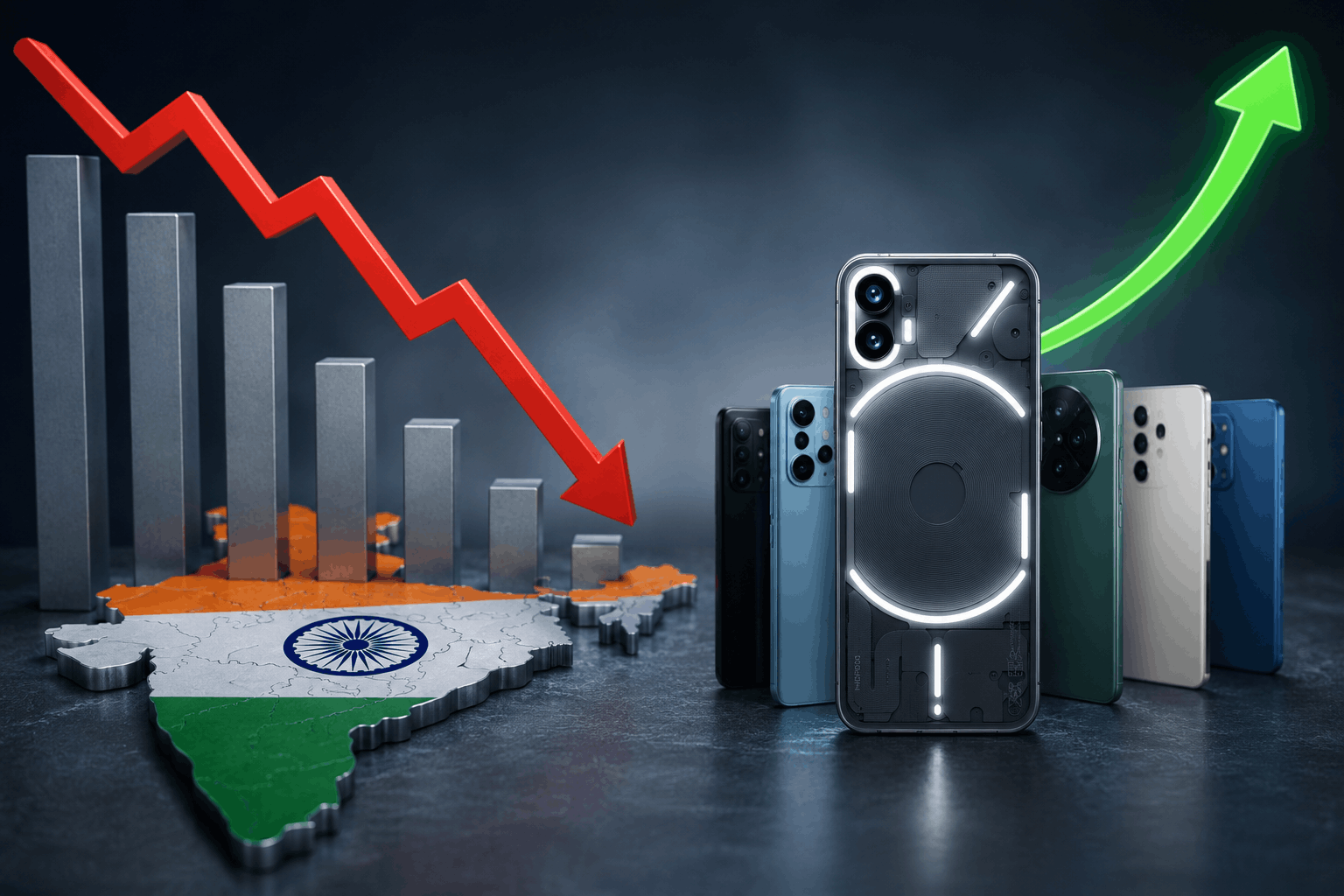
This India smartphone market decline is the steepest the country has seen in six years. According to Counterpoint Research’s Q2 2026 India Smartphone Shipment Tracker, shipments fell 10% year-on-year between April and June, marking the sharpest quarterly drop since 2020. Yet amid that slump, one brand bucked the trend entirely: London-based Nothing posted a staggering 105% year-on-year growth, cementing its status as India’s fastest-growing smartphone brand for the ninth time in the last ten quarters.
📖 Also Read: FIFA World Cup Final Today: Spain Take On Argentina At MetLife Stadium
India Smartphone Market Decline: Quick Facts
| Overall Market Decline (Q2 2026) | 10% YoY, steepest in 6 years |
| Fastest-Growing Brand | Nothing, +105% YoY |
| Market Leader | vivo (excluding iQOO), 18% share |
| Only Top-5 Brand With Positive Growth | Samsung, +2% YoY |
| Average Price Hike | Around 15% by end of Q2 |
| Full-Year 2026 Projection | 10% decline (Counterpoint) |
| Data Source | Counterpoint Research |
Note: Figures in this report are based on Counterpoint Research’s Q1 and Q2 2026 India Smartphone Shipment Trackers, as reported by Communications Today, FoneArena, GSMArena, and O Heraldo.
Why India’s Smartphone Market Is Shrinking
The core driver behind this India smartphone market decline comes down to cost. Rising memory and component prices have pushed smartphone prices higher across nearly every segment this year, with the average price hike reaching around 15% by the end of Q2 2026. That’s a significant jump for a market where affordability has traditionally been the biggest factor driving purchase decisions, particularly in the sub-₹20,000 segment that makes up the bulk of India’s smartphone volumes.
Faced with higher prices, many consumers have responded predictably: they’re delaying upgrades and holding onto their existing devices for longer. This pattern isn’t unique to India, but the scale of the pullback here has been especially pronounced, resulting in the steepest June-quarter decline the market has seen in six years. Notably, this isn’t a sudden shock; Counterpoint had already flagged the risk of a double-digit decline back in its Q1 2026 report, when the market fell a more modest 3% year-on-year and researchers warned that Q2 was likely to be considerably worse.
Chinese Brands Feel the Pressure Most
One of the more striking details in this quarter’s data is how unevenly the pain has been distributed. Chinese smartphone brands recorded their lowest combined market share for a second quarter since 2020, a significant shift for a market segment that has historically dominated India’s budget and mid-range categories. Xiaomi, including its POCO sub-brand, and realme were both hit particularly hard, posting year-on-year shipment declines as repeated price increases across their entry- and mid-tier lineups weakened demand.
Specifically, Xiaomi’s struggles were tied to higher prices across models like the Redmi A7, POCO C71, and POCO C75, while realme’s decline was linked to its P4 and C85 series. For both brands, the sub-₹20,000 price band, traditionally their strongest-performing segment, turned out to be the weakest part of their portfolio this quarter, underlining just how sensitive that price tier has become to even modest cost increases.
How the Top Brands Performed
Despite the overall market slump, the leaderboard among individual brands tells a more nuanced story. vivo, excluding its iQOO sub-brand, retained the top position with an 18% market share, driven by strong momentum in the premium segment following the launch of the V70. However, vivo’s own budget offerings weren’t immune to the broader pressure, with multiple price hikes across its Y and T series weighing on demand and contributing to a double-digit decline in that segment specifically.
Samsung stood out as the only brand among the top five to post positive year-on-year growth, expanding by 2% and narrowing the gap with vivo for the top spot. That growth came on the back of healthy demand across Samsung’s Galaxy A series and its flagship S series, alongside an aggressive summer sales push that included attractive promotions on models like the A07 5G, A17 5G, A37 5G, A57 5G, and the S25 and S26 series. Samsung also strengthened its position in the sub-₹20,000 segment through its A, M, and F series, with the ₹15,000-₹20,000 price band emerging as its single largest volume contributor for the quarter.
OPPO held onto third place with a 14% market share, powered by double-digit growth in the above-₹20,000 price segment through models like the A6 series and K14 series. Xiaomi, including POCO, ranked fourth with a 13% share, while realme rounded out the top five. Apple’s shipments declined 3% year-on-year, with its market share reaching 7%; demand for the iPhone 17 series reportedly remained strong, but supply constraints and inventory shortages limited how much of that demand actually translated into shipment growth.
Market Share by Brand: Q2 2026
| Brand | Market Share | YoY Change |
| vivo (excl. iQOO) | 18% | Mixed (premium up, budget down) |
| Samsung | ~17.6% | +2% |
| OPPO | 14% | Double-digit growth above ₹20,000 |
| Xiaomi (incl. POCO) | 13% | Decline |
| realme | 5th place | Decline |
| Apple | 7% | -3% |
| Nothing (incl. CMF) | Smaller but rapidly growing | +105% |
Nothing’s Remarkable Growth Story
Against this backdrop of broad market contraction, Nothing’s 105% year-on-year growth stands out as one of the most striking numbers in the entire report. This marks the ninth time in the last ten consecutive quarters that Nothing has emerged as India’s fastest-growing smartphone brand, an extraordinary run of consistency for a company that’s still relatively young compared to established players like Samsung, vivo, or Xiaomi.
Counterpoint attributed Nothing’s Q2 2026 surge specifically to strong demand for its Phone (4a) and Phone (4a) Pro models. Beyond product-level demand, the brand also credited enhanced visibility from its title sponsorship of Royal Challengers Bengaluru (RCB) during the Indian Premier League, a marketing move that appears to have paid off handsomely in terms of brand recognition during the quarter. Some reports also noted the successful launch of the Phone (4b) as contributing to the brand’s momentum heading into the second half of the year.
A Consistent Pattern Across Recent Quarters
Nothing’s Q2 performance wasn’t an isolated spike. In Q1 2026, the brand, including its CMF sub-brand, posted 47% year-on-year growth, already enough to make it the fastest-growing brand in India that quarter too. That consistency, leading growth in eight of the previous nine quarters heading into Q1, and now nine of the last ten heading into Q2, suggests Nothing has built something more durable than a single hit product cycle.
Part of that durability likely comes from how deliberately Nothing has positioned itself within the market. Rather than competing head-on with the largest volume players across every price tier, the brand has built a distinct identity around design-forward aesthetics, its signature transparent back panels, and a steady cadence of product launches across both its core Nothing Phone lineup and its more budget-friendly CMF sub-brand, allowing it to capture growth at multiple price points simultaneously.
Where the Bright Spots Are: Premium and Ultra-Premium Segments
Interestingly, not every part of the market has struggled equally. While budget and mid-tier segments bore the brunt of this quarter’s price-driven slowdown, the ultra-premium segment, phones priced above ₹45,000, showed real resilience. Within that specific bracket, Google posted standout growth of 68% year-on-year, a performance Counterpoint attributed largely to the company holding prices steady rather than following the broader industry trend of hiking prices in response to rising component costs.
This divergence, budget segments shrinking sharply while select premium players grow, points to a broader shift in how price sensitivity is playing out across different parts of India’s smartphone market. Consumers at the entry level appear considerably more willing to delay a purchase or extend the life of an existing device when faced with price increases, while buyers in the premium and ultra-premium brackets seem comparatively less deterred, provided the brand in question doesn’t add extra friction through its own price hikes.
How Sub-Brands Complicate the Market Share Picture
One nuance worth understanding when reading these figures is how differently market researchers can present ownership structures when it comes to sub-brands. Counterpoint’s headline figures treat vivo, OPPO, and their respective sub-brands (iQOO for vivo; OnePlus and realme for OPPO) as largely separate entities in its primary rankings. But when sub-brands are folded into their parent companies, the picture shifts meaningfully. vivo’s individual 17.8% share climbs to roughly 19.5% once iQOO is included, while OPPO’s third-place 14% share balloons to a commanding 26.1% once OnePlus and realme are factored in, arguably making the BBK Electronics-owned family of brands the true market leader when viewed as a single corporate group rather than as individual labels.
This distinction matters for anyone trying to understand who’s actually “winning” India’s smartphone market. Depending on how you slice the data, either vivo (as an individual brand) or the broader BBK ecosystem (spanning OPPO, OnePlus, realme, and vivo/iQOO together) could reasonably claim market leadership, a reminder that headline rankings don’t always capture the full competitive picture in a market as fragmented as India’s.
What This Means for Indian Consumers
For everyday smartphone buyers, this quarter’s data reflects a market that’s become noticeably more expensive to navigate than it was just a year ago. With average price hikes running around 15%, many consumers are finding that the budget and mid-range phones they might have previously upgraded to annually now cost meaningfully more, prompting many to stretch their existing devices’ usable lifespan further before making their next purchase.
At the same time, this shift has created genuine opportunities for brands willing to compete more aggressively on value or experience within specific segments. Samsung’s summer promotional push and Google’s decision to hold prices steady in the premium tier both appear to have resonated with price-conscious but quality-focused buyers, while Nothing’s design-led approach has clearly found a receptive audience willing to pay for a differentiated product even as overall market sentiment has cooled.
What’s Driving the Underlying Cost Pressure
Behind the headline price increases sits a broader global dynamic: rising memory and component costs that have affected smartphone manufacturers well beyond India’s borders. Memory chips, in particular, have seen significant cost inflation industry-wide, squeezing margins for manufacturers who then face a choice between absorbing those costs or passing them along to consumers through higher retail prices. Most brands in India appear to have chosen the latter path this quarter, which helps explain why the price-sensitive budget segment has borne the brunt of the resulting demand slowdown.
Apple’s relatively smaller shipment decline, just 3% compared to the double-digit drops seen among several competitors, was specifically attributed by analysts to the company’s stronger position for managing these memory cost pressures, thanks to its premium-focused portfolio and more efficient supply chain relative to volume-driven budget and mid-range competitors.
Putting This Decline in Historical Context
To appreciate just how significant this India smartphone market decline is, it helps to look back at India’s smartphone trajectory over the past several years. India has spent much of the last decade as one of the fastest-growing smartphone markets in the world, reporting growth in most quarters even as shipments slowed or contracted in other major markets globally. That long run of consistent expansion is part of why a 10% year-on-year drop registers as such a notable shift, rather than a routine seasonal fluctuation.
This isn’t entirely unprecedented territory for the market, though. India saw a comparable double-digit decline scare back in 2020, driven by a very different set of factors tied to the pandemic’s early disruption of global supply chains and consumer spending. What makes this current downturn distinct is that it’s being driven almost entirely by cost pressures within the industry itself, rising memory and component prices, rather than an external shock like a pandemic or a geopolitical disruption. That distinction matters for how the market might eventually recover, since cost-driven slowdowns tend to ease once underlying component prices stabilize, whereas demand shocks tied to broader economic disruption can take considerably longer to fully unwind.
What Analysts Are Watching for the Rest of 2026
Looking ahead, Counterpoint’s research team has been fairly consistent in its messaging: they flagged the risk of a double-digit decline as early as their Q1 2026 report, and Q2’s actual 10% drop has now confirmed that projection. For the full year, the firm currently projects the Indian smartphone market will decline by around 10% overall, suggesting the industry isn’t expecting a quick rebound in the immediate term.
Several factors will likely shape how the second half of 2026 plays out. Component and memory prices remain the single biggest variable, since any easing in those global cost pressures could allow manufacturers to moderate their retail price increases and potentially reignite demand in the budget segment that’s been hit hardest. Festive season sales, typically a major driver of smartphone purchases in India, will also serve as an important test of whether price-sensitive consumers are willing to return to the market once promotional discounts and financing offers become more widely available later in the year.
The Competitive Landscape Beyond the Top Five
While much of the reporting around this quarter’s numbers has focused on the top five brands, it’s worth noting that India’s broader smartphone landscape includes a long tail of smaller players competing for share in specific niches. Brands like Motorola, Infinix, Tecno, and various other entrants continue to operate in the market, often targeting extremely price-sensitive segments or specific feature niches that the larger brands don’t prioritize as heavily.
Nothing’s rise is particularly notable in this context, since the brand has managed to grow from a relatively niche, enthusiast-focused player into a genuine top-tier growth story within just a few years of its 2021 founding. That trajectory offers a useful case study for smaller and mid-sized brands operating in India: differentiated design, focused marketing around culturally relevant platforms like cricket, and a willingness to compete across multiple price tiers through sub-brands like CMF can meaningfully move the needle, even against much larger, more established competitors with far greater manufacturing scale and distribution reach.
Key Talking Points
1. This Is the Steepest Decline in Six Years
A 10% year-on-year drop isn’t just a routine fluctuation; it’s the sharpest June-quarter decline India’s smartphone market has recorded since 2020, underlining how significantly rising component costs have reshaped consumer buying behavior this year.
2. Nothing’s Growth Is Remarkably Consistent, Not a One-Off
Leading growth in nine of the last ten quarters is a genuinely rare achievement in a market this competitive. Nothing’s performance suggests a sustainable strategy built around design differentiation and smart marketing, rather than a single successful product cycle.
3. Budget and Premium Segments Are Diverging Sharply
While entry-level and mid-tier segments have taken the biggest hit from price increases, premium and ultra-premium categories, particularly brands like Google that held prices steady, have shown real resilience, highlighting a growing bifurcation in Indian consumer behavior.
4. Sub-Brand Accounting Changes the Leadership Narrative
Depending on whether sub-brands get counted alongside their parent companies, either vivo or the broader BBK Electronics family could reasonably claim market leadership, a reminder to read headline rankings carefully.
Why did Chinese smartphone brands lose share this quarter?
Chinese brands, including Xiaomi and realme, recorded their lowest combined market share for a second quarter since 2020, largely because repeated price hikes across their budget and mid-tier lineups hurt demand in their traditionally strongest price segments.
Does vivo or the BBK Electronics family actually lead the market?
It depends on how sub-brands are counted. vivo individually leads with 18%, but when OPPO’s sub-brands OnePlus and realme are included alongside OPPO, the combined BBK Electronics family claims a larger 26.1% share.
India Smartphone Market Decline: Frequently Asked Questions (FAQs)
How much did India’s smartphone market decline in Q2 2026?
India’s smartphone shipments fell 10% year-on-year in Q2 2026, marking the steepest June-quarter decline in six years, according to Counterpoint Research.
Why is Nothing India’s fastest-growing smartphone brand?
Nothing grew 105% year-on-year in Q2 2026, driven by strong demand for its Phone (4a) and Phone (4a) Pro models and increased brand visibility from its RCB title sponsorship during the IPL.
Which brand leads India’s smartphone market overall?
vivo (excluding iQOO) led with an 18% market share in Q2 2026, though the broader BBK Electronics family, including OPPO, OnePlus, and realme, claims a larger combined share when sub-brands are included.
Why are smartphone prices rising in India?
Rising memory and component costs have pushed manufacturers to increase prices by an average of around 15% by the end of Q2 2026, prompting many consumers to delay upgrades.
Is India’s smartphone market expected to recover soon?
Counterpoint projects the full-year 2026 market will decline by around 10%, suggesting the downturn is expected to persist through the rest of the year rather than reverse quickly.
Which brand grew the most in the premium segment?
Google posted 68% year-on-year growth in the above-₹45,000 ultra-premium segment, largely attributed to holding prices steady while competitors raised theirs.
Conclusion — A Market Under Pressure, With Pockets of Opportunity
This India smartphone market decline tells a story of an industry grappling with rising costs and increasingly cautious consumers, but it’s far from a uniformly bleak picture. While Chinese budget-focused brands like Xiaomi and realme have borne the brunt of the slowdown, and even market leader vivo has felt pressure in its budget lineup, other players have found genuine opportunity within the same challenging conditions. Samsung’s steady growth, Google’s premium-segment surge, and above all, Nothing’s extraordinary, sustained growth streak all suggest that smart pricing strategy and clear brand differentiation can still cut through even in a shrinking market. As India’s smartphone industry heads into the second half of 2026, how brands navigate this cost-driven slowdown will likely determine who consolidates share and who continues to lose ground.
Stay tuned to Mirrorly.in for more smartphone market coverage and analysis, including updates on how the India smartphone market decline evolves through the rest of 2026.
📖 Also Read: FIFA World Cup Final Today: Spain Take On Argentina At MetLife Stadium