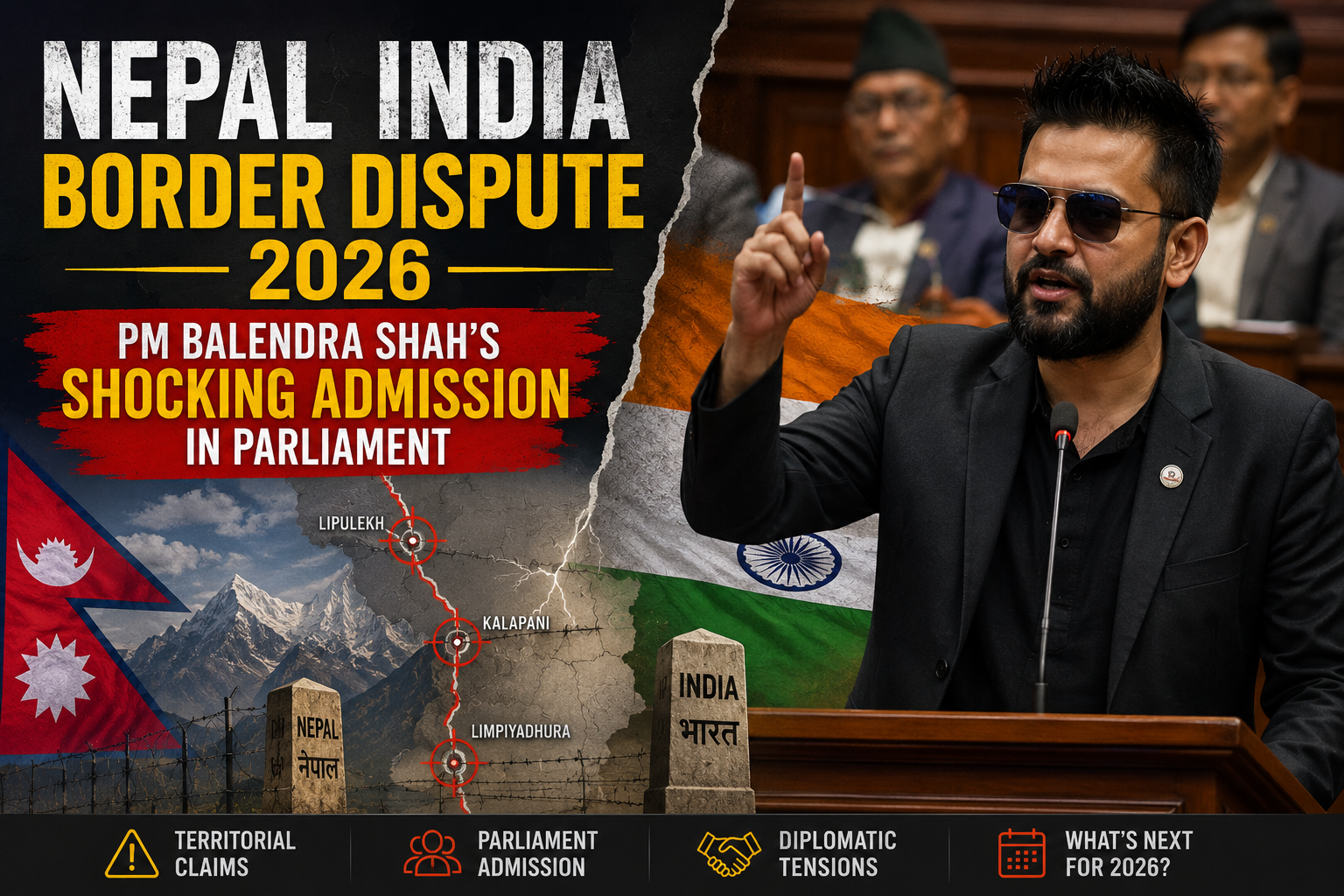
In a shocking and unprecedented statement, Nepal Prime Minister Balendra Shah admitted in Parliament on Sunday that Nepal has also encroached upon Indian territory — making him the first Nepal PM ever to make such an admission. This Nepal India border dispute 2026 development has sent shockwaves across diplomatic circles in both Kathmandu and New Delhi.
The statement came during a question-and-answer session in Nepal’s House of Representatives, where PM Shah was responding to questions about the long-running border dispute involving Kalapani, Lipulekh, and Limpiyadhura — territories that both India and Nepal claim as their own.
What makes this statement historic is not just what was said, but who said it — and how openly. No previous Nepali Prime Minister has ever publicly acknowledged that Nepal too may have crossed the border into Indian territory.
What Exactly Did Nepal PM Balendra Shah Say?
Speaking in Nepal’s House of Representatives on May 31, 2026, PM Balendra Shah made a stunning statement that caught even his own lawmakers by surprise. His exact words were:
“It might surprise you to hear this — I also found out recently after becoming Prime Minister. It is not just India; Nepal has also encroached upon Indian land. We will sit down for table talks and discuss the mutual encroachment of land.”
The Prime Minister did not specify the exact locations where Nepal may have crossed into Indian territory. However, he confirmed that the government is working through diplomatic channels to resolve the border disputes involving Lipulekh, Kalapani, and Limpiyadhura.
Nepal India Border Dispute 2026: The Background
The Nepal India border dispute is not new — it has been simmering for decades. But to understand why PM Shah’s statement is so significant, we need to understand the history of this dispute.
Kalapani, Lipulekh and Limpiyadhura — The Core Dispute
The main areas of contention between India and Nepal are three strategically important territories in the western Himalayas — Kalapani, Lipulekh, and Limpiyadhura. India maintains that these territories are part of Uttarakhand state, while Nepal claims them as its own territory based on historical maps and treaties.
- Kalapani — A high-altitude valley near the India-Nepal-Tibet tri-junction
- Lipulekh Pass — A strategic pass used for trade and the Kailash Mansarovar Yatra
- Limpiyadhura — A remote mountainous area that Nepal claims based on 1816 Sugauli Treaty
When Did the Dispute Escalate?
The dispute escalated significantly in 2020 when India inaugurated a new road through the Lipulekh Pass connecting Uttarakhand to Tibet. Nepal objected strongly, claiming the road passes through its territory. Nepal then published a new official map in 2020 that showed Kalapani, Lipulekh, and Limpiyadhura as part of Nepal — a move India rejected as politically motivated.
India firmly rejected Nepal’s territorial claims, calling Nepal’s new map an “unilateral artificial enlargement” of its territory that New Delhi finds “untenable.”
Kailash Mansarovar Yatra Controversy
Just days before PM Shah’s statement, India firmly rejected Nepal’s objection to the Kailash Mansarovar Yatra via the Lipulekh Pass in Uttarakhand — a route that has been used for decades by Indian pilgrims. Nepal had objected to the yatra route, claiming Lipulekh is Nepali territory. India dismissed the objection, reaffirming its position that Lipulekh is an integral part of India.
Why Nepal India Border 2026 Statement Is Historic
PM Balendra Shah’s admission is being called historic for several important reasons:
First Ever Admission by a Nepal PM
In the entire history of Nepal-India border relations, no Prime Minister of Nepal has ever publicly stated that Nepal may have also encroached on Indian territory. This is a first — and it represents a dramatic shift in Nepal’s official position on the border dispute.
Shows Political Maturity
By acknowledging both sides of the problem, PM Shah is demonstrating a more mature and balanced approach to diplomacy. Instead of the traditional “only India is wrong” narrative, he is opening the door for a more honest and productive dialogue.
Opens Door for Resolution
When both sides acknowledge their own mistakes, it becomes much easier to find a solution. PM Shah’s statement is being seen by many analysts as a positive step toward finally resolving a dispute that has troubled India-Nepal relations for years.
How Has India Reacted to Nepal India Border 2026 Statement?
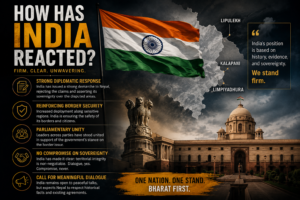
India has not yet issued an official response to PM Shah’s statement. However, diplomatic sources indicate that New Delhi has taken note of the admission with interest. India has consistently maintained that the border dispute should be resolved through bilateral dialogue — which is exactly what PM Shah is also proposing.
Nepal’s Foreign Ministry had earlier stated that the country is committed to resolving the border issue with India through diplomatic channels. A diplomatic note has already been sent by Nepal to India regarding the Lipulekh and Limpiyadhura dispute, and India has responded.
Controversy Back Home in Nepal
While PM Shah’s statement may be seen positively by India, it has triggered significant controversy within Nepal itself.
Former Nepalese ambassador to India Nilambara Acharya strongly criticised the PM, saying Shah has no information regarding Indian territories being encroached upon by Nepal. Acharya insisted that Nepal has never encroached Indian territories or extended its occupation in any border area.
Acharya explained that in some border areas, due to cross-holding occupations, the farmers of both countries have used each other’s land — but this is very different from official government-level encroachment. Critics argue that PM Shah’s statement may have weakened Nepal’s bargaining position in future diplomatic negotiations.
Nepal India Border 2026: What Happens Next?
PM Shah has called for table talks between India and Nepal to discuss the mutual land encroachment issue. He has confirmed that both countries have agreed to take the help of historians, surveyors, and experts to seek a resolution.
Kathmandu has also held diplomatic discussions on the border issue with China and the UK — both of whom have historical connections to the region through old treaties and colonial-era maps.
The key question now is: will India and Nepal finally sit down for serious, productive talks to resolve a dispute that has dragged on for decades? PM Shah’s statement — however controversial — may have just opened that door.
Key Facts at a Glance
| Who Said It | Nepal PM Balendra Shah |
| When | May 31, 2026 |
| Where | House of Representatives, Kathmandu |
| What He Said | Nepal has also encroached Indian territory |
| Disputed Areas | Kalapani, Lipulekh, Limpiyadhura |
| India’s Position | These are part of Uttarakhand |
| Nepal’s Demand | Resolve through bilateral dialogue |
| Historic First | First Nepal PM to admit border encroachment |
Conclusion
Nepal PM Balendra Shah’s admission that Nepal has also encroached upon Indian territory is one of the most significant diplomatic developments in India-Nepal relations in recent years. It is historic, controversial, and potentially transformative all at once.
The Nepal India border dispute 2026 is now at a critical juncture. With both sides acknowledging the complexity of the situation, there is now a genuine opportunity for dialogue, resolution, and a more stable, peaceful relationship between two nations that share deep historical, cultural, and civilisational bonds.
Whether this moment of honesty leads to lasting peace on the border — or simply more controversy — remains to be seen. But one thing is certain: PM Balendra Shah has changed the conversation in a way that cannot be ignored.
Stay tuned to Mirrorly.in for the latest updates on the Nepal India border dispute and all major developments in Indian and world affairs.