India-Australia Ties: PM Modi Visits Iconic Melbourne Cricket Ground During Australia Tour

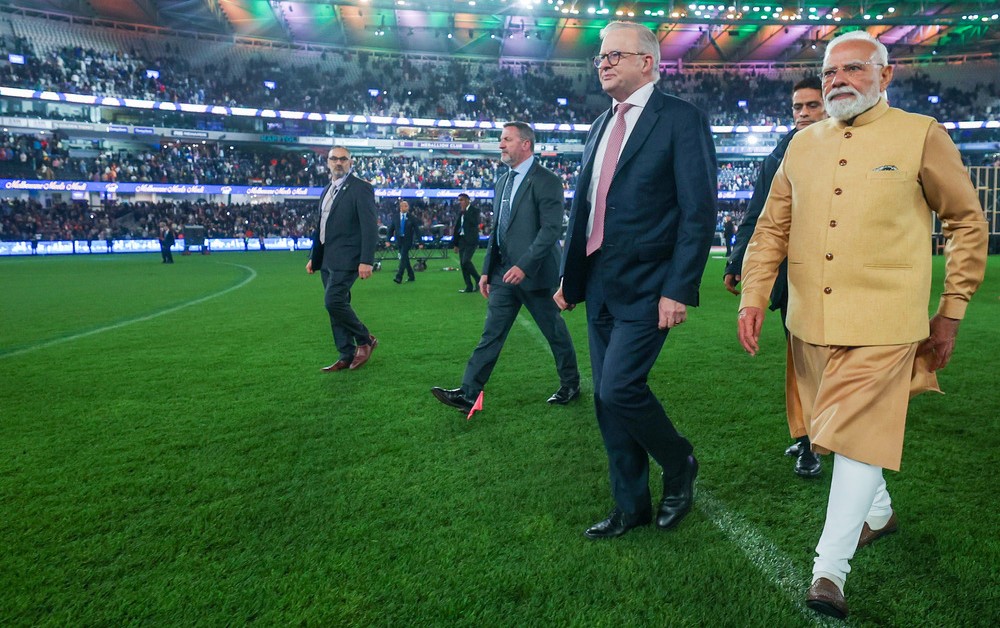
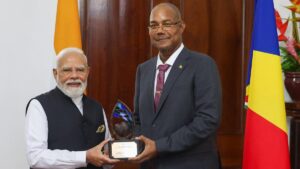
The PM Modi MCG visit capped off his three-day trip to Australia at one of the country’s most iconic landmarks. On Friday, he visited the Melbourne Cricket Ground (MCG) alongside Australian Prime Minister Anthony Albanese. The two leaders used the occasion to unveil a new roadmap for sports collaboration between India and Australia, a move officials say reflects the growing depth of the bilateral relationship well beyond trade and security.
The MCG visit came on the final day of Modi’s trip. It followed a packed schedule of high-level meetings, a bilateral summit, and outreach to Melbourne’s Indian community. Together, these engagements marked what Modi himself described as his third visit to Australia in 12 years, a milestone he said showcases how far the relationship has come.
The Visit at a Glance
| Event | PM Modi’s Australia Visit |
| Duration | Three-day visit, concluding Friday, July 10, 2026 |
| Key Location | Melbourne Cricket Ground (MCG) |
| Joined By | Australian PM Anthony Albanese |
| Key Announcement | India-Australia sports collaboration roadmap |
| Other Meetings | Opposition Leader Angus Taylor, Governor-General Sam Mostyn, Victoria Governor Margaret Gardner |
| Major Event | Third Australia-India Annual Summit |
| Context | Modi’s third visit to Australia in 12 years |
Note: Details in this report are based on statements from Foreign Secretary Vikram Misri and official readouts of PM Modi’s Australia visit.
Why the MCG Visit Matters

Foreign Secretary Vikram Misri, briefing reporters ahead of the visit, explained that the stop at the MCG was designed to spotlight sports as a growing area of cooperation between the two countries. He noted that the timing carries particular significance, since India is set to host the Commonwealth Games in 2030, while Australia will host the Olympic Games in 2032. Misri said this made sports a sector with real potential for cooperation and opportunities between the two sides. By visiting the ground together, Modi and Albanese aimed to signal that sports diplomacy is now a formal pillar of the relationship, alongside trade, defence, and education.
The MCG itself holds deep symbolic value for both nations. As one of the world’s most famous cricket stadiums, and a venue closely tied to the sport that both India and Australia are passionate about, it offered a fitting backdrop for a roadmap centered on shared sporting ambitions rather than formal treaty language.
A Packed Schedule Across Three Days
The MCG visit was the final stop in a busy itinerary. A day earlier, Modi held talks with Albanese, Australia’s Governor-General Sam Mostyn, and Victoria Governor Margaret Gardner. He also attended the Australia-India CEO Forum, met former Australian PM Scott Morrison, and joined an Indian community reception in Melbourne. Earlier still, Modi and Albanese took part in the third Australia-India Annual Summit, where the two sides reviewed the full range of bilateral cooperation, spanning trade and investment, critical minerals, clean energy, technology, defence and security, education, skills, mobility, science, innovation, and culture.
On the final day, Modi also met Angus Taylor, the Leader of the Opposition in Australia’s Parliament. According to the Ministry of External Affairs, the two leaders discussed ways to further strengthen the India-Australia Comprehensive Strategic Partnership. Officials described this meeting as evidence of bipartisan support in Australia for deepening ties with India, meaning both major political camps in Canberra back closer engagement with New Delhi regardless of which party is in government.
What Both Sides Discussed
Beyond the sports roadmap, the broader summit covered substantial ground. Misri described the overall visit as short but extremely productive, noting several concrete outcomes and a reaffirmation of shared objectives across multiple sectors. Both leaders also exchanged views on regional and global developments, reaffirming their commitment to a free, open, inclusive, and prosperous Indo-Pacific, language that reflects shared strategic interests in the wider region.
Trade and investment featured prominently in the discussions, alongside cooperation on critical minerals and clean energy, two areas where India and Australia have increasingly aligned interests. Australia holds substantial reserves of minerals essential to clean energy technology and electronics manufacturing, while India represents a major and growing market for such resources as it expands its renewable energy and electronics sectors.
How the India-Australia Relationship Got Here
To understand why a cricket ground visit carries diplomatic weight, it helps to look at how far the relationship has come. India and Australia first established formal trade links back in 1941, with the setting up of an India Trade Office in Sydney well before India’s independence. For decades afterward, the relationship stayed relatively modest, often summed up by observers using the shorthand of the “three Cs”: Commonwealth, curry, and cricket.
That began to change meaningfully in 2009, when the two countries upgraded their ties to a formal Strategic Partnership. Then, in June 2020, during a virtual summit between PM Modi and then-Australian PM Scott Morrison, the relationship was elevated further still, to a full Comprehensive Strategic Partnership, or CSP. That 2020 summit also produced a Mutual Logistics Support Agreement, giving each country’s military access to the other’s bases and facilities, along with new frameworks for cooperation on cyber technology and maritime security. Two years later, in March 2022, the two leaders agreed to institutionalize annual leader-level summits, a decision that directly led to the first Australia-India Annual Summit held in New Delhi in March 2023, and, ultimately, to this year’s edition in Melbourne.
Trade Ties: From Modest Beginnings to a $50 Billion Relationship
Economic ties between the two countries have grown just as dramatically as the diplomatic relationship. Bilateral trade in goods and services stood at roughly $16 billion in 2008-09. By 2020, it had risen to around $18 billion, before accelerating sharply in the years that followed. Today, two-way trade sits at close to $50 billion, roughly double what it was when the Comprehensive Strategic Partnership was first signed just a few years ago.
A major driver of this growth was the India-Australia Economic Cooperation and Trade Agreement, known as ECTA, signed in April 2022 and formally in force since December of that year. It marked India’s first bilateral trade agreement with a developed economy in over a decade, cutting or eliminating tariffs across a wide range of goods and addressing technical and safety barriers that had previously slowed trade flows. Since then, both sides have continued negotiating a more comprehensive follow-up pact, the Comprehensive Economic Cooperation Agreement, or CECA, aimed at deepening cooperation further, including in areas like digital trade and services mobility.
Australia today ranks among India’s top trading partners, having climbed from twelfth to fifth place among Australia’s export destinations over the past two decades. India, in turn, has become an increasingly important source of imports and investment interest for Australia, even though flows of Australian investment into India have grown more slowly than officials on both sides would like.
Defence and Security Cooperation Runs Deeper Than Headlines Suggest
Beyond trade and sports, defence cooperation has quietly become one of the most substantial pillars of the relationship. Since the 2020 Comprehensive Strategic Partnership agreement, India and Australia have upgraded their “2+2” dialogue, bringing together foreign and defence ministers from both countries, a level of engagement Australia maintains with only a small number of nations, including the United States and Japan. In October 2025, Indian Defence Minister Rajnath Singh made the first visit by an Indian defence minister to Australia since 2014, coinciding with the fifth anniversary of the CSP, where both sides agreed to hold annual defence ministers’ dialogues going forward.
The two countries have also finalized practical military arrangements, including an air-to-air refuelling agreement announced in late 2024, which allows each country’s air force to support the other’s aircraft during joint operations. Both nations are also part of the Quadrilateral Security Dialogue, or Quad, alongside the United States and Japan, a grouping widely seen as central to coordinating strategic approaches to the wider Indo-Pacific region.
People-to-People Ties and the Role of the Diaspora
Perhaps the most tangible sign of how close the relationship has become lies in the numbers of people moving between the two countries. India’s diaspora in Australia now stands at over a million people, one of the fastest-growing migrant communities in the country. Direct flight connections between India and Australia have tripled since 2022, making travel between the two nations easier than at any point in the relationship’s history.
Education remains a particularly strong thread connecting the two societies. Indian students have long formed one of the largest groups of international students in Australian universities, and several Australian institutions have moved to open campuses directly in India in recent years, a sign of how deeply intertwined the two education systems have become. New migration arrangements agreed in 2023 have also made it easier for skilled Indian workers to move to Australia, further reinforcing these human connections alongside the diplomatic and economic ones.
Not Without Its Challenges
Despite the clear momentum, analysts note the relationship hasn’t been without friction points. Trade disputes over agricultural products like sugar have occasionally strained ties, and progress on the more ambitious Comprehensive Economic Cooperation Agreement has moved slower than officials on both sides initially hoped. Australian investment into India has also lagged behind expectations, with India accounting for a relatively small share of Australia’s total outward foreign investment despite years of encouragement from both governments.
Some observers have also pointed out that people-to-people ties remain somewhat lopsided, with far more Indians travelling to and settling in Australia than the reverse. Addressing that imbalance, alongside deepening critical minerals cooperation, an area where Australia’s vast reserves and India’s growing clean energy and electronics sectors could complement each other significantly, remains an ongoing area of work for both governments as they look to build on the momentum generated by visits like this one.
Key Talking Points
1. Sports as a New Pillar of Diplomacy
The decision to formally unveil a sports collaboration roadmap signals that India and Australia now see sports as more than a soft-power gesture. With India preparing to host the 2030 Commonwealth Games and Australia gearing up for the 2032 Olympics, both countries have practical reasons to deepen cooperation on athlete training, infrastructure, and event management in the years ahead.
2. Bipartisan Backing in Australia
Modi’s meeting with Opposition Leader Angus Taylor, alongside his engagements with the sitting government, underscores that support for closer India-Australia ties isn’t tied to a single political party in Canberra. This kind of cross-party consensus generally makes long-term agreements more durable, since they’re less likely to be reversed following a change in government.
3. A Relationship Maturing Beyond Trade
While trade and critical minerals remain central to the relationship, this visit placed equal emphasis on people-to-people ties, culture, and sports. That broader focus suggests both governments are trying to build a relationship that resonates with everyday citizens and diaspora communities, not just policymakers and corporate boardrooms.
The Role of Cricket in India-Australia Diplomacy
Choosing the MCG specifically, rather than any other venue, wasn’t incidental. Cricket has long served as one of the most effective, if informal, channels of goodwill between India and Australia, often succeeding in building public affection between the two nations even during periods when formal diplomatic or trade ties moved more slowly. The two countries share a fierce, decades-long cricketing rivalry that regularly draws massive television audiences in both nations, alongside large numbers of Indian-origin fans who travel to Australia for Test series and other tours.
Analysts who track the relationship have noted that this kind of cricket diplomacy has historically delivered an outsized people-to-people dividend relative to the effort required, even as the two governments struggled for years to translate that public goodwill into deeper strategic or economic cooperation. By formally tying a sports collaboration roadmap to one of the sport’s most storied venues, Modi and Albanese appear to be acknowledging that dynamic directly, treating cricket not merely as a shared cultural touchstone but as a genuine platform for future collaboration on athlete development, coaching exchanges, and event hosting expertise as both countries prepare for their respective global sporting events in the next decade.
What the CEO Forum Discussions Revealed
Alongside the government-to-government engagements, the Australia-India CEO Forum that Modi attended brought together senior business leaders from both countries to discuss practical steps for deepening commercial ties. These forums typically focus on identifying specific sectors where private investment can accelerate the broader goals set out at the political level, ranging from clean energy and critical minerals processing to digital services and advanced manufacturing.
Clean energy cooperation, in particular, has emerged as a priority area in recent years, with both countries pursuing ambitious net-zero commitments and recognizing complementary strengths: Australia’s abundant mineral resources and renewable energy potential, paired with India’s large domestic market and manufacturing capacity for solar and battery technologies. Officials from both sides have periodically flagged green hydrogen as another promising area, given Australia’s renewable energy capacity and India’s growing demand for cleaner industrial fuel sources. Discussions at forums like this one are typically seen as laying the groundwork for the kind of concrete announcements, on solar taskforces, water security initiatives, or research partnerships, that have accompanied previous India-Australia summits in years past.
Frequently Asked Questions (FAQs)
Why did PM Modi visit the Melbourne Cricket Ground?
PM Modi visited the MCG alongside Australian PM Anthony Albanese to unveil an India-Australia sports collaboration roadmap, highlighting sports as a growing area of bilateral cooperation ahead of India’s 2030 Commonwealth Games and Australia’s 2032 Olympics.
Who else did PM Modi meet during his Australia visit?
PM Modi met Australian PM Anthony Albanese, Opposition Leader Angus Taylor, Governor-General Sam Mostyn, Victoria Governor Margaret Gardner, and former PM Scott Morrison, in addition to attending the Australia-India CEO Forum and an Indian community reception.
What was discussed at the Australia-India Annual Summit?
The summit covered trade and investment, critical minerals, clean energy, technology, defence and security, education, skills, mobility, science, innovation, culture, sports, and people-to-people ties.
How many times has PM Modi visited Australia?
This marks PM Modi’s third visit to Australia in 12 years, which he described as reflecting the significant progress made in India-Australia relations.
What is the India-Australia Comprehensive Strategic Partnership?
It’s the broad framework governing India-Australia relations, covering cooperation across trade, defence, education, and other sectors. During this visit, Modi and Opposition Leader Angus Taylor discussed ways to further strengthen this partnership.
When was the India-Australia Comprehensive Strategic Partnership established?
The Comprehensive Strategic Partnership was established on 4 June 2020, during a virtual summit between PM Modi and then-Australian PM Scott Morrison, upgrading the relationship from the Strategic Partnership signed in 2009.
How big is bilateral trade between India and Australia?
Two-way trade between India and Australia has grown to nearly $50 billion, roughly double what it was when the Comprehensive Strategic Partnership was signed in 2020, supported significantly by the India-Australia Economic Cooperation and Trade Agreement (ECTA).
What role does the Quad play in India-Australia relations?
India and Australia are both members of the Quadrilateral Security Dialogue (Quad), alongside the United States and Japan, a grouping focused on coordinating strategic approaches to the Indo-Pacific region and reinforcing the broader defence and security cooperation the two countries have built since 2020.
Conclusion — A Relationship Reaching New Heights
The PM Modi MCG visit offered a fitting close to a diplomatically packed three days in Australia. Beyond the substantial outcomes from the Annual Summit, the sports collaboration roadmap and the bipartisan warmth shown by both the government and opposition in Canberra point to a relationship that’s expanding well beyond traditional trade and security cooperation. With major sporting events on the horizon for both countries, this latest chapter in India-Australia ties suggests the relationship is set to grow even further in the years ahead.
Looking back at how far the relationship has travelled, from a modest trade office set up in Sydney in 1941 to a Comprehensive Strategic Partnership underpinning nearly $50 billion in annual trade, defence cooperation on par with some of Australia’s closest allies, and a diaspora exceeding a million people, this MCG visit feels less like an isolated photo opportunity and more like a natural extension of a deliberate, decades-long effort by both governments. Whether that momentum translates into concrete progress on the still-unfinished Comprehensive Economic Cooperation Agreement, deeper critical minerals cooperation, or a more balanced flow of people and investment between the two countries will likely shape how this chapter of India-Australia relations is remembered in the years to come.
Stay tuned to Mirrorly.in for more updates on India’s foreign relations.