Rice, Roti and Rising Diabetes: What Is Really Happening on India’s Dinner Plates?

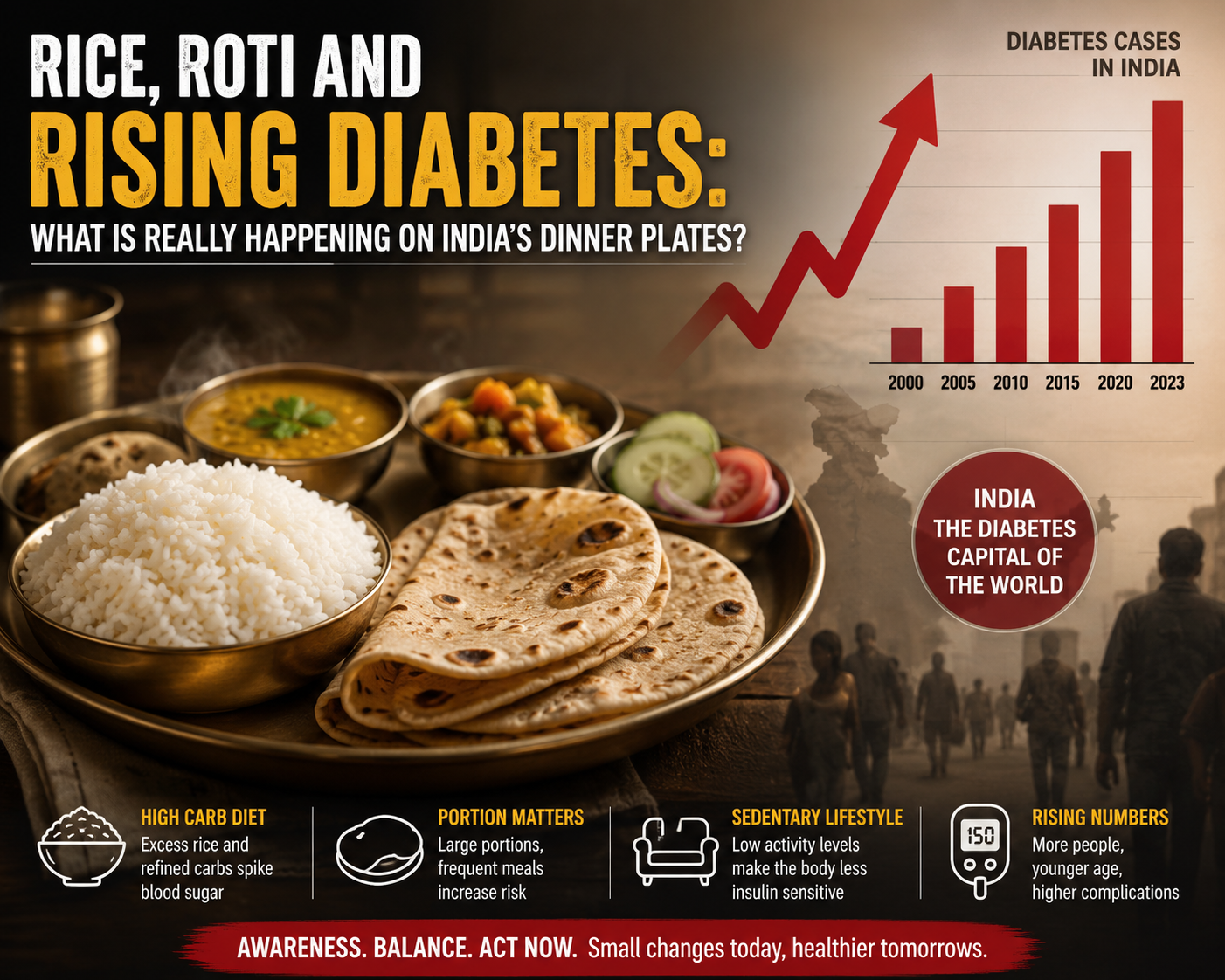
Rice and roti have been the foundation of Indian food culture for thousands of years. Moreover, they are not just food — they are comfort, tradition, and identity. However, a landmark study by the Indian Council of Medical Research (ICMR) has revealed a deeply concerning truth about India’s diabetes rice roti diet connection. Furthermore, the findings are forcing a national conversation about what Indians eat, how much they eat, and what the consequences are for their health.
The ICMR-INDIAB survey — published in the prestigious journal Nature Medicine — studied over 18,000 adults across 30 states and union territories. Its findings are stark: 62 percent of all calories in the average Indian diet come from carbohydrates — primarily rice, wheat, and sugar. In addition, only 12 percent of calories come from protein. This carb-heavy, protein-deficient dietary pattern directly links to India’s explosive rise in diabetes, prediabetes, and obesity.
India already has the largest number of diabetic people in the world. Furthermore, the numbers keep growing. So what is happening on India’s dinner plates — and what can we do about it?
📖 Source: ICMR-INDIAB Study — Published in Nature Medicine
India Diabetes Rice Roti Diet — Key Statistics
| Study | ICMR-INDIAB Survey-21 — Nature Medicine |
| Sample Size | 18,000+ adults across 30 states/UTs |
| Carbs % of diet | 62% of total daily calories |
| Protein % of diet | Only 12% — recommended is 15%+ |
| Diabetes risk increase | 15-30% higher with high carb diet |
| Animal protein intake | Only 1% of daily calories |
| Dairy contribution | Only 2% of daily calories |
| India’s diabetic population | Largest in the world — 101 million+ |
| Prediabetes cases | 136 million Indians at risk |
The Problem — India’s Carb-Heavy Diet
The diabetes rice roti diet problem starts with the average Indian meal — a pure carbohydrate feast. A typical lunch or dinner might include 2-3 rotis or a large serving of rice, a small bowl of dal, a vegetable dish cooked in oil, and perhaps a sweet. Furthermore, breakfast often means poha, idli, dosa, or paratha — all carbohydrate-rich foods.
According to the ICMR study, this dietary pattern gives the average Indian approximately 62 percent of their daily calories from carbohydrates. In contrast, global dietary guidelines recommend that carbohydrates contribute no more than 45-65 percent of daily calories — and that protein intake should reach at least 15 percent.
However, India’s protein intake sits critically low at just 12 percent. Most of this protein comes from plant sources — cereals, pulses, and legumes. Dairy contributes only 2 percent, and animal protein a mere 1 percent of daily calories. This is a protein crisis hiding in plain sight on India’s dinner plates.
Why Are Indians Eating So Many Carbs?
- Cultural tradition — rice and roti have been Indian staples for centuries
- Affordability — carbohydrates are cheaper than protein-rich foods
- Vegetarian majority — most Indians avoid meat, limiting animal protein access
- Cooking habits — Indian cooking traditionally uses large quantities of grains
- Lack of awareness — most people do not know how many carbs they consume
Is Rice the Villain? What Experts Say
For years, people blamed rice as the primary cause of India’s diabetes epidemic. However, experts now push back against this oversimplified narrative. Dr Gagandeep Singh, founder of Redial Clinic and specialist in reversing diabetes without medication, says the focus on rice alone is misplaced.
“Rice was never the real problem. The real problem is what surrounds it. Look at a typical Indian meal — a large serving of rice or roti, a small bowl of dal, a vegetable dish cooked generously in oil, and sometimes a sweet to finish.” — Dr Gagandeep Singh
Furthermore, the ICMR study itself notes that switching from white rice to whole wheat roti or millets does not significantly reduce diabetes risk if total carbohydrate intake stays high. Moreover, milling whole wheat flour also raises its glycaemic index — meaning blood sugar spikes almost as quickly with roti as with white rice.
In addition, the Tata 1mg health platform notes that neither rice nor roti are entirely bad for diabetes when someone consumes them in the right amounts. The real issue is portion size, meal composition, and the near-total absence of adequate protein in most Indian meals.
Rice vs Roti — Which Is Better for Diabetes?
| Factor | White Rice | Wheat Roti |
| Glycaemic Index | High (72-75) | Medium-High (62-70) |
| Blood sugar spike | Rapid rise | Slightly slower |
| Protein content | Very low (2-3g/100g) | Slightly higher (3-4g) |
| Fibre content | Low (white rice) | Moderate |
| Calories per serving | ~200 (1 cup cooked) | ~100 (1 medium roti) |
| Better choice | Brown/Basmati in moderation | Whole wheat in moderation |
The Real Problem — India’s Protein Crisis
While carbohydrates get all the attention in the diabetes rice roti diet conversation, the real dietary emergency may actually be India’s critically low protein intake. The ICMR study found that only 12 percent of daily calories come from protein in the average Indian diet — well below the recommended 15 percent or more.
Furthermore, the ICMR researchers found a powerful insight: replacing just 5 percent of carbohydrate calories with protein calories — for example, eating more dal and less rice — can halve the risk of developing prediabetes. This remarkably simple and affordable dietary change could transform India’s public health outcomes.
Why Is India’s Protein Intake So Low?
- Vegetarian majority — over 70% of Indians are largely vegetarian
- Cost — quality protein sources like eggs, fish, and meat are expensive
- Cultural stigma — protein-rich foods like eggs face social taboos in some communities
- Lack of awareness — most Indians do not know how much protein they need
- Dal as the only protein — most vegetarian protein comes from dal alone
How Much Protein Do You Actually Need?
The Indian Council of Medical Research recommends approximately 0.8-1 gram of protein per kilogram of body weight per day for adults. For a 60 kg adult, this means 48-60 grams of protein per day. Moreover, active individuals and those over 50 may need even more.
However, the average Indian consumes far less than this recommended amount — primarily because carbohydrate-heavy rice and roti dominate their plates, leaving little room for protein-rich foods.
India Diabetes Rice Roti — What Can You Do?
The good news is that you do not need to completely abandon rice or roti to improve your health. Furthermore, you do not need expensive supplements or dramatic dietary changes. The ICMR researchers say that modest, practical food swaps can make a significant difference.
5 Practical Food Swaps for Better Health:
- Add more dal — increase dal portion size and reduce rice/roti serving by the same amount
- Switch to millets — foxtail millet, bajra, and jowar have lower glycaemic index than rice or wheat
- Add eggs or paneer — one egg or 50g of paneer adds significant protein to any meal
- Eat smaller carb portions — use a smaller bowl for rice; try 2 rotis instead of 3-4
- Add protein at every meal — curd, sprouts, chickpeas, peanuts all add affordable protein
Simple Rule to Follow:
Fill half your plate with vegetables, one quarter with protein (dal, eggs, paneer, fish), and only one quarter with carbohydrates (rice or roti). This simple change can dramatically improve blood sugar control.
Common Myths About Rice, Roti and Diabetes — Busted
Myth 1: All Rice Is Bad for Diabetes
Fact: Low-glycaemic rice varieties like basmati rice work fine in moderation. Furthermore, cooling cooked rice before eating converts some starch into resistant starch, which is better for blood sugar. The problem is not rice itself — it is the quantity and what accompanies it.
Myth 2: Switching to Brown Rice Solves the Problem
Fact: Brown rice is better than white rice, but the ICMR study shows that simply switching grain types does not significantly reduce diabetes risk if total carbohydrate intake stays high. Furthermore, milling whole grains raises their glycaemic index. The total carb load matters more than the type of grain.
Myth 3: Roti Is Always Better Than Rice
Fact: Roti has a slightly lower glycaemic index than white rice, but the difference is not as dramatic as many people believe. Moreover, eating 4-5 rotis in one meal can cause just as much blood sugar spike as a large bowl of rice. Portion size matters for both.
Myth 4: Only South Indians Are Affected
Fact: While South India does consume more white rice, the ICMR study covered all 30 states and found carbohydrate dominance across the country. In fact, Northeast India — which has nearly 99 percent white rice dependence — shows some of the highest regional blood sugar spikes.
India’s Diabetes Crisis — The Big Picture
India currently has the largest diabetic population in the world — over 101 million people living with diabetes and an estimated 136 million people with prediabetes. Furthermore, people sometimes call India the diabetes capital of the world. Moreover, the numbers keep growing.
The ICMR study’s findings add important context to this crisis. India’s diabetes epidemic is not simply a genetic problem — dietary patterns that evolved over generations link directly to it. Furthermore, the shift toward more refined, processed carbohydrates in urban areas has accelerated the problem.
However, the solutions are within reach. Moreover, they do not require expensive medical interventions — just modest, practical changes to what Indians put on their plates every day.
📖 Also Read: Fashion Trends India 2026 — Complete Style Guide
Conclusion — India Diabetes Rice Roti Diet
Rice and roti are not the enemy. Furthermore, they are not going anywhere — nor should they. However, the way Indians eat them — in excessive quantities, without adequate protein, and with little dietary diversity — contributes to one of the world’s most serious diabetes crises.
The ICMR’s findings are a wake-up call, not a reason to panic. In conclusion, small, practical changes — more dal, more protein, smaller carb portions, more millets — can make a profound difference to India’s health outcomes. Moreover, these changes do not require abandoning tradition; they simply require balance.
Your dinner plate is one of the most powerful health tools you have. Furthermore, the good news is that you already know what to add — more dal, more vegetables, more protein. The choice is on your plate. Stay tuned to Mirrorly.in for more health, nutrition and wellness updates!
📖 Also Read: RBI Plastic Currency Notes India 2026 — Complete Guide