Japan PM India Visit 2026: Sanae Takaichi and PM Modi Unveil 16-Point Roadmap — AI, Semiconductors, Defence, Energy and Everything Announced at the 16th India-Japan Summit

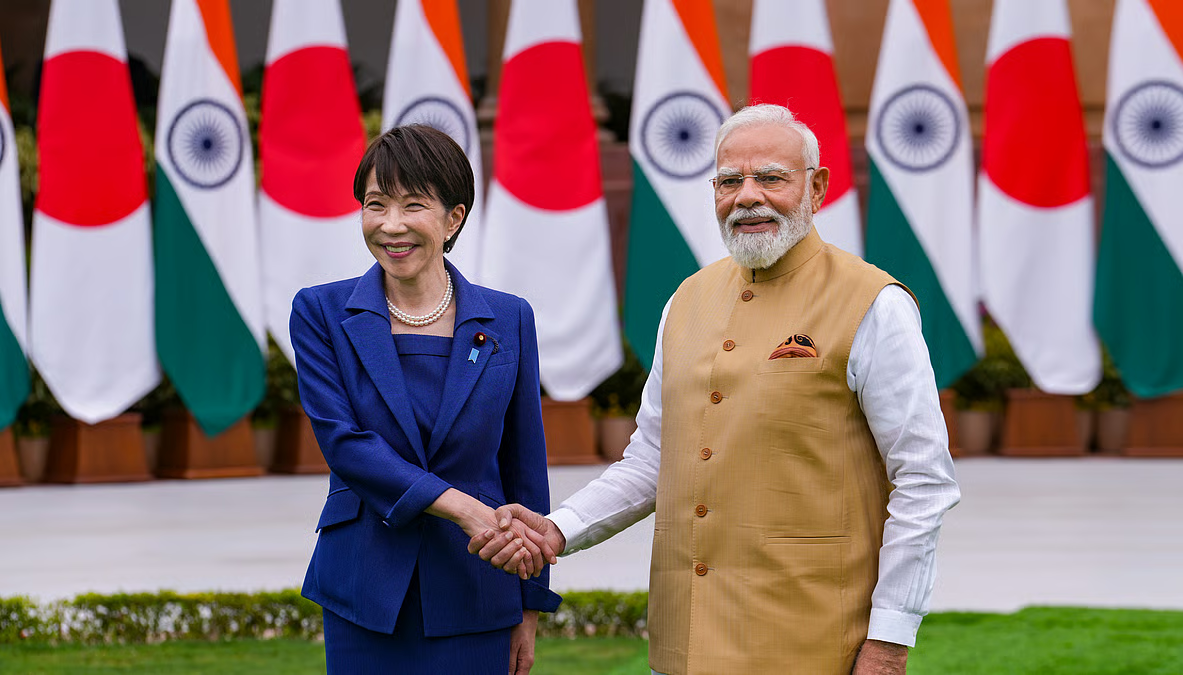
Japanese Prime Minister Sanae Takaichi arrived in New Delhi on July 1, 2026 for a historic three-day state visit — her first trip to India since becoming Japan’s first woman Prime Minister. Takaichi received a ceremonial welcome at Rashtrapati Bhavan on July 2 and held delegation-level talks with PM Narendra Modi at Hyderabad House, culminating in the 16th India-Japan Annual Summit. The two leaders unveiled a sweeping 16-point joint roadmap covering artificial intelligence, semiconductors, defence co-development, energy resilience, critical minerals, batteries, pharmaceuticals and people-to-people ties — the most comprehensive outcome document in the history of the India-Japan partnership.
PM Modi welcomed Takaichi as his “younger sister” and called the visit the start of a “new chapter” in the Special Strategic and Global Partnership between two of the world’s five largest economies. He recognised the technological partnership between India and Japan as the “strongest pillar” of bilateral ties, affirming a shared resolve to converge Japan’s precision technology with India’s software capabilities. Furthermore, Tokyo confirmed it will raise its private-sector investment target beyond the existing commitment of ¥10 trillion (~$68 billion) over ten years — underscoring just how seriously Japan views India as its most important long-term partner in Asia.
📖 Also Read: PM Modi in Seychelles: Indian Ocean as Ocean of Opportunity — MAHASAGAR and What It Means
Japan PM India Visit 2026 — Key Facts at a Glance
| Visiting Leader | Sanae Takaichi — Prime Minister of Japan (First Woman PM of Japan) |
| Visit Duration | 3 days — July 1 to July 3, 2026 |
| Summit | 16th India-Japan Annual Summit |
| Summit Venue | Hyderabad House, New Delhi — July 2, 2026 |
| Ceremonial Welcome | Rashtrapati Bhavan — July 2, 2026 |
| Historic First | First visit to India by Takaichi since assuming PM office; first woman PM of Japan |
| Joint Roadmap | 16-Point Roadmap — most comprehensive summit outcome in India-Japan history |
| 3 Key Policy Documents | Joint Declaration on Economic Security, Joint Statement on AI Cooperation, Joint Statement on Energy Resilience |
| Japan’s Investment Target (10 Years) | ¥10 trillion (~$68 billion) — expected to be raised further |
| Bilateral Trade (FY 2025-26) | $27.5 Billion |
| Japanese Companies Operating in India | 1,400+ (nearly half in manufacturing) |
| Business Forum | India-Japan Business Forum — 150+ Japanese business leaders and investors |
| Previous Summit | 15th Summit — PM Modi visited Tokyo, August 2025 |
Note: All details are based on official MEA and PMO statements, ANI, The Tribune, Modern Diplomacy, The Week and Organiser reports published on July 2, 2026. The full text of all signed agreements was not publicly available at the time of publishing.
The 16-Point Roadmap — What India and Japan Agreed
Prime Minister Narendra Modi and Japanese Prime Minister Sanae Takaichi, following their delegation-level talks, unveiled three key policy documents: the India-Japan Joint Declaration on Economic Security, the Joint Statement on Cooperation in the Field of Artificial Intelligence, and the Joint Statement on Energy Resilience.
Alongside these three anchor documents, both countries announced agreements covering batteries, pharmaceuticals, critical minerals, mobility, biotechnology, financial services, internet governance and AI — producing a total of 16 outcome points from the summit. Together, these outcomes represent a significant deepening of what was already one of Asia’s most substantial bilateral relationships.
| Area | What Was Agreed |
| Artificial Intelligence | Joint Statement on AI — cooperation across entire AI stack: semiconductors, GPUs, compute, multilingual models, AI governance, cybersecurity and AI for public good |
| Economic Security | Joint Declaration on Economic Security — 5 priority sectors: semiconductors, critical minerals, ICT, clean energy, pharmaceuticals |
| Energy Resilience | Joint Statement on Energy Resilience — strategic petroleum reserves, crude oil stockpiling, maritime energy transport, green hydrogen and ammonia |
| Semiconductors | Joint Declaration — diversify supply chains, deepen cooperation in manufacturing, R&D, design, skill development; expand Japan’s role in India Semiconductor Mission 2.0 |
| Defence | First joint defence co-development project agreement; radar antenna technology for Indian warships; Quad-aligned maritime security cooperation |
| Batteries and EVs | MoU — trusted, resilient and sustainable battery supply chains; EV manufacturing cooperation |
| Pharmaceuticals | MoU — pharma supply chain resilience; R&D collaboration; capacity building |
| Critical Minerals | Technical cooperation between Geological Survey of India and JOGMEC; e-waste recycling ecosystem for critical mineral recovery |
| ICT / 5G / 6G | 5G Advanced, Open RAN, data centres, submarine cables, AI infrastructure; standards for beyond-5G and 6G |
| Rupee-Yen Trade | Japan Ministry of Finance and RBI working on local currency trade cooperation agreement in FY2026 |
| People-to-People | 500 skilled Indian AI professionals to Japan by 2030; joint research, internships, industry partnerships |
| Economic Security Dialogue | Track 1.5 Dialogue established — governments, industry and experts |
Fact 1 — Who Is Sanae Takaichi? Japan’s First Woman PM

Sanae Takaichi carries significant historic weight into this India visit. She is Japan’s first woman Prime Minister — a milestone in one of the world’s most male-dominated major democracies — and her ascent to the top of Japanese politics represents a generational shift in the country’s political culture. PM Modi called her a “visionary and popular leader” and noted she is from Nara prefecture in Japan, which holds Buddhist connections to India — a cultural bridge that adds symbolic warmth to what is otherwise a rigorously strategic visit.
Notably, Takaichi built her reputation in Japanese politics as a technology and innovation champion. Before becoming Prime Minister, she served as Minister of Internal Affairs and Communications and developed a strong public profile as an advocate for digital transformation, AI regulation and semiconductor self-sufficiency — the very areas that dominate this India visit’s agenda. Her visit is being framed as a summit about semiconductors and supply chains rather than submarines, as Tokyo seeks to lock India in as a trusted economic-security partner amid mounting global uncertainty.
Fact 2 — The AI Partnership: India’s Software + Japan’s Hardware
Artificial intelligence dominated the substantive discussion at the 16th India-Japan Summit more than any other single topic. PM Modi recognised the technological partnership between India and Japan as the “strongest pillar” of bilateral ties, affirming shared resolve to converge Japan’s precision technology with India’s software capabilities. This framing captures the essential logic of why AI cooperation between these two countries makes structural sense: Japan brings advanced manufacturing, precision engineering, semiconductor fabrication and industrial robotics; India brings a vast software engineering talent pool, rapidly expanding digital infrastructure, and one of the world’s fastest-growing AI research communities.
The two countries agreed to cooperate across the entire AI technology stack, including secure digital infrastructure, semiconductors, GPUs, compute resources, multilingual and open-source AI models, AI governance, cybersecurity and AI applications for public good. Specifically, three landmark institutional collaborations emerged from the AI discussions:
- IIT Bombay’s BharatGen Technology Foundation and Japan’s National Institute of Informatics (NII) — collaboration on multilingual scientific large language models
- Sarvam AI and Preferred Networks — partnership on foundational AI models
- IndiaAI Mission and Japan’s Ministry of Economy, Trade and Industry (METI) — MoU to support AI startups and innovation
Additionally, both countries reaffirmed their goal of bringing 500 highly skilled Indian AI professionals to Japan by 2030, while expanding joint research, internships and industry partnerships. This talent mobility commitment is particularly significant given Japan’s well-documented demographic challenge — an ageing population and shrinking workforce that makes India’s young, technically skilled talent pool strategically valuable to Tokyo.
Fact 3 — Economic Security: The Core of the Summit
The India-Japan Joint Declaration on Economic Security identifies economic security as a foundational pillar of bilateral ties and seeks to elevate cooperation through project-based collaboration in five priority sectors: semiconductors, critical minerals, information and communication technology, clean energy and pharmaceuticals.
The context behind this declaration matters enormously. Since the COVID-19 pandemic and rising geopolitical tensions, both governments have sought to reduce vulnerabilities in global supply chains, particularly in sectors such as semiconductors, critical minerals and advanced manufacturing. Both India and Japan share a common strategic interest in reducing dependence on Chinese-dominated supply chains in these critical sectors — and this summit formalises that shared objective into a concrete, project-based cooperation framework.
They also agreed to establish a Track 1.5 Economic Security Dialogue involving governments, industry and experts — creating an ongoing institutional channel for coordination on economic security issues that will operate between annual summits.
Fact 4 — Semiconductors: India Joins Japan’s Chip Strategy

Semiconductor cooperation represents one of the most strategically significant and commercially valuable elements of this summit. Japan is a global leader in semiconductor materials, equipment and advanced chip packaging — areas where Indian industry currently has limited capability. India, in turn, offers land, engineering talent, government incentives under the semiconductor mission, and a rapidly growing domestic market for chips.
In semiconductors, the two sides agreed to diversify supply chains, deepen cooperation in manufacturing, research, design and skill development, and encourage greater participation of Japanese companies in India’s Semiconductor Mission 2.0. Several major Japanese semiconductor companies — including those in the chip materials and equipment spaces — already have India on their expansion radar, and the summit’s joint declaration provides the governmental framework to accelerate those moves.
Notably, Japan has already committed to a target of ¥10 trillion, roughly $68 billion, in private-sector investment into India over ten years, and Tokyo is expected to raise this commitment further. A significant portion of this enhanced commitment targets semiconductor and electronics manufacturing — positioning India as Japan’s preferred alternative hub to China for critical technology supply chains.
Fact 5 — Defence: First Joint Co-Development Project
India and Japan signed an agreement covering their first joint defence co-development project, marking another step in expanding military cooperation. Defence ties between the two countries have steadily strengthened over the past decade through joint military exercises, maritime cooperation and defence technology exchanges.
Specifically, a proposed agreement on stealth-boosting radar antenna technology for Indian warships featured in the defence discussions — a concrete technology transfer that would enhance India’s naval capabilities in precisely the domain most relevant to Indo-Pacific maritime security. Both India and Japan are Quad members alongside the United States and Australia, and their shared concerns about maintaining freedom of navigation and stability in the Indo-Pacific add strategic urgency to every defence cooperation agreement they sign.
Importantly, officials on both sides were at pains to stress that economics, not security, is driving this particular chapter of the relationship — signalling that while defence ties deepen, the primary framing of the Japan PM India visit is economic partnership rather than military alliance-building.
Fact 6 — Energy Resilience: Green Hydrogen and Petroleum Security
India and Japan adopted a Joint Statement on Energy Resilience aimed at strengthening cooperation on strategic petroleum reserves, crude oil stockpiling, maritime energy transport and clean energy development. This energy pillar addresses two very different but equally important dimensions of energy security: ensuring stable fossil fuel supply chains in the short term, while building clean energy alternatives for the longer term.
On clean energy, green hydrogen and green ammonia emerged as particularly significant areas of cooperation. India’s abundant solar energy and vast land availability make it one of the world’s cheapest producers of green hydrogen and ammonia. Japan provides the necessary investment for hydrogen and ammonia production while India has immense resource. Japan is also providing advanced technology, while India offers manufacturing potential. This complementarity makes the India-Japan green energy partnership one of the most commercially promising aspects of the bilateral relationship.
Fact 7 — Rupee-Yen Trade: Reducing Dollar Dependence
One of the quieter but strategically significant announcements from this summit involves trade settlement in local currencies. The proposal for local currency trade was first introduced during PM Modi’s visit to Japan in August 2025. At that time, the two countries released a joint vision document for the next ten years, committing to strengthening payment systems and expanding trade in local currencies. Japan’s Ministry of Finance is now working on a cooperation agreement with the Reserve Bank of India during the 2026 financial year to formally implement the framework.
Rupee-Yen trade settlement reduces both countries’ exposure to the US dollar in bilateral commerce — a goal India has pursued with multiple trading partners since 2022. For Japan, it provides greater financial stability in bilateral trade with India during periods of yen-dollar volatility. For India, it advances the rupee’s internationalisation agenda while strengthening financial ties with one of Asia’s most stable economies.
India-Japan Relations: How We Got Here
| Year | Milestone |
| 2006 | India-Japan Strategic and Global Partnership established |
| 2014 | Partnership elevated to Special Strategic and Global Partnership under PM Modi and PM Abe |
| 2022 | Japan commits ¥5 trillion (~$42 billion) investment in India over 5 years |
| August 2025 | PM Modi visits Tokyo — 15th India-Japan Summit — ¥10 trillion 10-year investment target announced; Joint Vision for the Next Decade released |
| July 1, 2026 | Japan PM Sanae Takaichi arrives in New Delhi — her first India visit as PM |
| July 2, 2026 | 16th India-Japan Annual Summit — 16-point roadmap, 3 joint declarations, defence co-development MoU, AI and semiconductor agreements |
Japan PM India Visit 2026 — Frequently Asked Questions (FAQs)
Why did Japan PM Sanae Takaichi visit India in July 2026?
Japan PM Sanae Takaichi’s visit to India follows PM Modi’s visit to Tokyo in August 2025 for the 15th India-Japan Annual Summit and reflects the shared commitment of both countries to further strengthen the India-Japan Special Strategic and Global Partnership. Takaichi arrived on July 1 for a three-day state visit, participating in the 16th India-Japan Annual Summit on July 2 and attending the India-Japan Business Forum alongside PM Modi.
What is the 16-point roadmap announced at the India-Japan Summit 2026?
The 16-point roadmap sets an ambitious agenda spanning economic security, artificial intelligence, energy resilience, critical technologies, mobility, clean energy and people-to-people exchanges. It includes three anchor policy documents — the Joint Declaration on Economic Security, the Joint Statement on AI Cooperation, and the Joint Statement on Energy Resilience — plus agreements on batteries, EVs, pharmaceuticals, critical minerals, ICT, defence co-development and local currency trade.
Who is Sanae Takaichi and why is her visit historically significant?
Sanae Takaichi is Japan’s first woman Prime Minister — a historic milestone in one of the world’s most male-dominated major democracies. Furthermore, this India visit marks her first trip to India since assuming the PM’s office. PM Modi welcomed her warmly, calling her his “younger sister” and noting her connection to Nara prefecture, which shares Buddhist ties with India.
What AI agreements did India and Japan sign at the 2026 Summit?
Key AI agreements include collaboration between IIT Bombay’s BharatGen Technology Foundation and Japan’s National Institute of Informatics on multilingual scientific large language models, a partnership between Sarvam AI and Preferred Networks on foundational AI models, and an MoU between the IndiaAI Mission and Japan’s METI to support AI startups and innovation. Both countries also reaffirmed the goal of bringing 500 skilled Indian AI professionals to Japan by 2030.
How much is Japan investing in India?
Japan has committed to a target of ¥10 trillion (approximately $68 billion) in private-sector investment in India over ten years, and Tokyo is expected to raise this commitment further at the 2026 summit. Additionally, Japan recorded $3.2 billion in FDI in India between April and December 2025, with approximately 1,400 Japanese companies currently operating in India.
What is India-Japan bilateral trade in 2026?
Bilateral trade between India and Japan reached approximately $27.5 billion during the 2025-26 financial year. Both countries are working toward expanding this figure through the new Economic Security framework, local currency trade settlement, and increased Japanese investment in Indian manufacturing and technology sectors.
What defence agreements did India and Japan sign in 2026?
India and Japan signed an agreement covering their first joint defence co-development project, marking another step in expanding military cooperation. Specifically, the discussions included a proposed agreement on stealth-boosting radar antenna technology for Indian warships. Both countries are Quad members and share concerns about maritime security and stability across the Indo-Pacific region.
What is the significance of Rupee-Yen trade between India and Japan?
Rupee-Yen trade settlement reduces dependence on the US dollar in bilateral commerce — advancing India’s rupee internationalisation agenda and providing Japan with greater financial stability during yen-dollar volatility periods. Japan’s Ministry of Finance is working on a cooperation agreement with the RBI during the 2026 financial year to formally implement the local currency trade framework first introduced during PM Modi’s 2025 Tokyo visit.
Conclusion — A “New Chapter” That Is Really a New Decade
PM Modi called Sanae Takaichi’s visit the start of a “new chapter” — and the evidence from this summit suggests he is right, though perhaps in a more fundamental sense than the diplomatic language implies. The 16-point roadmap unveiled at the 16th India-Japan Annual Summit is not an incremental step forward from the partnership that preceded it. It represents a qualitative shift: from an investment-and-infrastructure partnership to a comprehensive economic security alliance built around the technologies that will define the next twenty years — AI, semiconductors, clean energy, critical minerals and quantum computing.
Japan needs India’s scale, its talent, its market, and its geographic position in the Indo-Pacific. India needs Japan’s capital, its precision manufacturing technology, its semiconductor supply chain expertise, and its political reliability as a democratic partner in Asia. The convergence of these complementary needs — expressed through 16 outcome points and three joint declarations in a single afternoon at Hyderabad House — represents the most substantive India-Japan summit in the partnership’s twenty-year history. Stay tuned to Mirrorly.in for complete coverage of all developments from Takaichi’s ongoing India visit.
📖 Also Read: India FATF Vice President: Vivek Aggarwal Elected — First Time in History